Page 6/15 CT-1000
3Design and function description
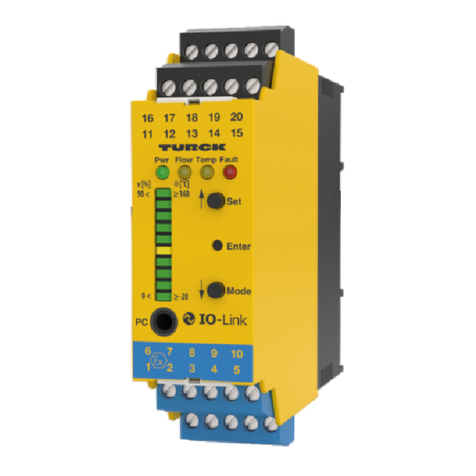
The design of the CT-1000 level sensor is illustrated in Figure 1 with the screw-in unit
version as an example. Inside the sensor head (1) and concealed by the cap (2) are the
protected terminals and configuration buttons. The electrical connection is established by
means of an M16x1.5 screwed cable gland (3) and screw terminals or by an M12 plug-in
connection. Ground connection (4) is required only in conjunction with the CT-1000
Mono version (see section 5 Electrical connection). On the probe neck, there is either a
screw-in unit (5) or a flange (not shown) for installing the probe in the container.
Figure 1: The CT-1000 level sensor
A current pulse generates a linear voltage drop (< 100 mV) on the probe tube (6) electri-
cally insulated from tank potential. The voltages at the bottom end and top end of the
tube are measured.
As long as the probe tube is not immersed, it has no path to the tank potential. This state
is detected by the signal processor, which outputs an “empty” signal. As soon as the
probe tube is immersed, the voltage measured at the immersed tube end corresponds to
tank potential and the voltage measured at the top end is added to the voltage drop
along the non-immersed part of the probe tube.
With the probe tube fully immersed, the voltages measured at the top and bottom ends
of the tube are equal in respect of the potential reference point. The region in between is
mostly linear, depending on the tank geometry and the distance between the tube end
and tank bottom, which makes it possible to calculate the fill level from the ratio of the
measured voltages.