1818
Green unroasted beans have a very grassy fragrance and are essentially devoid of the flavor that we
associate with coffee. Green coffee beans can last for several years when stored in a cool, dry place.
Roasting the beans for between 12 and 23 minutes at a temperature of 392º - 482ºF (200º - 250ºC),
develops the characteristic flavors that we associate with brewed coffee. During the roasting process,
several changes take place to create a familiar coffee taste. As the beans start to turn brown, water
content drops from 10% to 1%; fat increases from 12% to 16%; sugar decreases from 10% to 2;,
chlorogenic acid is reduced from 7% to 4.5% and trigonelin lowers from 1% to 0.5%. Caffeine,
cellulose, pectin and ash remain unchanged but the physical volume of the bean increase from 1.5 to
2.0 times while the bean’s weight drops by 20%. As roasting time is increased, acidity is reduced and
bitter notes become more pronounced. There are eight levels of roasting characteristics commonly
associated with coffee.
* Times given for roasting stages may vary depending on the type of green beans being roasted,
household voltage and other variables
Roasting Level Approximate Time* Actual
Temperature Characteristics
Light Roast
Cinnamon Roast
Medium Roast
High Roast
City Roast
Full City Roast
French Roast
Italian Roast
12 minutes
13 minutes
14 minutes
15 minutes
17 minutes
19 minutes
21 minutes
23 minutes
446ºF
(230ºC)
455ºF
(235ºC)
455ºF
(240ºC)
464ºF
(245ºC)
482ºF
(250ºC)
482ºF
(250ºC)
482ºF
(250ºC)
482ºF
(250ºC)
Strong acid, yellowish-brown color. Slight
grain smell. Weak flavor
American style. Slightly acidic. Cinnamon
color.
Acidic characteristics and sweet flavors.
Nut-like color. American style.
Bitter notes more pronounced than acid.
Good for iced coffee.
Standard well-balanced taste and flavor.
New York City origin.
Bitter characteristic slightly more assertive
than acidity. Good for iced coffee.
Pronounced bitter notes; rich unique taste.
European style. Good for iced coffee.
Strong and bitter but not acidic. Almost
black in color. Good for espresso or
cappuccino.
1717
9. Cleaning & Maintenance
Oils and residual debris remaining from the roasting process
will build up and adversely affect the taste of future batches.
Clean the chamber using a dish washing brush, sponge and
dish washing liquid. Dry the chamber completely before
storing it away.
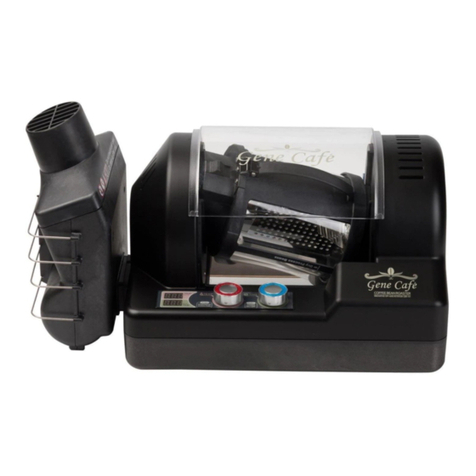
Roasting Chamber
Please clean the chamber periodically as the below instructions.
Stacked chaffs have coffee oil and block the small holes inside of the chamber. If smoke is not going
outside by stacked chaffs, you may be troubled of potential fire or too much smoke from inside.
Remember to clean the mesh plate of the chaff collector after every 5 batches.
Please wear proper gloves on cleaning.
Clean the metal filter with a soft brush.
After cleaning, make sure to dry completely.
Chaff Collector
Remember to clean the mesh net at the bottom
of the unit after every 10 batches.
*Wear the glove to prevent the damage.
*Be Careful of cleaning the separator and blade
assembly.
Use a diswashing brush to clean the
outside metal filter and inside screens
on the chaff collector
When cleaning the Gene Cafe, be aware
of sharp edges that may cause a cut.
When cleaning the Gene Cafe, be aware
of sharp edges that may cause a cut.
Metal filter