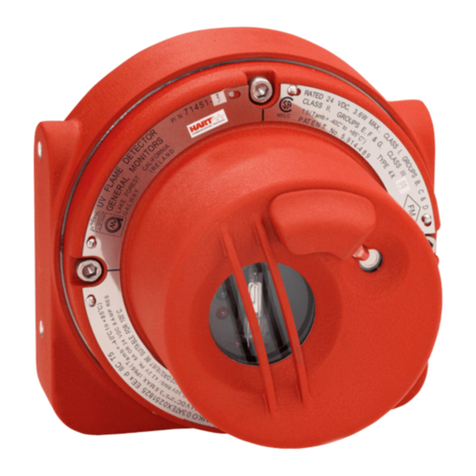
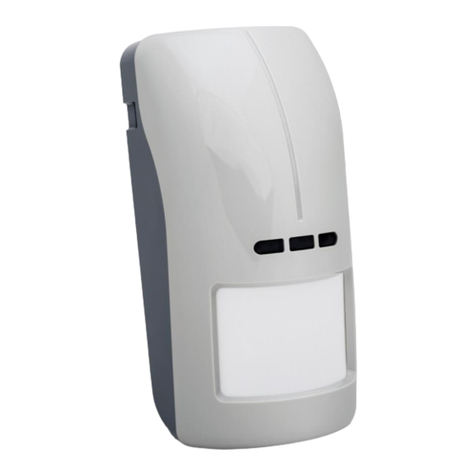
General Monitors FL3102 User manual

MODEL FL3102
Digital Frequency Infra-Red (DFIR)
Flame Detector
The information and technical data disclosed in this
document may be used and disseminated only for the
purposes and to the extent specifically authorized in
writing by General Monitors.
Instruction Manual 07-08
General Monitors reserves the right to change
published specifications and designs without prior
notice.
MANFL3102
Part No. MANFL3102
Revision D/07-08

Model FL3102
i
Warranty
General Monitors warrants the Model FL3102 to be free from defects in
workmanship or material under normal use and service within two (2) years from
the date of shipment.
General Monitors will repair or replace without charge any such equipment found
to be defective during the warranty period. Full determination of the nature of,
and responsibility for defective or damaged equipment will be made by General
Monitors’ personnel.
Defective or damaged equipment must be shipped to General Monitors’ plant or
representative from which the original shipment was made. In all cases this
warranty is limited to the cost of the equipment supplied by General Monitors.
The customer will assume all liability for the misuse of this equipment by its
employees or other personnel.
All warranties are contingent upon proper use in the application for which the
product was intended and do not cover products which have been modified or
repaired with out General Monitors’ approval or which have been subjected to
neglect, accident, improper installation or application, or on which the original
identification marks have been re moved or altered.
Except for the express warranty stated above, General Monitors disclaims all
warranties with regard to the products sold, including all implied warranties of
merchantability and fitness and the express warranties stated herein are in lieu of
all obligations or liabilities on the part of General Monitors for damages including,
but not limited to, consequential damages arising out of/or in connection with the
performance of the product.
Warnings
WARNING - Through engineering design, testing, manufacturing techniques, and
rigid quality control, General Monitors supplies the finest flame detection systems
available. The user must recognize his responsibility for maintaining the flame
detection system in operational condition.
WARNING - The Model FL3102 DFIR Flame detector contains components,
which can be damaged by static electricity. Special care must be taken when
wiring the system, to ensure that only the connection points are touched.
SAFETY WARNING - Installation and Maintenance must be carried out by
suitably skilled and competent personnel only.
TOXIC, COMBUSTIBLE AND FLAMMABLE GASES & VAPORS ARE VERY
DANGEROUS. EXTREME CAUTION SHOULD BE USED WHEN THESE
HAZARDS ARE PRESENT.

Model FL3102
ii
System Integrity Verification
General Monitors mission is to benefit society by providing solutions through
industry leading safety products, services and systems that save lives and
protect capital resources from the dangers of hazardous flames, gases and
vapors.
The safety products you have purchased should be handled carefully and
installed, calibrated and maintained in accordance with the respective product
instruction manual. Remember these products are for your safety.
To ensure operation at optimum performance, General Monitors recommends
that certain maintenance items be performed.
Commissioning Safety Systems
Before power up, verify wiring, terminal connections and stability of mounting for
all integral safety equipment including, but not limited to:
•Power supplies
•Control modules
•Field detection devices
•Signaling / output devices
•Accessories connected to field and signaling devices
After the initial application of power (and any factory specified warm-up period) to
the safety system, verify that all signal outputs, to and from devices and modules,
are within the manufacturers’ specifications. Initial testing should be performed
per the manufacturers’ recommendations and instructions.
Proper system operation should be verified by performing a full, functional test of
all component devices of the safety system, ensuring that the proper levels of
alarming occur.
Fault/Malfunction circuit operation should be verified.
Periodic Testing of Field Devices
Periodic testing/calibrating should be performed per the manufacturers’
recommendations and instructions. Testing/Calibrating procedures should
include, but not be limited to:
•Verify integrity of all optical surfaces and devices
•For flame detectors, use the appropriate test lamp
When testing produces results outside of the manufacturers’ specifications,
replacement of the suspect device(s) should be performed as necessary.
Maintenance intervals should be independently established through a
documented procedure, including a Maintenance log maintained by plant
personnel or third party testing services.

Model FL3102
iii
Periodic System Verification
The following system verifications should be performed at least annually:
Verify wiring, terminal connections and stability of mounting for all integral safety
equipment including, but not limited to:
•Power supplies
•Control modules
•Field detection devices
•Signaling / output devices
•Accessories connected to field and signaling devices
Proper system operation should be verified by performing a full, functional test of
all component devices of the detection system, ensuring that the proper levels of
alarming occur.
Fault/Malfunction circuit operation should be verified.
Maintenance intervals should be independently established through a
documented procedure, including a maintenance log maintained by plant
personnel or third party testing services.

Model FL3102
Quick Start Guide
i
1.0 Quick Start Guide
1.1 Upon Receipt of Equipment
All items shipped by General Monitors are packed in shock absorbing containers,
which provide a considerable degree of protection against physical damage.
When received, the contents should be carefully removed and checked against
the enclosed packing slip. All subsequent correspondence with General Monitors
must specify the equipment part number and serial number.
1.2 Choosing Detector Locations
Several variables are involved in selecting the locations to install detectors to
ensure proper flame detection. There are no hard and fast rules defining the
optimum location. There are some general suggestions that should be
considered in regard to particular conditions at the site where the unit(s) are
being installed:
1.2.1 Detector Field of View
Each Model FL3102 Flame Detector has a 120° maximum Cone of Vision. This
Cone has its vertex at the center of the detector (see Figure 1).
1.2.2 Optical Sensitivity Range
The distance at which the detector will respond to a flame is a function of the
intensity of that flame. The maximum distance is 50 feet (15.2m) for a gasoline
fire with a surface area of 1 square foot (0.92m2).
1.2.3 Environmental Factors
•Mounting should be as free from shock and vibration as possible and
convenient for visual inspection and cleaning.
•Detectors mounted in dirty atmospheric conditions will require more frequent
inspection, cleaning, and sensitivity checking.
•Observe the ambient temperature range for the specific model (see Section
8.1.4 Environmental Specifications). For outdoor installations or other areas
exposed to intense, direct solar radiation, the detector may reach
temperatures well above specifications. For this condition, a cover for shade
may be required to bring the detector temperature within specifications. As
with any cover or object near-by, make sure the field-of-view of the detector
is not obstructed.
•Avoid conditions of ice build up on the optical detector windows. Complete
icing-over of the IR detector window can result in fault conditions.

Model FL3102
Quick Start Guide
ii
1.3 Detector Installation
The Model FL3102 Detector is an explosion proof assembly rated for use in
Class I, Divisions 1 & 2, Group B, C & D, Class II, Group E, F & G, and
Class III areas. The detector(s) should be mounted pointing downward so that
dust/moisture will not accumulate on the IR windows. The detector(s) should be
mounted in locations, which will inhibit people or objects from obscuring the
detector’s Cone of Vision.
NOTE – Before installing these units, please read the warning statement on page
13 of this manual. These units must have a conduit seal installed.
Mounting hardware should be used as shown in Figures 2 and 3.
NOTE – The swivel (961-003) is rated for Class I, Div 1 & 2, Groups C & D. Use
mounting bracket for Group B areas.
The overall dimensions of the detectors and mounting hardware are shown in
Figure 4.

Model FL3102
Quick Start Guide
iii
Figure 1 FL3102 Field of View

Model FL3102
Quick Start Guide
iv
REAR VIEW
WALL MOUNTING
2.80[71.12]
2.80[71.12] 4.66[118.4]
REF HOLE :
4X Ø.26[6.6]
4X M6 WASHER
BRACKET ASSEMBLY
4X M6 X 14
30°
3.75[95.3] 5.00[127.0]
60°
30°
Figure 2 Swivel Elbow Drawing
(Class I, Div 1&2, Groups C&D)
Figure 3 Mounting Bracket Drawing
(Class I, Div 1&2, Groups B,C&D)

Model FL3102
Quick Start Guide
v
DATA+
DATA-
RESET
ALMTEST
DATA2+
0-20mA
DATA2-
+24VDC
COM
+24VDC
COM
CHAS GND 110
FLT 1 92
FLT 2 10 1
WARN C 5
WARN 2
FLT C
WARN 1
7
8
6
ALM 1
ALM 2
ALM C
3
4
2
6
4
3
5
8
7
9
FIELD TERMINATIONS
TB2 TB1
Figure 4 FL3102 Outline Drawing
WARNING – General Monitors requires that the conduit entry be sealed per the
Canadian Electrical Code Handbook (Part 1, Section 18-154). Conduit seals
prevent water from entering the units’ housing through the conduit entry. Water
entering the housing through the conduit entry will damage the electronics and
nullify the warranty.

Model FL3102
Quick Start Guide
vi
1.4 Terminal Connections
All wire connections are made through the ¾ NPT openings in the Base
Assembly to the terminal block (See Figure 7). The Terminal Block is located on
the Base Assembly (See Figure 8) and accepts 12 AWG to 22 AWG stranded or
solid-core wire. Each wire should be stripped as shown in Figure 5.
Figure 5 Wire-Strip Length
To connect the wire to the Terminal Block, insert the conductor into the
connection space as shown in Figure 7 and tighten the corresponding screw
terminal.
Figure 6 Detector Housing and Base
Table of contents
Other General Monitors Security Sensor manuals

General Monitors
General Monitors FL3110 User manual

General Monitors
General Monitors TS4000 User manual

General Monitors
General Monitors IR5500 Operating instructions

General Monitors
General Monitors FL3112 User manual

General Monitors
General Monitors IR400 User manual

General Monitors
General Monitors FL4000H User manual

General Monitors
General Monitors IR5500 User manual

General Monitors
General Monitors FL3100 User manual

General Monitors
General Monitors TL104 User manual

General Monitors
General Monitors FL4000 User manual