The transmitter must be power supplied with 24Vac/dc.
It is recommended to use a connection cable o at least 0,5mmq
section and a maximum length o 100mt. Connection cables
must have separate run rom power cables.
It is recommended to check the maximum load, i used with
current output, or the minimum load, i used with voltage output.
In order to use voltage output (0-10V) pin 7 and 8 must be
connected together.
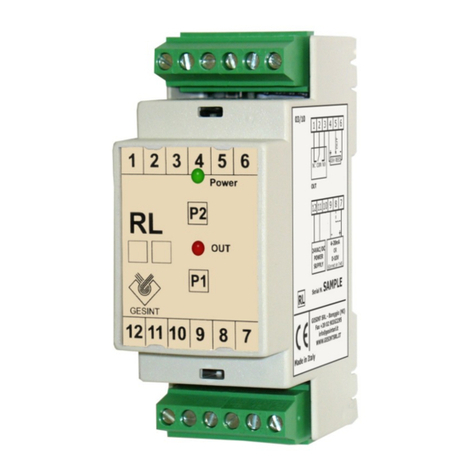
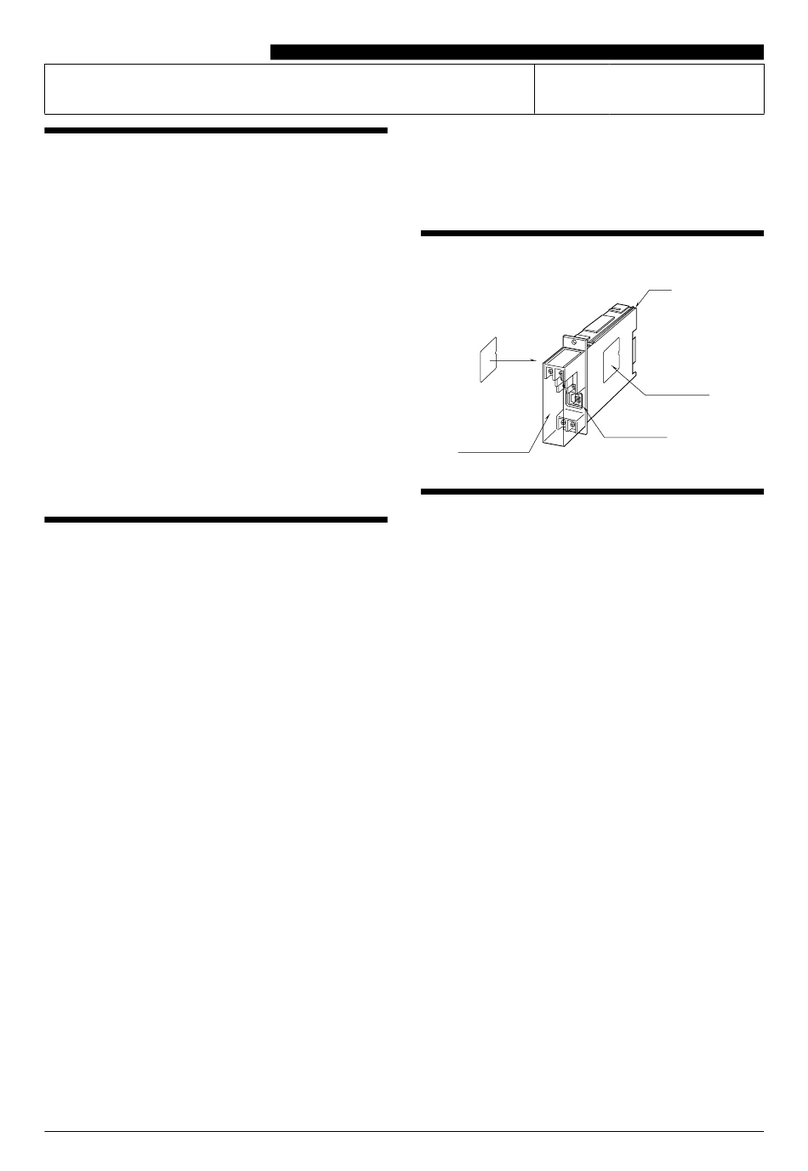
In order to access the 2 programming buttons, remove the ront cover o the transmitter.
Then connect a re erence multimeter to the analogue output pins.
1) Press P2 button or at least 3 seconds, until G EEN led start blinking, and ED
leds blink alternatively.
2) Set luid at the desired level and wait until value on multimeter is stabilized. Then
press and release P2 or irst threshold (OUT1) or P1 or second threshold (OUT2).
3) Repeat step 2) i you need to acquire the other threshold. Please note that now is
blinking the ED led corresponding to the threshold that is not acquired yet.
4) To store threshold(s) acquired press and release both P1 and P2.
Is it possible to disable thresholds on the transmitter by executing only step 1) and 4).
Threshold calibration
4-20mA or 0-10V output calibration
During manu acturing and actory testing, the transmitter is calibrated or 4-20mA or
0-10V output using precise instruments. This calibration should be executed only i a
di erent output type or range is needed.
In order to access the 2 programming buttons, remove the ront cover o the transmitter.
Then connect a re erence multimeter to the analogue output pins.
During this calibration phase, relays output will be activated or diagnostic purpose. It is
recommended to disconnect upper terminal board.
1) While transmitter is powered o , keep pressed both P1 and P2 buttons and then
power on.
2) Keep both buttons pressed or at least 3 seconds, until G EEN led start blinking:
now it’s possible to release them.
3) OUT2 ED led is now on, indicating the output calibration corresponding to the
minimum level.
4) Press P2 or increase and P1 or decrease the output value, until you read on
multimeter the needed value (ex. 0,0Vdc or 4,0mA).
5) Now press both P1 and P2 and release them.
6) OUT1 ED led is now on, indicating the output calibration corresponding to the
maximum level.
7) Press P2 or increase and P1 or decrease the output value, until you read on
multimeter the needed value (ex. 10,0Vdc or 20,0mA).
8) Now press both P1 and P2 and release them.
9) Both ED led remain on or a ew seconds while data are stored in the transmitter.
10) Transmitter reset itsel and start working.
0-100% level calibration
In order to access the 2 programming buttons, remove the ront cover o the transmitter.
Then connect a re erence multimeter to the analogue output pins.
1) Press P1 button or at least 3 seconds, until G EEN led start blinking, and ED
leds blink alternatively.
2) Set luid level at minimum and wait until value on multimeter is stabilized. Then
press and release P1 button.
3) Now only one o the two ED leds is blinking. Set luid level at maximum and wait
until value on multimeter is stabilized. Then press and release P2 button.
4) ED leds are now blinking together. Press both P1 and P2 and release them so
that transmitter writes in memory the data acquired.
It is possible to acquire only o the two level settings, by pressing P1 button or minimum
level or P2 button or maximum level and then con irm by pressing both P1 and P2.
For better per ormance, it is recommended to avoid calibration where the di erence
between minimum and maximum level is lower than 1/3 o transmitter range span.
Electrical connections
LED signalling
G EEN LED (Power):
•
ON: transmitter is powered and working
•
Fast blinking: programming mode
•
Slow blinking: empty or invalid data in eeprom, transmitter need to be calibrated
(both output and level)
ED LED (Out1 - Out2):
•
ON: active level threshold
•
Blinking: programming mode