2308-390
WARNINGS
High Pressure Spray Can Cause Serious Injury
. For Professional Use Only.
Observe All W
arnings. Read and understand all instruction manuals before operating equipment.
FLUID
INJECTION HAZARD
General
Safety
The
hydraulic reciprocator and pump can generate high
fluid
pressure. Spray from leaks or ruptured components
can
inject fluid through your skin
and into your body and
cause extremely serious injury , including the need for
amputation.
Also, fluid injected or splashed into the
eyes
or
on the skin can cause severe damage.
Never
point the dispense valve at anyone or at
any part of
the
body
. Never put hand or fingers over the nozzle.
Always
follow the
Pressure Relief
Procedure,
right, be
-
fore cleaning or removing the dispense valve nozzle or
servicing
any system equipment.
Never
try to stop or deflect leaks with your
hand or body
.
Check operation of all equipment safety devices before
each
use.
Medical Alert––Airless Spray W
ounds
If any fluid appears to penetrate your skin, get
EMER-
GENCY
MEDICAL CARE A
T ONCE. DO NOT TREA
T
AS A SIMPLE CUT
.
Tell
the doctor exactly what fluid
was injected.
Note
to Physician:
Injection in the skin is a traumatic
in
jury.
It is important to treat the injury surgically as
soon
as possible.
Do not delay treatment to research
toxicity.
T
oxicity is a
concern with some exotic coatings
injected directly into the blood stream. Consultation
with a plastic surgeon or reconstructive hand surgeon
may
be advisable.
Pressure Relief Procedure
To
reduce the risk of serious injury
, including fluid
injection,
injury from moving parts, and splashing
in
the eyes or
on the skin, always follow this proce
-
dure whenever you shut of f the pump, when
checking or servicing any part of the dispensing
system,
when installing, cleaning
or changing dis
-
pense
valve nozzles, and whenever you stop dis
-
pensing.
1. Close the supply line shutof f valve, and then
the
return line shutof
f valve.
2. Open the dispensing valve to relieve pres-
sure.
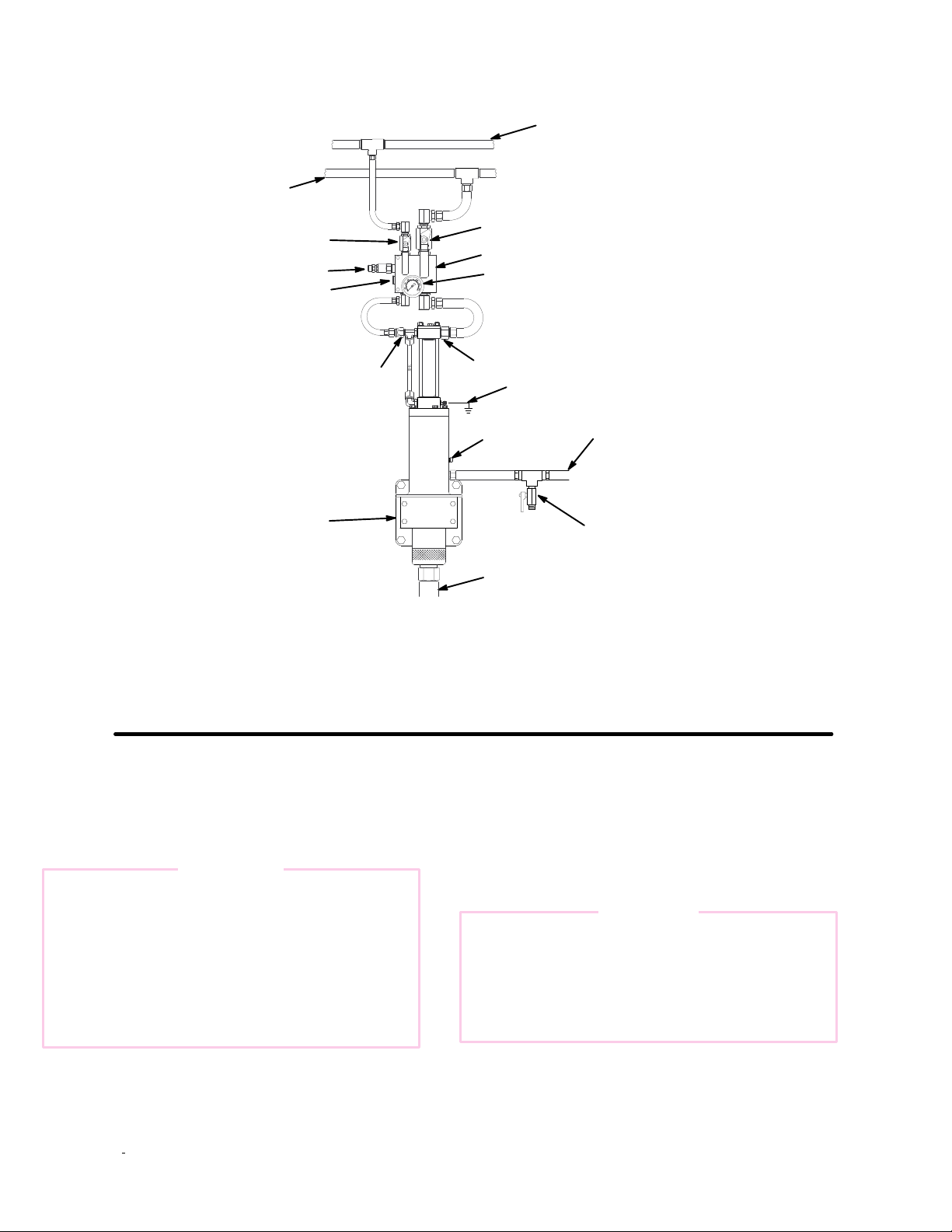
3. Place a container under the drain valve to
catch any drainage. Open the pump outlet
drain
valve.
4. Leave
the drain valve open until you are
ready
to
dispense again.
If you suspect that the dispense valve nozzle or
hose
is completely clogged, or
that pressure has
not been fully relieved after following the steps
above,
very slowly
loosen the hose end
coupling
to relieve pressure gradually , then loosen com-
pletely.
Clear the obstruction.
Emergency Stop Procedure
Close the supply line shutof
f valve marked
STOP.
EQUIPMENT MISUSE HAZARD
General
Safety
Any
misuse of the dispensing equipment or accessories,
such
as overpressurizing, modifying parts, using incom
-
patible chemicals and fluids, or using worn or damaged
parts,
can cause them to rupture and result
in injection or
other
serious injury
, fire, explosion or property damage.
Never
alter or modify any part of this equipment; doing
so
could
cause it to malfunction.
Check
all spray equipment regularly and repair or
replace
worn
or damaged parts immediately
.
Always
read and follow
the fluid and solvent manufactur
-
er’s recommendations regarding the use of protective
eyewear,
clothing and equipment, including respirators.
Fluid Compatibility
BE
SURE that all fluids and solvents used are
chemically
compatible
with the wetted parts shown in the T
echnical
Data
section on page 23. Always read the fluid and solvent
manufacturer’s
literature before using them in your sys
-
tem.
System Pressure
The reciprocator
Maximum Hydraulic Input Pressure
is
1500
psi (105 bar).
The
displacement pump
Maximum Fluid Outlet Pressure
is
375 psi (26 bar)
.
The maximum working pressure of the pump is directly
proportional
to the pressure at which the reciprocator is
op
-
erated.
Be sure that any components or accessories added to
the
reciprocator power supply side or the
pump fluid out
-
let
side are rated to withstand this pressure.