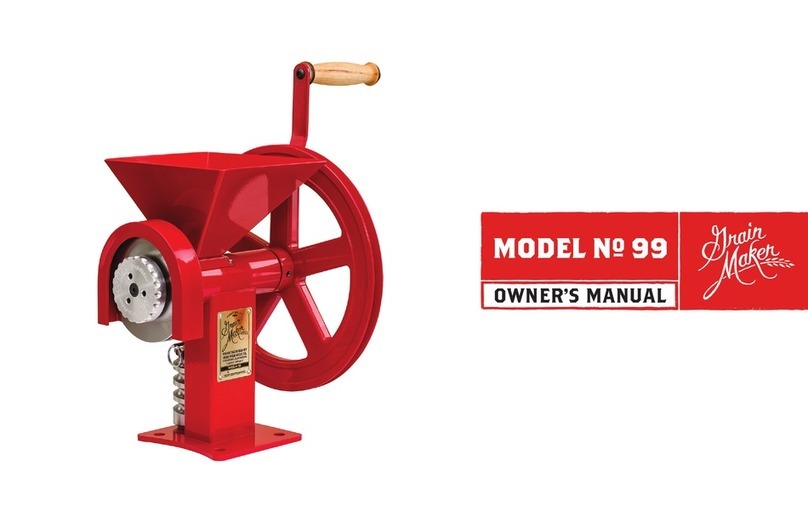
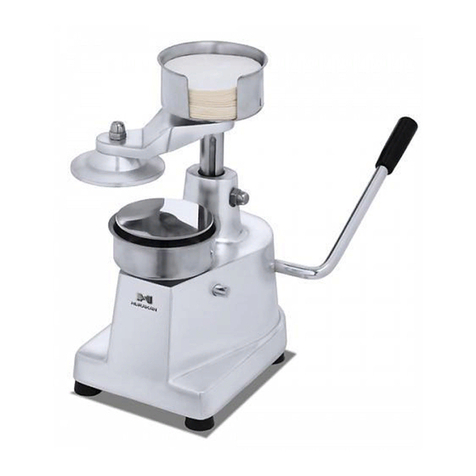
The GrainMaker®Roller/Flaker/Crusher Mill
comes partially assembled. You will need to
attach the handle to the pulley with the
supplied hex wrenches. This completes
the assembly. Before operating this mill,
you will need to secure it to your work
surface either by bolting or using the clamp.
Protect yourself and your Mill! Get in the
habit of using the hopper guard every time
you mill. Grain should be the only item ever
placed in the mill.
Bin or Chute
The mill comes with a ten-cup capacity
stainless steel bin. When larger quantities
are being produced, you can mount the
mill on the edge of a work surface, and use
the stainless steel chute. To use the chute,
remove the ten cup bin, then slide in the
chute and hook it onto the bolts located
on the inside of the frame. Milled grain can
now ow easily down the chute into a pail
or bag.
Adjusting the Thickness
The mill is equipped with dual drive gears
and a unique pull and turn self locking
knob. The knob is spring loaded with
multiple positions for a ake or crack
thickness. This simply adjusts the width
between the rollers. To change the gap
between the rollers, simply grasp the knob
and pull it out away from the body of the
mill until you can turn it to one of the other
settings. Once you have chosen a
thickness, close the slide at the bottom of
the hopper. Ensure the hopper guard is in
the hopper, ll with the grain of your choice
and begin rolling, making sure you are
turning the handle clockwise.
Using the Roller/Flaker/Crusher
Open the hopper feed slide until grain falls
down into the rollers. Roll a small amount
to see if it is the desired thickness. If the
nished product is too thin, simply move
to the next larger number, if it is too thick,
close the hopper feed slide and run the
rest of the material through that has already
fallen into the rollers, then adjust the dial to
the next smaller number. Repeat until you
have your desired thickness. When using
this mill with the settings between 1-3,
it may be necessary to motorize the mill.
HINT: Most grains roll better if they are
moistened a little. The night before you
plan to mill, add one tablespoon of water
to a quart of oat groats. Cover and let rest
at least a few hours or overnight and they
will roll atter and thinner.
MOTORIZATION Tips
The mill can be used without gear
reduction. (Since the mill is flaking,
rolling or crushing, there is no need to
reduce the speed of the mill as you do
when milling flour.) Just secure a v-belt
to the fly-wheel on the mill and attach it
INTRODUCTION
SET-UP
Close the hopper feed slide if there is grain
in it. Locate the two black thumbscrews,
unscrew the two thumbscrews, then lift
the hopper assembly from the body of the
mill. Make sure that all hair, loose clothing,
ngers etc. are kept out of the rollers. Place
the hopper on a clean, at surface and
remove the scraper bars. You can then use
a brush, or even a wire brush if need be to
clean the rollers. The rollers are steel;
you will not damage them. Except when
cleaning, only grain should come in contact
with the rollers. When nished cleaning,
replace the scraper bars, set the hopper
back on the mill and tighten the screws.
CAUTION: IF YOU HAVE A MOTOR CONNECTED
TO YOUR MILL, YOU MUST UNPLUG THE
CORD BEFORE YOU CLEAN YOUR MILL.
IT IS EXTREMELY IMPORTANT AND
NECESSARY THAT ALL HAIR, FINGERS,
LOOSE CLOTHING ETC. BE KEPT AWAY
FROM THE ROLLERS ONCE THE HOPPER
IS REMOVED. THESE ROLLERS WILL BE
EXPOSED DURING THE CLEANING PROCESS.
NEVER LEAVE MILL UNATTENDED DURING
THE CLEANING PROCESS.
CLEANING
to a motor. We recommend a 56 Frame
1 HP motor 1800 RPM’s or lower.
Place protective guarding around all belts,
pulleys and areas where ngers, loose
clothing and hair may get caught or
entangled. Serious injury, dismemberment
or death could occur.
HINT: We recommend this motor:
1 HP 115/230 Volt AC 1725 RPM Leeson
Farm Duty Motor, Item Number: 10-1026
SurplusCenter.com