logo
Brands
  1. Home
  2. •
  3. Brands
  4. •
  5. Greenheck
  6. •
  7. Fan
  8. •
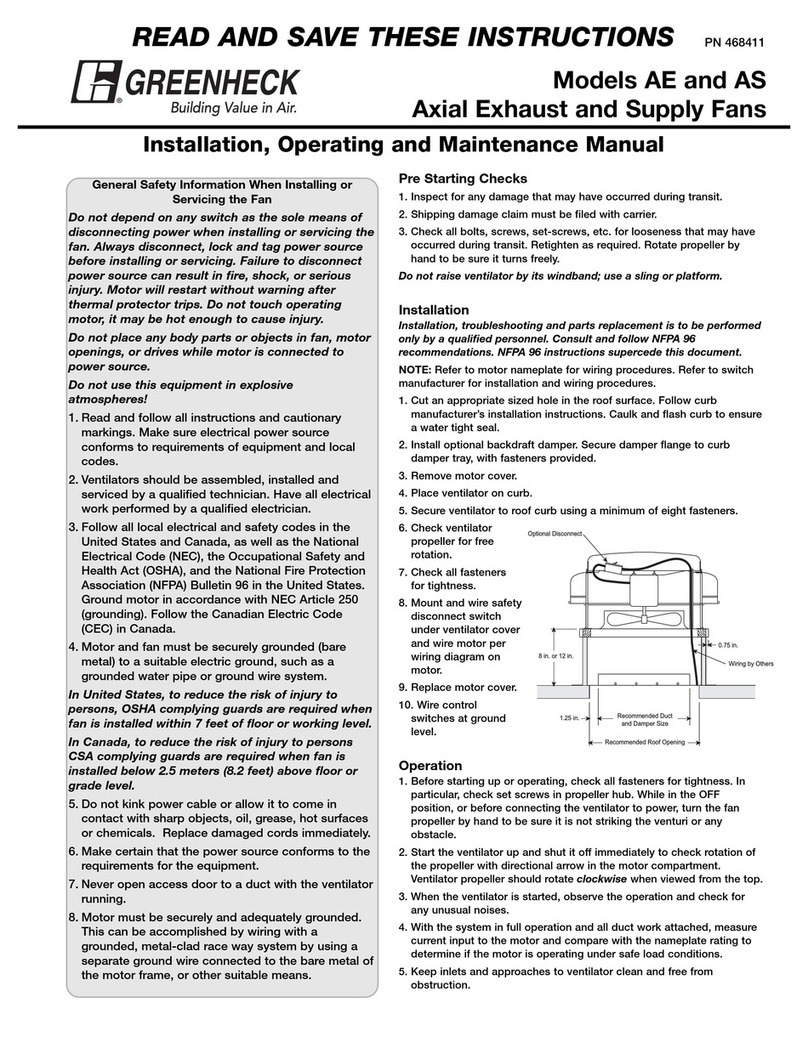
  9. Greenheck AE User manual

Greenheck AE User manual

This manual suits for next models

15

Other Greenheck Fan manuals

Greenheck MiniCore Series User manual

Greenheck

Greenheck MiniCore Series User manual

Greenheck PVE-20 User manual

Greenheck

Greenheck PVE-20 User manual

Greenheck ECV Series User manual

Greenheck

Greenheck ECV Series User manual

Greenheck MiniVent User manual

Greenheck

Greenheck MiniVent User manual

Greenheck ERVe-20 Instruction manual

Greenheck

Greenheck ERVe-20 Instruction manual

Greenheck DGX User manual

Greenheck

Greenheck DGX User manual

Greenheck ASSURE-120S-S1 User manual

Greenheck

Greenheck ASSURE-120S-S1 User manual

Greenheck APEX-200 User manual

Greenheck

Greenheck APEX-200 User manual

Greenheck Vektor ERS-MD User manual

Greenheck

Greenheck Vektor ERS-MD User manual

Greenheck APD User manual

Greenheck

Greenheck APD User manual

Greenheck WD-323 User manual

Greenheck

Greenheck WD-323 User manual

Greenheck 471837 User manual

Greenheck

Greenheck 471837 User manual

Greenheck DF-18 User manual

Greenheck

Greenheck DF-18 User manual

Greenheck SBCE User manual

Greenheck

Greenheck SBCE User manual

Greenheck USF User manual

Greenheck

Greenheck USF User manual

Greenheck EHH-401 User manual

Greenheck

Greenheck EHH-401 User manual

Greenheck AMPLIFY DM User manual

Greenheck

Greenheck AMPLIFY DM User manual

Greenheck SP Series User manual

Greenheck

Greenheck SP Series User manual

Greenheck XG-Dual User manual

Greenheck

Greenheck XG-Dual User manual

Greenheck FJC User manual

Greenheck

Greenheck FJC User manual

Greenheck TAUB-CA Installation and operating instructions

Greenheck

Greenheck TAUB-CA Installation and operating instructions

Greenheck USGF User manual

Greenheck

Greenheck USGF User manual

Greenheck SMD-302 User manual

Greenheck

Greenheck SMD-302 User manual

Greenheck 474051 User manual

Greenheck

Greenheck 474051 User manual

Popular Fan manuals by other brands

ELTA FANS H03VV-F installation guide

ELTA FANS

ELTA FANS H03VV-F installation guide

Hunter 20714 Owner's guide and installation manual

Hunter

Hunter 20714 Owner's guide and installation manual

Emerson CARRERA VERANDA CF542ORB00 owner's manual

Emerson

Emerson CARRERA VERANDA CF542ORB00 owner's manual

Hunter Caraway Owner's guide and installation manual

Hunter

Hunter Caraway Owner's guide and installation manual

Panasonic FV-15NLFS1 Service manual

Panasonic

Panasonic FV-15NLFS1 Service manual

Kompernass KH 1150 operating instructions

Kompernass

Kompernass KH 1150 operating instructions

VES FALA100/12V/TR Original instructions

VES

VES FALA100/12V/TR Original instructions

Vertiv Liebert DCD user manual

Vertiv

Vertiv Liebert DCD user manual

Westinghouse GFP Series owner's manual

Westinghouse

Westinghouse GFP Series owner's manual

Venmar KUBIX HRV PLUS Series user guide

Venmar

Venmar KUBIX HRV PLUS Series user guide

Maico ECR 31 installation instructions

Maico

Maico ECR 31 installation instructions

Sonnenkonig Dinky instruction manual

Sonnenkonig

Sonnenkonig Dinky instruction manual

S&P ECOWATT HXBR manual

S&P

S&P ECOWATT HXBR manual

Wider IMP03369BH instruction manual

Wider

Wider IMP03369BH instruction manual

Panasonic F-60DHN Operating and installation instructions

Panasonic

Panasonic F-60DHN Operating and installation instructions

Broan 766BN installation guide

Broan

Broan 766BN installation guide

Premium PFS16022 Use manual

Premium

Premium PFS16022 Use manual

Litex Industries E-CGL52CB5C1 installation guide

Litex Industries

Litex Industries E-CGL52CB5C1 installation guide

https://manuals.online logo
https://manuals.online logoBrands
  • About & Mission
  • Contact us
  • Privacy Policy
  • Terms and Conditions

Copyright 2025 Manuals.Online. All Rights Reserved.

®
Axial Exhaust and Supply Fans 1
®
Document 468411
Model AE and AS
Axial Exhaust and Supply Fans
Installation, Operation and Maintenance Manual
Please read and save these instructions for future reference. Read carefully before attempting to assemble, install,
operate or maintain the product described. Protect yourself and others by observing all safety information. Failure
to comply with these instructions will result in voiding of the product warranty and may result in personal injury
and/or property damage.
General Safety Information
When Installing or Servicing the Fan
Do not depend on any switch as the sole means of
disconnecting power when installing or servicing the
fan. Always disconnect, lock and tag power source
before installing or servicing. Failure to disconnect
power source can result in fire, shock, or serious
injury. Motor will restart without warning after thermal
protector trips. Do not touch operating motor, it may be
hot enough to cause injury.
Do not place any body parts or objects in fan, motor
openings, or drives while motor is connected to power
source.
Do not use this equipment in explosive atmospheres!
1. Read and follow all instructions and cautionary
markings. Make sure electrical power source conforms
to requirements of equipment and local codes.
2. Ventilators should be assembled, installed and serviced
by a qualified technician. Have all electrical work
performed by a qualified electrician.
3. Follow all local electrical and safety codes in the United
States and Canada, as well as the National Electrical
Code (NEC), the Occupational Safety and Health Act
(OSHA), and the National Fire Protection Association
(NFPA) Bulletin 96 in the United States. Ground motor
in accordance with NEC Article 250 (grounding). Follow
the Canadian Electrical Code (CEC) in Canada.
4. Motor and fan must be securely grounded (bare metal)
to a suitable electric ground, such as a grounded water
pipe or ground wire system.
In United States, to reduce the risk of injury to persons,
OSHA complying guards are required when fan is
installed within 7 feet of floor or working level.
In Canada, to reduce the risk of injury to persons, CSA
complying guards are required when fan is installed
below 2.5 meters (8.2 feet) above floor or grade level.
1. Do not kink power cable or allow it to come in contact
with sharp objects, oil, grease, hot surfaces or
chemicals. Replace damaged cords immediately.
2. Make certain that the power source conforms to the
requirements for the equipment.
3. Never open access door to a duct with the ventilator
running.
4. Motor must be securely and adequately grounded.
This can be accomplished by wiring with a grounded,
metal-clad race way system by using a separate
ground wire connected to the bare metal of the motor
frame or other suitable means.
Pre-Starting Checks
1. Inspect for any damage that may have occurred during
transit.
2. Shipping damage claim must be filed with carrier.
3. Check all bolts, screws, setscrews, etc. for looseness that
may have occurred during transit. Retighten as required.
Rotate propeller by hand to be sure it turns freely.
Installation
Installation, troubleshooting and parts replacement is to
be performed only by a qualified personnel. Consult and
follow applicable building codes which will supercede this
document.
NOTE: Refer to motor nameplate for wiring procedures.
Refer to switch manufacturer for installation and wiring
procedures.
1. Cut an appropriate sized hole in the roof surface. Follow
curb manufacturer’s installation instructions. Caulk and
flash curb to ensure a watertight seal.
2. Install optional backdraft damper. Secure damper flange
to curb damper tray with fasteners provided.
3. Remove motor cover.
4. Place ventilator on curb.
5. Secure ventilator to roof curb using a minimum of eight
fasteners.
6. Check ventilator propeller for free rotation.
7. Check all fasteners for tightness.
8. Mount and wire safety disconnect switch under ventilator
cover and wire motor per wiring diagram on motor.
9. Replace motor cover.
10. Wire control switches at ground level.
Recommended Duct
and Damper Size
Recommended Roof Opening
1.25 in.
Wiring by Others
0.75 in.
8 in. or 12 in.
Optional Disconnect

468410 • AE and AS, Rev 3, March 2018 Copyright 2018 © Greenheck Fan Corporation2
As a result of our commitment to continuous improvement, Greenheck reserves the right to change specifications
without notice.
Specific Greenheck product warranties are located on greenheck.com within the product area tabs and in the
Library under Warranties.
®
Phone: 715.359.6171 • Fax: 715.355.2399 • Parts: 800.355.5354 • E-mail: [email protected] • Website: www.greenheck.com
Our Commitment
AMCA Publication 410-96, Safety Practices for Users and
Installers of Industrial and Commercial Fans, provides
additional safety information. This publication can be obtained
from AMCA International, Inc. at www.amca.org.
Greenheck Propeller Hooded Roof Fans catalog provides
additional information describing the equipment, fan perfor-
mance, available accessories, and specification data.
Troubleshooting
Problem Cause Corrective Action
Ventilator
Inoperative
Blown fuse or breaker Replace or repair motor
Defective motor Replace or repair
Incorrectly wired Shut power OFF and check wiring
for proper connections
Insufficient
Airflow
Blocked duct or clogged filters Clean or replace
Speed too slow Check for correct drives
Damper closed Inspect/repair damper
Incorrect propeller rotation Check motor wiring
Loose fitting duct sections
Check for secure connection
where duct permitting air loss
sections are joined (suggest duct
tape at seams for sealed closure)
Excessive
Noise or
Vibration
Loose propeller Tighten set screws
Accumulation of material on propeller Clean
Ventilator base not securely anchored Secure properly
Motor hood loose and rattling Tighten acorn nuts securing
motor hood
Fan propeller out of balance Replace propeller
Motor
Overloads or
Overheats
Propeller RPM too high Check drives
Shorted motor winding Replace motor
Incorrect propeller rotation Check motor wiring
Over/Under line voltage Contact power company
Maintenance
Disconnect and lockout power source
before servicing.
Uneven cleaning of the propeller will
produce an out-of-balance condition that
will cause vibration in the ventilator.
1. Keep inlets and approaches to ventilator
clean and free from obstruction.
Depending on the usage and severity
of the contaminated air, a regularly
scheduled inspection for cleaning the
fan propeller, ventilator, and surrounding
areas should be established.
2. Check for unusual noises when fan is
running.
3. Periodically inspect and tighten
setscrews.
4. Follow motor manufacturer’s instructions
for motor lubrication.
Parts List
Shroud
Propeller
Motor Cover
Isolator Kit
Motor
Conduit
Curb Cap/Venturi
Windband
Operation
1. Before starting up or operating, check all fasteners
for tightness. In particular, check set screws in
propeller hub. While in the OFF position, or before
connecting the ventilator to power, turn the fan
propeller by hand to be sure it is not striking the
venturi or any obstacle.
2. Start the ventilator up and shut it off immediately
to check rotation of the propeller with directional
arrow in the motor compartment. Ventilator propeller
should rotate counterclockwise on all models when
viewed from the top and clockwise for size 10 only.
3. When the ventilator is started, observe the operation
and check for any unusual noises.
4. With the system in full operation and all ductwork
attached, measure current input to the motor and
compare with the nameplate rating to determine if
the motor is operating under safe load conditions.
5. Keep inlets and approaches to ventilator
clean and free from obstruction.