8
© Guldmann 03/2021 # 900696_101
© Guldmann 03/2021 # 900696_101
•
• Look for snags, punctures, tears, holes
• Look for frayed or insecure seams
• Look for any acid / caustic / thermal burns
• Look for changes in material consistency, e.g. increased
• Look for any imbedded particles
Has the shape of the sling been altered, made shorter or
longer in relation to the original size using knots, needles,
tape or other methods?
Conclusion
conditions then it must be taken out of service regardless of the
weight of the person to be lifted.
2.03 Disposal of slings
Slings are disposed of by incineration. By proper incineration
polyester will be degraded to carbon dioxide and water.
3.00 Service and lifetime
3.01 Safety/service inspections
In accordance with international standard EN/ISO 10535 “Hoist for
-
ods” an inspection must be performed every 6-month according
to the following instructions, which is not intended to represent all
potential inspection steps. Potential damage may vary. Judgment
of inspector/site prevails.
Safe Operating Practices with Slings
Considerations for damaged or defective slings and taking them
out of service:
Withdraw the sling from service if one or more of the following
conditions are present:
• chemical or caustic burns
• melting or charring of any part of the sling
• snags, punctures, tears or cuts
• broken or worn stitches
• missing, illegible or incomplete sling tag
• knots in any part of the sling
• abrasion
• other visible damage that causes doubt as
to the strength of the sling
Sling inspection is done for the protection of the user, the caregiv-
er, and the overall hospital site safety. A sling inspection system
suggestions and results. The inspection process can also help to
identify inventory duplicity in certain sling types and sizes.
Sling inspection system
-
tion of slings at your facility is your best safeguard. Consider em-
ploying a three part system of inspection. Slings that are removed
from service and are not capable of repair should be disposed of
into active inventory.
1)Initial
This level of inspection is done at the time that the sling is re-
ceived into your facility. The inspector should ensure that no dam-
age has occurred during transit, and also verify that the sling work
load limits match those contained in the manufacturer’s catalogue.
If your facility documents the sling inspection process through writ-
ten inspection records, the paper trail should begin at this stage.
2)Frequent
before each use. The sling should be examined and removed
from service if damage is detected. The sling user should also
determine that the sling is proper for the user conditions, care task
3)Periodic
Your facility might want to consider implementing a program for a
periodic level of inspection at regular intervals. The interval should
and information derived through the inspection process. Recom-
mendations to prevent damage and enhance service life could
inspection records are maintained, they should always reference
the condition of the sling. Not intended to represent all potential
inspection steps or all potential aspects of product management
program. Judgment of inspector/site prevails.
Slinginspectiontechnique
The sling inspection procedure should be thorough, systematic
are recommended. Certain forms of damage are far more discern-
able through hands-on inspection, than by visual inspection. For
-
tion alone may not reveal all forms of sling damage. Once signs
load limit of the sling, with the intent of continuing to use it, but at
service life out of a damaged sling. The operating rule and stand-
ard should be: intact = use; damage = do not use.
Consider the practice of documenting sling inspections through
written inspection records. The documentation should include
information such as: the name of manufacturer, the sling stock
of the sling. Other important information might also include the
date it was received or put into use at your facility and any special
-
gram would be the realization of repetitive forms of damage and
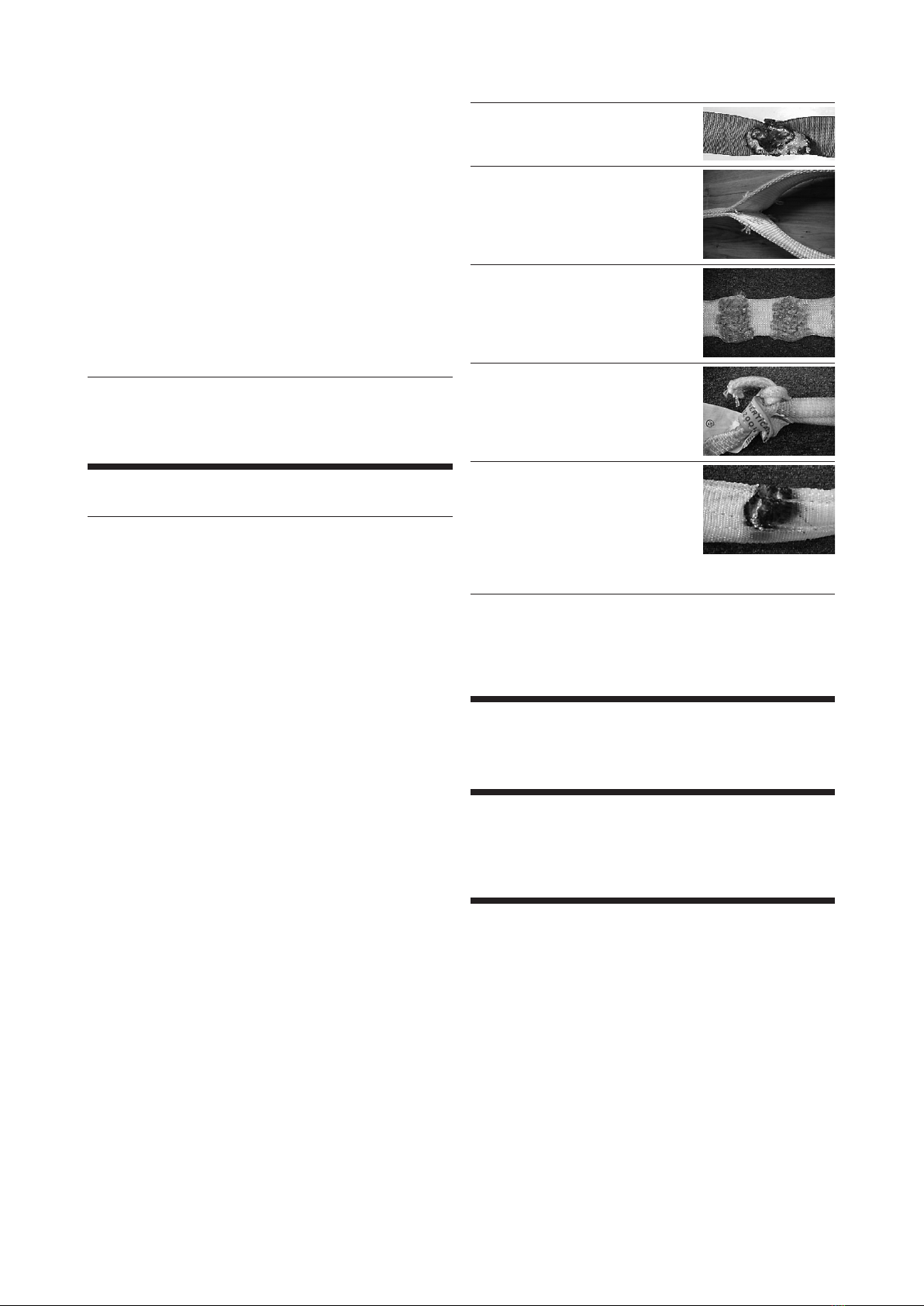
Sample visual examples of synthetic sling damage x)
Chemical/caustic burns
Broken stitching
Crushed / Frayed webbing
Knots