Version 2.2
http://www.hobbyeagle.com 3 / 4 eagle.koo@hotmail.com
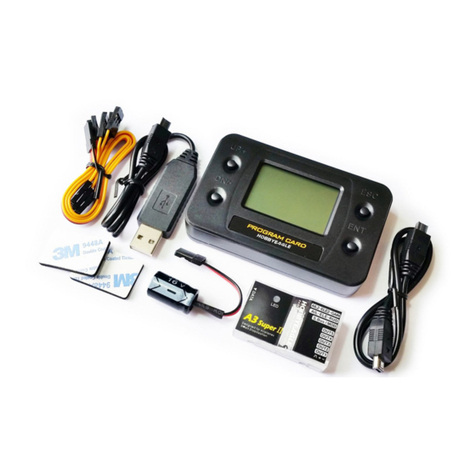
Thank you for purchasing EAGLE series of flight controller. If any difficulties are encountered while setting up or operating your A3 Pro, please consult this manual
first. For further help, yo
u may also visit our website at
http://www.hobbyeagle.com, or contact us via email [email protected].
Features
★ 3 Flight Modes can be switched between Normal Mode, AVCS Mode and Gyro Off in flight;
★ 3 Model Types supported: Normal Airplane, Flying-wing (Delta-wing) and V-tail;
★ Specifically optimized to work for 3D flight;
★ Independent gyro gain adjustment for Aileron, Elevator and Rudder;
★ Basic setting functions including Stick Centering and Gyro Reversing;
★ Smaller and lighter, more compatible with small airplane.
Specifications
Voltage Range: 5 - 6V DC
PWM Output: 50Hz /Travel:1520±500µs/Limit:970~2070µs
Full-Scale Range of Gyro: ±1000dps
Sample Rate of Gyro: 1KHz
Operating Temperature: -40 ℃ to 85 ℃
Dimensions: 30 × 40mm Weight: 8 g
VERY IMPORTANT!!
1. Make sure that your plane has been well installed before use;
2. In order to make the best use of your board, please read this manual carefully and install it step by step following the instructions below;
3. (FW V2.1 or above) The board has to re-learn the center position after you making a trim (or SubTrim) change within the transmitter, or the servos
may move to the full left or full right when switching to AVCS Mode. To do this, just quickly flip the flight mode switch twice between Normal Mode
and AVCS Mode within 1 second!
4. Verify that the mixing of flying-wing or v-tail has been disabled within your transmitter as A3 Pro has already built these functions in!
5. Don’t move the plane when the blue light is flashing very rapidly (about 2 seconds) after power on until initialization done!
Installation Guide
【Step 1: Board Mounting】
The board need to be firmly mounted near the center of gravity of the plane, by the double sided tape provided. Please make sure the longer side of the board is
along with the heading direction. The board must be leveled with the body of the plane. Please refer to the illustration below.
【Step 2: Wiring】
Once installation is completed, please connect the channels of aileron, elevator, rudder and switch from your receiver to the pins marked “IN”, pin 1 for aileron, pin
2 for elevator, pin 3 for rudder and pin 4 for the flight mode switch (You should directly connect the throttle channel to ESC or throttle servo without
bridging the board). Connect the servos to the pins marked “OUT”, pin 1 for aileron servo, pin 2 for elevator servo and pin 3 for rudder servo. When the aileron is
operated by two separate servos, you should use a Y extension cable. Pay attention to the color of wires to avoid anti-plug.
【Step 3: Model Type Selection】
A3 Pro uses a 3-bit jumper (J1-2-3) for model type selection. Please match the type of your plane with Normal Airplane, Flying-wing (Delta-wing) and V-tail
according the table as shown below. Restart the board to activate the selected type.
Jumper Setting Servo Connection
No. Model Types
J1 J2 J3 OUT-1 OUT-2 OUT-3
1 Setting Mode 0 0 0 - - -
2 Normal Airplane ▲ 1 0 0 Aileron Servo Elevator Servo Rudder Servo
3 Flying-wing (Delta-wing) 0 1 0 Left Wing Servo Right Wing Servo * Rudder Servo
4 V-tail 0 0 1 * Aileron Servo Left Tail Servo Right Tail Servo
Notes: “0” represents “OPENED”, “1” represents “CLOSED”, “▲” is the default setting.
【Step 4: Gyro Gain Setting】
A3 Pro offers 3 fine tuning potentiometers to adjust the gyro gain for aileron, elevator and rudder (clockwise for increase, anticlockwise for
decrease). The best setting is determined by factors like fuselage size, weight and the power allocation used and so on. We recommend
you put the gain to a lower volume for the first flight, then fine tune to get the best result. The adjustment will take effect immediately without
a restart. For your safety, please don’t adjust them until all the propellers become motionless.
【Step 5: Switch Channel Configure】
Assign a 3-position switch to the channel which connected to the pins “IN-4”
for switching the flight mode in flight. When use a 2-position switch, you can
only switch between Normal Mode and AVCS Mode. It will be set to Normal
Mode by default if the switch channel is not connected to the board.
However it is not recommended as the board might get interrupted by
the reception during the flight, which will result in the unexpected
flight mode. When the board is operating, the indicator lights show the current flight mode, blue for normal mode, red for AVCS mode and both blue and red off
indicates that the gyro has been disabled.
【Step 6: Stick Centering】
To get the best result, you should apply the “Stick Centering” function to calibrate channel range following the Map of Setting Methods. For the first use of A3 Pro
No. Flight Modes Switch Position Pulse Range LED
1 Normal Mode▲ ON < 1320µs Blue
Version 2.2
http://www.hobbyeagle.com 4 / 4 eagle.koo@hotmail.com
or replacing a new radio system, calibration is needed to obtain the best performance. Before doing this, please turn the trim (or SubTrim) of all channels to zero,
after calibration, all servos will center, fine-tune the aileron, elevator and rudder by changing the length of the linkage rods or the trim (or SubTrim)
parameters within your transmitter. You must have the board re-learn the new center position after changing the trim, see P3 “VERY IMPORTANT” No.3. Stick
Centering works on of aileron, elevator and rudder channels. To enter this function, you must get IN 1-2-3 ready.
【Step 7: Before Flight Checking】
Verify that the gyro compensation is in the correct direction for the first-time installation, otherwise, it could lead to losing control or even crash during
the flight! Turn on the board, pick the plane up and check it by following the 6 steps shown below:
① Rise the head up around the pitch axis, the elevator should flap down accordingly; ② Put the head down around the pitch axis, the elevator should flap up
accordingly. ③ Rotate left around the roll axis, the left aileron should flap down and the other one flap up accordingly; ④ Rotate right around the roll axis, the left
aileron should flap up and the other one flap down accordingly; ⑤ Rotate right around the yaw axis, the rudder should turn left accordingly; ⑥ Rotate left around
the yaw axis, the rudder should turn right accordingly.
If the gyro compensates in an incorrect direction, reverse it by following the instructions of Gyro Reversing Function below.
Map of Setting Methods
LED Indicator Description
Condition LED Indicator Description
Blue, very rapid flashing for 3 seconds after power on Initializing, don’t move the plane until Initialization is done!
Blue, N flashes after initialization Initialize success, N stands for the Model Type selected, N=1( Normal
Airplane), N=2(Flying-wing), N=3(V-tail).
Initialization
Red, very rapid flashing after initialization Initialize failed, undefined Model Type, check the jumper J1-2-3
Solid Blue Normal Mode, ready for flight
Solid Red AVCS Mode, ready for flight
Operating
Both Off Gyro is disabled, ready for flight
Setting Mode