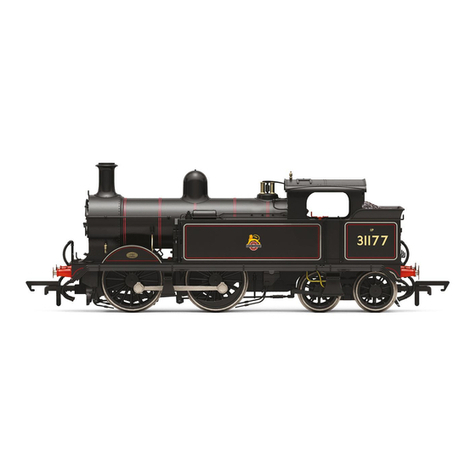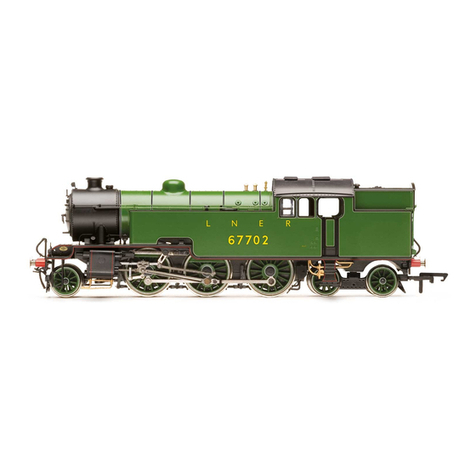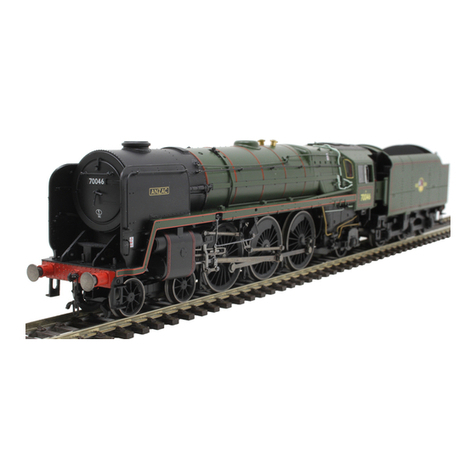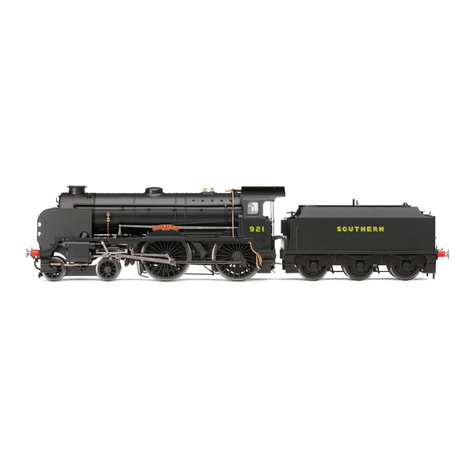
2-6-4T CLASS 4P FOWLER
LOCOMOTIVE
Operating and Maintenance Instructions
Hornby Hobbies Limited, Westwood, Margate, Kent CT9 4JX
4/1071A 0508 Printed in China
General
Please read right through these instructions,
particularly the Safety Notes on page 4.
Hornby locomotives are precision built and, if treated
with care, will give many years of good service. This
Hornby locomotive is produced to super detail standard
and therefore incorporate delicate, protruding detail
and many small parts. Care should be taken to avoid
damage when handling the model especially the valve
gear, coupling rods and the small detail parts of the
locomotive body.
This locomotive should not be operated on track
curves of less than 438mm radius, which is Hornby
2nd radius track.
The five-pole electric motor of the locomotive is
designed to be operated from a variable 12 volts,
DC power supply only. This should be obtained by
using a suitable Power Controller operated from the
normal domestic mains electricity supply.
NEVER CONNECT A LOCOMOTIVE DIRECTLY
TO THE MAINS ELECTRICITY SUPPLY.
The locomotive will normally draw a current of between
·2 and ·4 amp depending upon the track configuration
and whether or not gradients are included. There will
be a current surge on starting the locomotive.
Running Hints
If a locomotive ceases to respond normally to the power
controller, or runs badly, check that the following are in
order:
• Allelectricalconnectionsarecorrectlymadeandthe
wall power socket is switched “ON”.
• Thepowerconnectingclipiscorrectlyinsertedinto
a suitable section of track.
• Alltracksectionsarecorrectlyttedtogetherand
all fishplates (rail-joiners) are fitting tightly onto
adjoining metal rails.
• Alllocomotivewheelsarecorrectlypositionedonthe
track rails.
• Thetenderdrawbarpinismakingcontactwiththe
contacts on the locomotive drawbar and the upper
contacts of the drawbar are making contact with the
drawbar pin plate of the tender (if applicable).
• Thedirectioncontrolswitchonthetraincontrolleris
set to operate in one direction or the other, and not
in the central “OFF” position.
DCC Ready – contact your specialist dealer for advice.
Routine Maintenance
Track Cleaning – In normal use, model railway layouts
will eventually accumulate a blackish deposit on the
running surfaces of the rails, and some of this will be
transferred onto the locomotive’s pick-up wheels.
The 12 volt DC supply is collected from the track
through the wheels on one side of the locomotive and
returned through the wheels on the other side. If the
deposit is allowed to build up, it will have the following
adverse effects:
• Thedrivingwheelswillnotbeabletoachieve
maximum traction
• Therewillbeareductioninthepowerreachingthe
locomotive motor
It is therefore essential that the track and wheels are
kept clean. This can be done by wiping the surfaces with
a clean, non-fluffy cloth. More stubborn deposits can be
removed by using the Hornby Track Cleaning Rubber,
reference R8087, which can be obtained from Hornby
Service Dealers.
Motor – The locomotive is fitted with a sealed, long-
life, 5-pole motor which requires no maintenance.
After a considerable amount of use the motor may
require replacement and this should be carried out by
a Hornby Service Dealer. However, instructions for
motor replacement are given in Section 4 on page 3,
only for owners who are fully experienced in such tasks
and who have soldering facilities. Do not attempt this
work unless you are absolutely confident in being able
to successfully complete it.
Chassis – The locomotive chassis may, from time to
time, pick up fluff, fabric fibres and pet hairs which can
become entangled in the gears and around axles. For
this reason, it is not advisable to run the locomotive on
track which is laid on a carpet. It is important to check
regularly and remove any such debris with the aid of
small tweezers.
Lubrication – Although the locomotive was lubricated
during manufacture, the lubricant can sometimes dry
out in storage. Lubrication should be carried out at
approximately 6-monthly intervals, or every 100 hours
of running. Instructions for carrying out lubrication
procedures are given in section 1 on page 2.
Locomotive Bodywork – Locomotive and tender
bodies are overall spray painted and the rest of the
decoration is applied by a printed process, not transfers.
Safety Notes
14
Television Suppression
Your Hornby locomotive incorporates radio and television interference suppressors. Should interference be
experienced despite these precautions, it may be due to close proximity of the model railway layout to receivers,
aerials, or their “downlines”. In this case, move the layout further away from aerials and receivers.
It is most important that track and wheels be kept absolutely clean.
Waste electrical products should not be disposed of with household waste.
Please recycle where facilities exist. Check with your Local Authority or retailer for recycling advice.
IMPORTANT
• Onlyremovethelocomotiveandtenderfromthepackagingbycarefully
lifting them from the finger holes provided.
• Thislocomotiveismadetoexactingnescalestandardsandtherefore
necessarily incorporates small, delicate, protruding parts – handle with care.
• Beforeusingthemodel,readthroughtheOperatingandMaintenance
Instructions in this leaflet.
Spare Parts and Service
Spare parts packs can be obtained from Hornby Service Dealers who are also able to offer a repair service.
• Thislocomotiveisnotsuitableforchildrenunder
3 years of age because of small parts which can
present a choking hazard. Some components have
functional points and sharp edges – handle with care.
• Thislocomotiveisintendedforindooruseonly.
• Thetransformerisnotatoy.Itisa“Transformerfor
Toys”.Beforeuse,checkthatthetransformeristhe
correct voltage for your mains electricity supply. This
locomotive is only to be used with the recommended
transformer. The transformer should be examined
regularly for damage to the casing, plug pins and
cables. In the event of such damage, the
set should not be used until the transformer is
replaced with a new Hornby recommended unit.
Never attempt to open the transformer yourself.
• Thislocomotivemustnotbeconnectedto
more than the recommended number of power
supplies. The output terminals of the transformer
must not be connected directly, or indirectly, to the
output of any other AC circuit derived from a
transformer or mains power supply.
• Beforecleaninganypart,disconnectthetransformer
from the mains electricity supply.
Do not use liquid for cleaning.
12V
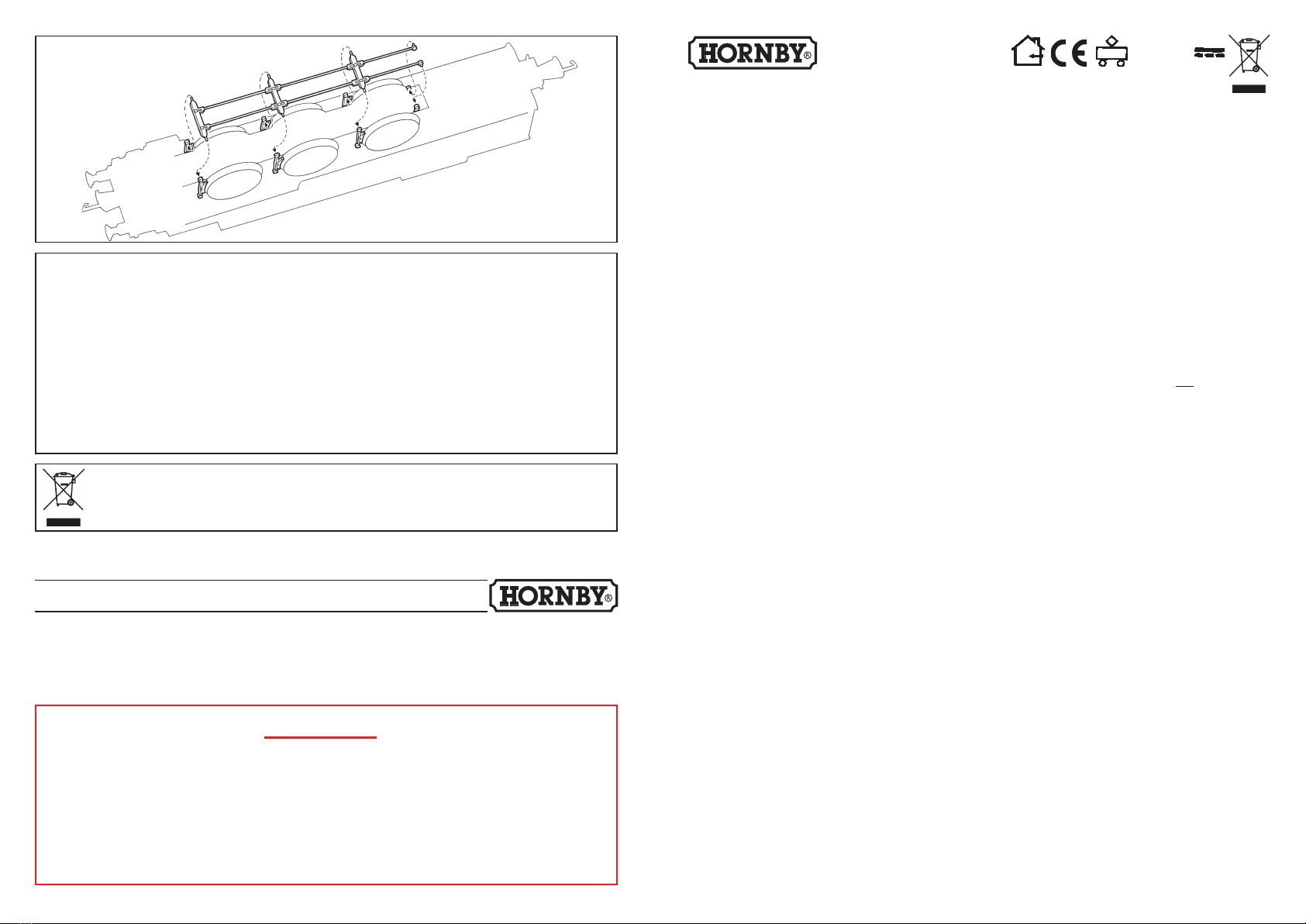
Brake Rods