Page 10
•Launch
The most important thing during the take-off is, like at all other gliders too, not the
force but the constancy of the pull. At the start we advice to fix the accelerator
with the Velcro which is attached at the front of the sitting board, in order to avoid
tripping while pulling up the glider or when starting up.
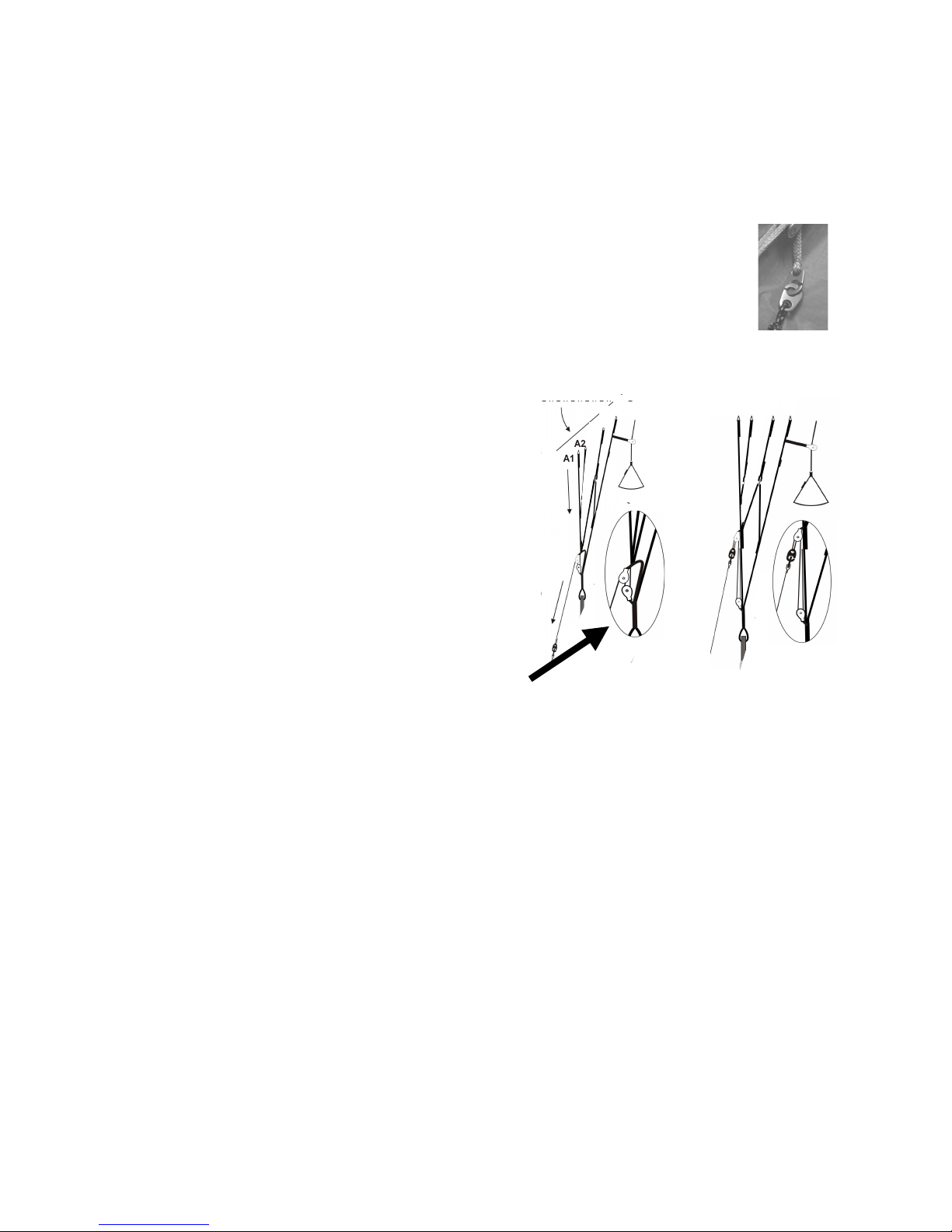
Hold the inner A-risers and the handles of the brakes and use progressive
pressure on the A-risers and the energy of your own body weight until the wing is
fully inflated overhead. The canopy is inflated quickly.
When there is no pull from the lines use slight pressure on the brake. After a few
accelerating steps and at the same time let go of the brakes gently, you will take
off. Then use slight pressure again on the brakes to fly at a speed with minimal
sink rate.
When there is strong wind the reverse launch technique is recommended. Holding
the brakes, turn around to face the wing passing one set of risers over your head
as you turn. We suggest building a "wall" by partially inflating your glider on the
ground, thus sorting out the lines thoroughly.
Check the airspace is clear and gently pull the glider up with inner riser. When the
glider is overhead, check it gently with the brakes, turn and launch. In stronger
winds, be prepared to take a couple of steps towards the glider as it inflates and
rises.
Active flying
Active flying in normal flight means that the wing is always kept at a safe angle of
attack and, if at all possible, vertically above the pilot. The moving air affecting the
wing often changes the angle of attack in an unwanted way. When flying into an
upwind the paraglider often bucks, the wing drops back, the angle of attack
increases, getting closer to a stall. In upwind the canopy pitches forward, the angle
of attack is reduced an there is the risk of a collapse. Both can occur
symmetrically, on both sides or asymmetrically, on one side only.
It is impossible to control the angle of attack by looking to the canopy. Look in the
direction you are flying, changes in the horizon inform the pilot about the canopy’s
movements.
Breaking is also an absolute must! If the canopy pitches forward, the angle of
attack decreases. In the case of strong forward pitching there is a risk of the
canopy collapsing due to its insufficient angle of attack. The pilot must therefore
prevent the canopy from pitching forward by pulling the controls down on both
sides. Inversely, the angle of attack increases if the wing drops back behind the
pilot, e.g. when entering into a thermal. The canopy is closer to stalling.
In these flight situations a significant breaking movement by the pilot can lead to a
spin or a stall. When the wing drops back, the pilot therefore must not break and/or
if the pilot is already holding the controls low, he must release them accordingly.
Any change in the angle of attack immediately transfers in to a change in the
control pressure of the brakes. The control pressure presents the pilot with
immediate information on the angle of attack and on what the canopy is doing or
about to do.