Innovative Circuit Technology Ltd. 7
Wire the load device to be powered by the charger directly to the LOAD +/-
output terminals on the charger back panel. Remove the snap on connector
cover and use appropriately sized wire with crimped on spade lugs sized to mate
with the output terminal block.
Connect the backup battery (or series string of batteries) negative wire to the
BATT –terminal. Connect the battery positive terminal to a suitably sized over
current protection device (fuse or Circuit breaker, 30A max) then to the charger
BATT + terminal. Use appropriately sized wire rated for the maximum operating
current, with crimped on spade lugs sized to mate with the output terminal block
screws.
Make a Ground connection (if required) to only a single +/- battery or load
terminal (Load side preferred). Do not connect both the load and battery to
ground as this will bypass critical internal circuitry, disabling the charge control
functions. The internal LVD relay is in series with the BATT + terminal.
Check that all connections to the charger are correct and tight; re-install the
snap on connector cover
Connect the AC power cord, with the front panel switch in the off position.
OPERATION
With the unit mounted, wired, and powered as described in the INSTALLATION
section, close the external battery breaker, or install the external battery fuse.
Turn the front panel power switch to the ON position and check that the green
CHARGE indicator on the front panel is flashing, indicating the battery is charging,
or is lit continuously indicating the battery is charged or the Fixed Float mode is
selected.
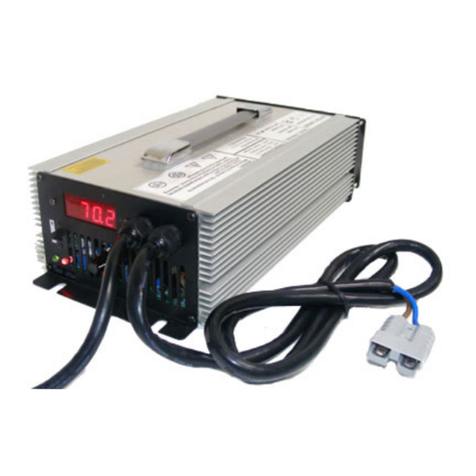
Front View (optional meter display shown)
The unit is now ready to power the load, and charge the backup battery. If AC
power should fail (or be switched off) the internal LVD relay will keep the battery
connected to the LOAD output, to ensure there is no interruption in output