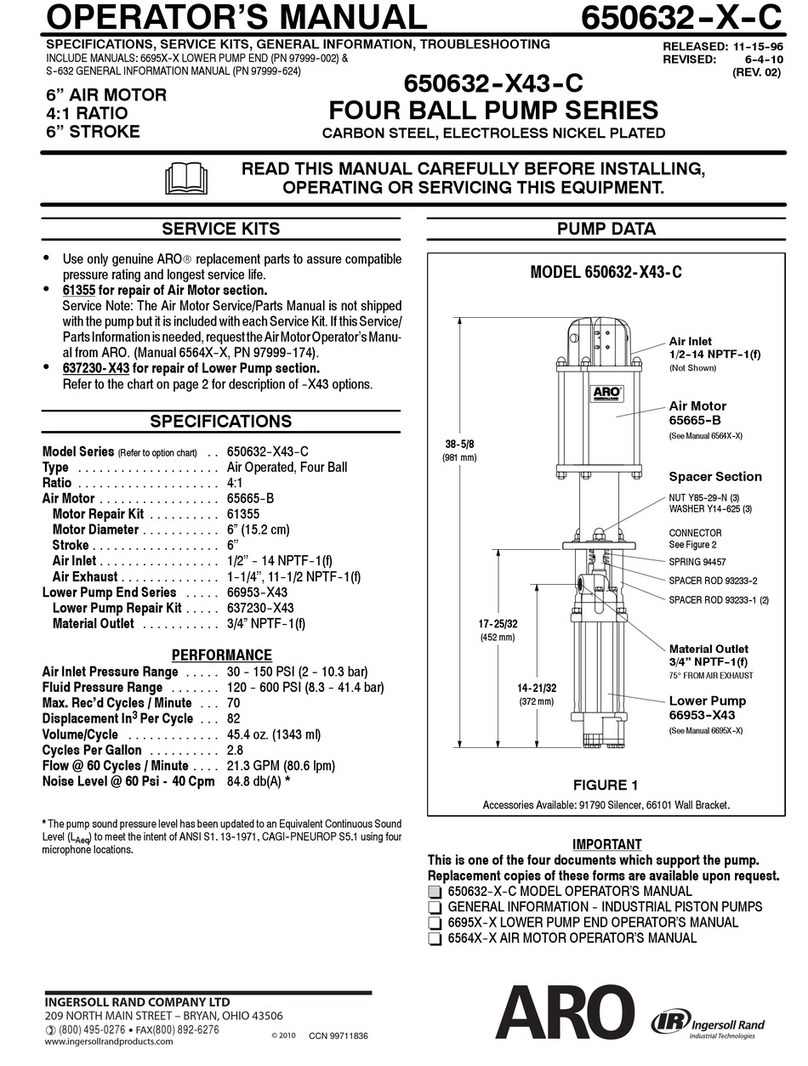
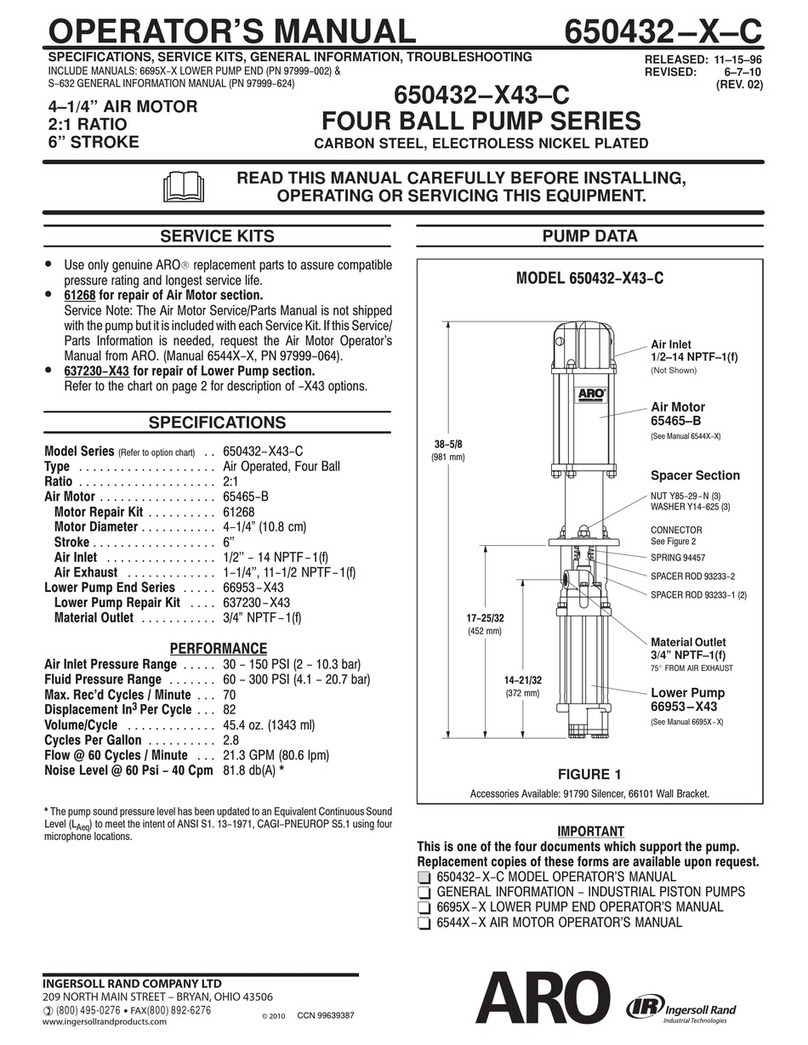
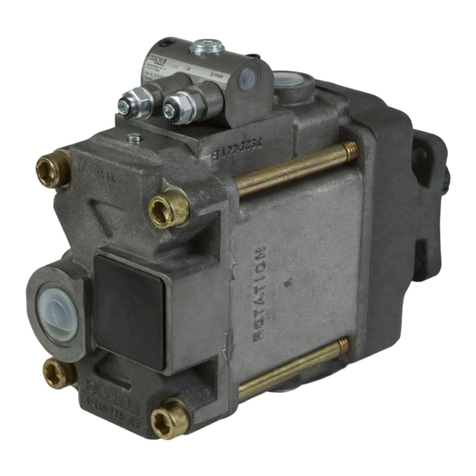
650936-X
PUMP
OPTION DESCRIPTION CHART
650936ā–āX
ACKING MATERIAL
LUNGER TY E
S RINGARRANGEMENT
ACKING MATERIAL (PACKIN S ARE UPPER AND LOWER UNLESS NOTED)
3LASS FILLED PSTA 'D (UPPER)
CUHMW-PE UHMW-PE (LOWER)
UHMW-PE/LEATHER STA 'D R
S RING ARRANGEMENT
1COIL SPRIN
4MULTIPLE WAVE SPRIN
LUNGER TY E
3HD SS W/HD CHROME PLATIN
X3
GENERAL
DESCRIPTION
WARNING HAZARDOUS RESSURE. Do not exceed maxiĆ
mum operating pressure of 1472 psi (102 bar) at 1200 psi (83
bar) inlet hydraulic pressure.
UM RATIO X MAXIMUM UM
INLET RESSURE TO UM MOTOR =FLUID RESSURE
Pump ratio is an expression of the relationship between the pump motor area and the
lower pump end area. EXAMPLE: When 150 p.s.i. (10.3 bar) inlet pressure is supplied
to the motor of a 5:1 ratio pump it will develop a maximum of 750 p.s.i. (52 bar) fluid
pressure (at no flow) - as the fluid control is opened, the flow rate will increase as the
motor cycle rate increases to keep up with the demand.
WARNING Refer to general information sheet for additional
safety precautions and important information.
•The Two-Ball pumps are primarily designed for the pumping of meĆ
dium viscosity fluids compatible with carbon steel. The lower pump
is designed for easy priming and the double acting feature is stanĆ
dard in all ARO industrial pumps. Material is delivered to the pump
discharge outlet on both the up and down stroke.
•The motor is connected to the lower pump end by a spacer section.
This allows for lubrication of the upper packing gland and prevents
motor contamination because of normal wear and eventual leakĆ
age through the material packing gland. Be sure the solvent cup is
adequately filled with lubricant to protect the upper packings and
insure longest service life.
TROUBLE SHOOTING
Pump problems can occur in either the Hydraulic Motor Section or the
Lower Pump End Section, use these basic guidelines to help determine
which section is affected.
If the pump will not cycle.
•Be certain to first check for non-pump problems including kinked,
restrictive or plugged inlet/outlet hose or dispensing device. DeĆ
pressurize the pump system and clean out any obstructions in the
inlet/outlet material lines.
•Refer to the motor manual for trouble shooting if the pump does not
cycle and/or hydraulic fluid leaks from the hydraulic motor.
If the pump cycles but does not deliver material.
•Refer to the lower pump end manual for further trouble shooting.
PUMP
CONNECTION – UPPER / LOWER
NOTE: All threads are right hand.
1. Lay the pump assembly on a workbench.
2. Remove the top three screws and washers from the three spacer
rods (see figure 1).
3. Pull the hydraulic motor from the lower pump end until motor piston
rod is in the ``down" position and lower pump end rod is in ``up" posiĆ
tion.
4. Remove the three spacer rods by unscrewing the bottom three cap
screws and washers.
5. Remove the cotter pin and unscrew the lower pump end rod from
the adapter (see figure 2).
Pump Motor
Piston Rod
Cotter Pin
Y15–47–C
Adapter
93350–1
UM CONNECTOR DETAIL
FIGURE 2
REASSEMBLY
1. Align the pump motor with the lower pump end.
2. Screw the adapter onto the motor piston rod.
3. Screw the lower pump rod into the adapter and secure with the cotĆ
ter pin. NOTE: Bend the ends of the pin into the groove of adapter.
4. Reinstall the spacer rods to the lower pump end, securing with
three washers and cap screws.
5. Bring the motor and lower pump together and retain with the three
screws and washers.
N 97999-546
6).81&15'&
15'&6).81&45"(h%611&3
15'&-08&3
15'&