4
Getting started
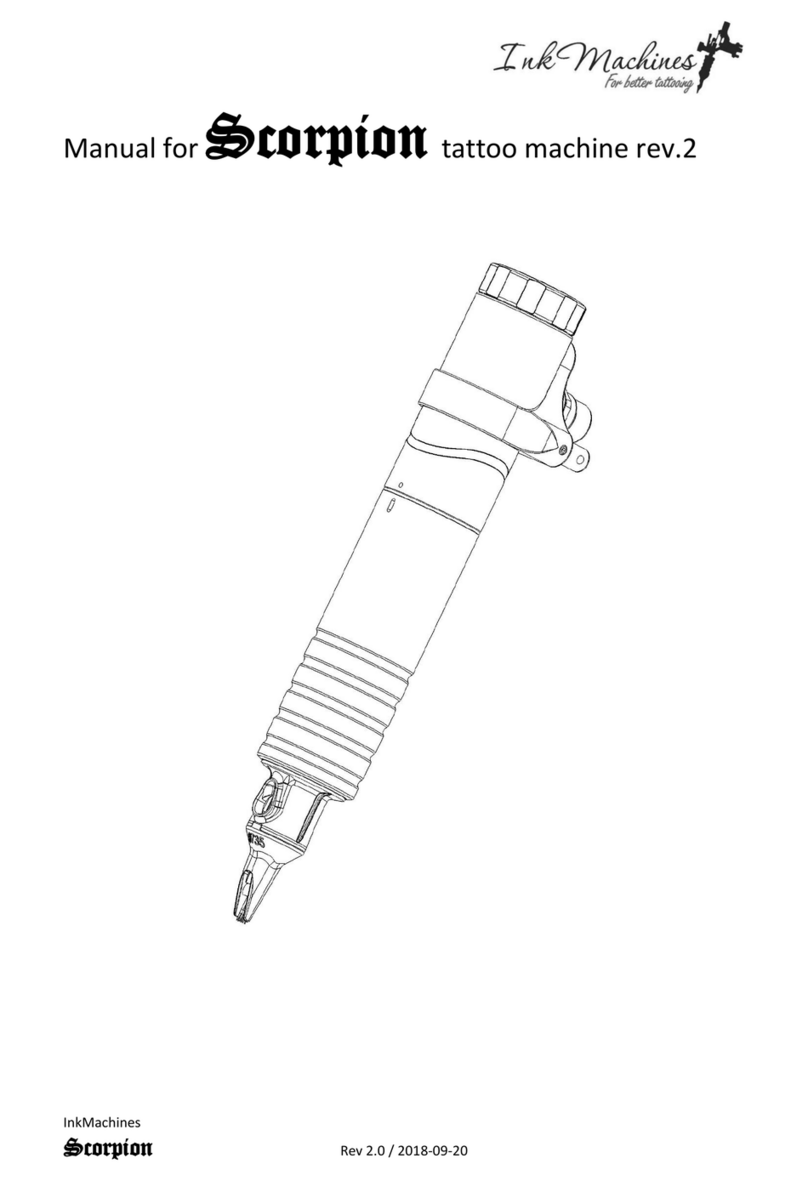
1. Disconnect the machine from the power supply.
2. Attach a new quality rubber nipple or grommet to the needlebar pin . The nipple or
grommet should have a tight fit with the needlebar loop.
3. Open the retainer to make clearance for the needlebar and tube by adjusting the
retainer screw .
4. Bend the needlebar to a slight arc shape to compensate the pressure from the needlebar
retainer. This enables the needles to work straighter, prevent it from wobbling and
making it more stable in the tip.
5. Insert the needle carefully into the tube without damaging the needle tips.
6. Insert the tube / needle assembly trough the tube vice clamp and tighten the vice
lightly. Attach the needlebar loop to the nipple.
7. Move the needlebar pin and the attached needlebar down to the bottom of its
stroke by pressing the needlebar pin downwards, if the needlebar pin won’t move
down push the excentric bearing to the side at the same time.
8. Inspect and adjust the protrusion and alignment of the needle and tip by moving the
grip and tube to the desired location. Tighten the tube vice firmly when done .
9. Adjust the needlebar retainer by turning the retainer screw until the retainer
o-rings makes contact with the needlebar. Don’t tighten more than necessary to
keep the needle stable in the tip. If the needlebar don’t align properly with the retainer
o-rings, adjust / bend the needlebar so that it aligns.
10. Connect the machine to a power supply ( max 14 volts DC ) either with a RCA cable
to the RCA contact or a clipcord to the clipcord binding posts , if you
choose to use a clipcord make sure to connect positive to + and negative to –marked
on the machine next to the bindingposts.
11. Run the machine between 9-12 volts depending on needle size and friction, fine adjust
the needlebar retainer until the needle feels stable in the tip and make sure that
everything runs smoothly without excessive friction or noise.
12. Run the machine and adjust the needle suspension by feeling the needlebar pin
and nipple with your finger and by turning the cap to get the desired hitting,
clockwise = harder, counter clockwise = softer. When the cap is turned clockwise to
the bottom the needlebar pin will be locked with the piston . This position will
give the hardest hitting and shortest stroke. When the cap is turned counter clockwise
the stroke will be increasingly softer / longer until the limit is reached. When the limit
is reached the adjustment screw will make contact with the cap from the inside
and produce noise, turn the cap clockwise until the adjustment screw clears the cap
and the noise stops. If you turn the cap too far and the cap should come off during this
operation, screw down the adjustment screw two turns and reattach the cap by pushing
it until it clicks into place.
13. Encapsulate the machine and cord with plastic bags and wrappings for tattoo
equipment.