Basic info about blood pressure
Systolicpressure means that the ventricles contract and pump out blood, increasing the blood pressure. The diastolic pressure
meansthat the ventricles relax so the blood pressure decreases.
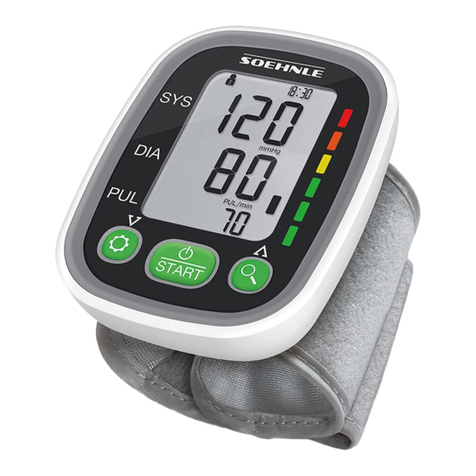
AHA indicator
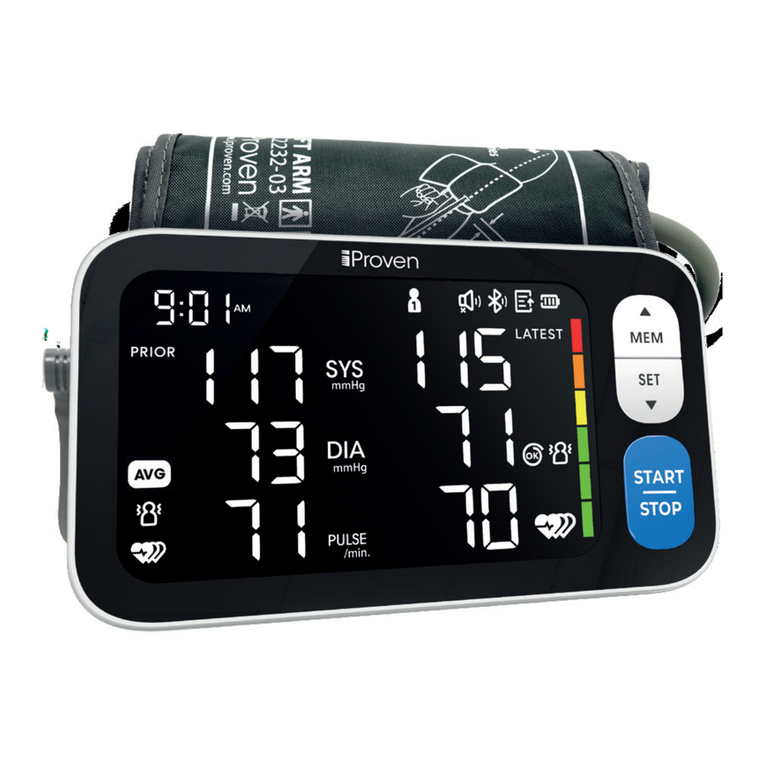
Aftereach measurement an arrow indicates the corresponding AHA category color on the left of the display. The colors represent
thedierent categories of the American Heart Association blood pressure classication as depicted in the chart below.
Electromagnetic compatibility measures
Pleasepay attention to the precautions of EMC
(ElectromagneticCompatibility) of this Monitor. The
BloodPressure Monitor must be installed and used
accordingto the EMC information shown in this manual.
Thedevice can be aected by portable and mobile RF
communicationequipment.
Removeany devices that emit electromagnetic elds
suchas mobile phones from nearby the device.
TheBlood Pressure Monitor has been tested and
inspectedto guarantee a proper performance.
Donot store or use this Monitor with other electric
equipment.
Manufacturer’sdeclaration on Electromagnetic Immunity for all ME Equipments and Systems Manufacturer’sdeclaration on Electromagnetic Immunity for all ME Equipments
and Systemsthat do not provide LIFE-SUPPORTING
The safe distancesbet weenpor table and mobile RF communications
equipment, ME Equipments and Systemsthat are not LIFE-SUPPORTING
Changes in blood pressure
Thereare many factors that cause the
bloodpressure to change. Weather,
emotions,stress, food, physical activities;
allthese inuence the variations in
theblood pressure. Bear in mind that
measuringin clinical settings tend to
causethe blood pressure to increase.
Thisis called “white coat eect”.
Error messages and FAQ Important symbols on the monitor
PROBLEM SYMPTOM CHECK THIS REMEDY
Nopower
Low
batteries
Error
message
Displaywill not
lightup.
Batteriesare exhausted. Replacewith new batteries
Insertthe batteries
correctly
Replacewith new batteries
Batteriesare inserted
incorrectly.
Displayis dim or
show Batteriesare low.
E01 shows
E03 shows
E04 shows
EExx,showson
thedisplay.
Acalibration error
occurred.(XX can
besome digital symbol,
suchas 01, 02,etc., if
thissimilar situation
appear,all belong to
calibrationerror.)
Retakethe measurement.
Ifthe problem persists,
contactthe retailer or our
customerservice
departmentfor further
assistance.Referto the
warrantyfor contact
informationand return
instructions.
Thetreatment of the
measurementfailed.
E02 shows
Thecuff is too tight
ortoo loose.
Refastenthe cuff and then
measureagain.
Themonitor
detectedmotion
whilemeasuring.
Movementcan affect the
measurement.Relaxfor a
momentand then
measureagain.
Relaxfor a moment and
thenmeasure again.
Themeasurement
processdoes not
detectthe pulse
signal.
Loosenthe clothing on
thearm and then
measureagain.
Warning
message
Relaxfor a moment.
Refastenthe cuff and then
measureagain. If the
problempersists, contact
yourphysician.
“out” shows Outof measurement
range
About22cm~42cm
TypeBF applied part
Powersupply
Displaymode
Measurementmode Oscillographictesting mode
Measurementrange
Measurementperimeter
ofthe upper arm
Weight Approx.260g(Excludingthe dry cells and cuff)
Externaldimensions
Attachment
Modeof operation Continuousoperation
Degreeof protection
Protectionagainst
ingressof water
Accuracy
Normalworking condition
Storage& transportation
condition
SoftwareVersion A01
Pressure:
5℃-40℃within±3mmHg(0.4kPa)
Pulsevalue:±5%
Ratedcuff pressure:
0mmHg~299mmHg(0kPa~ 39.9kPa)
Measurementpressure:
SYS:60mmHg~230mmHg (8.0kPa~30.7kPa)
DIA:40mmHg~130mmHg (5.3kPa~17.3kPa)
Pulsevalue: (40-199)beat/minute
IP21It means the device could protected against
solidforeign objects of 12.5mm and greater, and
protectagainst vertically falling water drops.
DeviceClassification
BatteryPowered Mode:
InternallyPowered ME Equipment
ACAdaptor Powered Mode: Class II ME Equipment
Atemperature range of :+5°C to +40°C
Arelative humidity range of 15% to 90%,
non-condensing,but not requiring a water
vapourpartial pressure greater than 50 hPa
Anatmospheric pressure range of :
700hPa to 1060 hPa
Temperature:-20°Cto +60°C
A relative humidity range of ≤ 93%,
non-condensing,at a water vapour pressure
upto 50hPa
Symbolfor “THE OPERATION
GUIDEMUST BE READ”
Symbolfor “MANUFACTURER”
Symbolfor “SERIAL NUMBER”
Symbolfor “TYPE BF APPLIED
PARTS”
Symbolfor “DIRECT CURRENT”
Symbolfor “ENVIRONMENT
PROTECTION- Electrical waste
productsshould not be disposed of
withhousehold waste. Please recycle
wherefacilities exist. Check with your
localauthority or retailer for recycling
advice”
Symbolfor “MANUFACTURE
DATE”
Caution:These notes must be
observed to prevent anydamage
to the device.
TheGreen Dot is the license
symbolof a European
networkof industry-funded
systemsfor recycling the
packagingmaterials of
consumergoods.
Symbolfor “Recycle”
Complied EuropeanStandards List
ENISO 14971:2012 / ISO 14971:2007 Medical devices -
Applicationof risk management to medical devices
EN980:2008 Symbols for use in the labelling of medical devices
EN1041:2008 Information supplied by the manufacturer of medical
devices
EN60601-1:2006/ IEC 60601-1:2005+A1:2012 Medical electrical
equipment- Part 1: General requirements for basic safety and
essentialperformance
EN60601-1-11:2010/ IEC 60601-1-11:2015 Medical electrical
equipment- Part 1-11: General requirements for basic safety and
essentialperformance - Collateral standard: Requirements for medical
electricalequipment and medical electrical systems used in the home
healthcareenvironment
EN60601-1-2:2015/ IEC 60601-1-2:2014 Medical electrical
equipment- Part 1-2: General requirements for basic safety and
essentialperformance - Collateral standard: Electromagnetic
compatibility- Requirements and tests
ENISO 81060-1:2012 Non-invasive sphygmomanometers - Part 1:
Requirementsand test methods for non-automated measurement type
EN1060-3:1997+A2:2009 Non-invasive sphygmomanometers -
Part3: Supplementary requirements for electro-mechanical blood
pressuremeasuring systems
EN1060-4:2004 Non-invasive sphygmomanometers - Part 4: Test
proceduresto determine the overall system accuracy of automated
non-invasivesphygmomanometers
EN60601-1-6:2010/IEC 60601-1-6:2010+A1:2013 Medical
electricalequipment - Part 1-6: General requirements for basic safety
andessential performance - Collateral standard: Usability
EN62366:2008/ IEC 62366-1:2015 Medical devices - Application
ofusability engineering to medical devices
EN62304:2006/AC: 2008 / IEC 62304:2006 Medicaldevice
software- Software life-cycle processes
Riskmanagement
Labeling
Usermanual
GeneralRequirements
forSafety
Electromagnetic
compatibility
Performance
requirements
Clinicalinvestigation
Usability
Softwarelife-cycle
processes
Bio-compatibility
ISO10993-1:2009 Biological evaluation of medical devices- Part
1:Evaluation and testing within a risk management process
ISO10993-5:2009 Biological evaluation of medical devices -
Part5: Tests for in vitro cytotoxicity
ISO10993-10:2010 Biological evaluation of medical devices -
Part10: Tests for irritation and skin sensitization
ISO15223-1:2012 Medicaldevices.Symbolsto be used with
medicaldevice labels, labelling and information to be supplied. Part 1 :
Generalrequirements
IEC80601-2-30:2013 Medical electrical equipment- Part 2-30:
Particularrequirements for the basic safety and essential
performanceof automated non-invasive sphygmomanometers
ISO81060-2:2013 Non-invasivesphygmomanometers-Part 2:
Clinicalvalidation of automated measurement type
Guidanceand manufacturer’s declaration – electromagnetic emissions
RFemissions
CISPR11 Group1
ClassB
ClassA
Complies
Compliance
Harmonicemissions
IEC61000-3-2
Voltagefluctuations/
flickeremissions
IEC61000-3-3
RFemissions
CISPR11
Emissionstest Electromagneticenvironment - guidance
Thedevice is intended for use in the electromagn etic environment specified below. The customer or the
userof the device should assure that it is used in such an environment.
Thedevice uses RF energy only for its internal
function.Therefore, its RF emissions are very low
andare not likely to cause any interference in nearby
electronicequipment.
Thedevice is suitable for use in all establishments,
otherthan domestic and those directly connected to
thepublic low-voltage power supply network that
suppliesbuildings used for domestic purposes.
Guidanceand manufacturer’s declaration – electromagnetic immunity
Immunitytest
±8kV contact
±15kV air ±8kV contact
±15kV air
±2kV
powersupply lines:
line(s)to line(s): ±1 kV
line(s)to earth: ±2 kV
0%0.5 cycle
At0°, 45°, 90°, 135°,
180°,225°,270°and 315°
0% 1 cycle
and70% 25/30 cycles
Singlephase: at 0
0%300 cycle
30A/m
50Hz/60Hz
NOTE U
T
isthe a.c. mains voltage prior to application of the test level.
Compliancelevel
Electrostatic
discharge(ESD)
IEC61000-4-2
Electromagnetic
environment- guidance
30A/m
50Hz/60Hz
Powerfrequency
(50Hz/60Hz)
magneticfield
IEC61000-4-8
Voltagedips,
shortinterruptions
andvoltage
variationson
powersupply
inputlines
IEC61000-4-11
Electricalfast
transient/burst
IEC61000-4-4
Surge
IEC61000-4-5
input/outputlines:
±1kV
Thedevice is intended for use in the electromagnetic environment specified below. The customer or the
userof the device should assure that it is used in such an environment.
IEC60601 test level
Floorsshould be wood, concrete
orceramic tile. If floors are
coveredwith synthetic material,
therelative humidity should be at
least30%.
±2kV
powersupply lines:
100kHz repetition
frequency
line(s)to line(s): ±1 kV
100kHz repetition
frequency
Mainspower quality should be
thatof a typical commercial or
hospitalenvironment.
Mainspower quality should be
thatof a typical commercial or
hospitalenvironment.
Mainspower quality should be
thatof a typical commercial or
hospitalenvironment.
Powerfrequency magnetic fields
shouldbe at levels characteristic
ofa typical location in a typical
commercialor hospital
environment.
0%0.5 cycle
At0°, 45°, 90°, 135°,
180°,225°,270°and
315°
0% 1 cycle
and70% 25/30 cycles
Singlephase: at 0
0%300 cycle
Guidanceand manufacturer’s declaration – electromagnetic immunity
Immunitytest Compliance
level
IEC60601
Testlevel
ConductedRF
IEC61000-4-6
RadiatedRF
IEC61000-4-3
10V/m,80% Am
at1kHz
150kHz to
80MHz:
3Vrms
6Vrms(in ISM
andamateur
radiobands)
80%Am at 1kHz
Electromagneticenvironment - guidance
NOTE1 A t80 MHz and 800 MHz, the higher frequency range applies.
NOTE2 T heseguidelinesmay not apply in all situations. Electromagnetic propagation is affected by
absorptionand reflection from structures, objects and people.
a
Fieldstrengths from fixed transmitters, such as base stations for radio (cellular / cordless)
telephonesand land mobile radios, amateur radio, AM and FM radio broadcast and TV broadcast
cannotbe predicted theoretically with accuracy. To assess the electromagnetic environment due to
fixedRF transmitters, an electromagnetic site survey should be considered. If the measured field
strengthin the location in which the device is used exceeds the applicable RF compliance level
above,the device should be observed to verify normal operation. If abnormal performance is
observed,additional measures may be necessary, such as re-orienting or relocating the device.
Overthe frequency range 150 kHz to 80 MHz, field strengths should be less than 3V/m .
b
Thedevice is intended for use in the electromagnetic environment specified below. The customer or the
userof the device should assure that it is used in such an environment.
150kHz to
80MHz:
3Vrms
6Vrms(in ISM
andamateur
radiobands)
80%Am at 1kHz
Portableand mobile RF communications
equipmentshould be used no closer to any part
ofthe device, including cables, than the
recommendedseparation distance calculated
fromthe equation appropriate for the frequency
ofthe transmitter.
Recommendedseparation distances:
d=0.35;
d=1.2
10V/m,80% Am
at1kHz
80MHz to 800 MHz:
d=1.2
800MHz to 2.7 GHz:
d=2.3
where,
Pisthemaximum
outputpower rating of the
transmitterin watts (W)
accordingto the
transmittermanufacturer,
disthe recommended
separationdistance in
meters(m). Field
strengthsfrom fixed RF
transmitters,as
determinedby an
electromagneticsite
survey,should be less
thanthe compliance level
ineach frequency range.
Interferencemay occur in
thevicinity of equipment
markedwith the following
symbol:
150kHz to 80 MHz 8 0MHz to 800 MHz 800 MHz to 2.7 GHz
Recommendedseparation distances between portable and mobile RF communications
equipmentand the device.
Ratedmaximum output
powerof transmitter
(W)
Separationdistance according to frequency of transmitter(m)
0.01
0.1
1
10
100
0.12 0.12
0.38
1.2
3.8
12
0.23
0.73
2.3
7.3
23
Thedevice is intended for use in an electromagnetic environment in which radiated RF disturbances are
controlled.The customer or the user of the device can help prevent electromagnetic interference by
maintaininga minimum distance between portable and mobile RF communications equipment
(transmittters)and the device as recommended below, according to the maximum output power of the
communicationsequipment.
Fortransmitters rated at a maximum output power not listed above, the recommended separation
distance
dinmetres (m) can be estimated using the equation applicable to the frequency of the
transmitter,where Pis the maximum output power rating of the transmitter in watts (W) according to the
transmittermanufacturer.
NOTE1 At80 MHz and 800 MHz, the separation distance for the higher frequency range applies.
NOTE2 Theseguidelines may not apply in all situations. Electromagnetic propagation is affected by
absorptionand reflection from structures, objects and people.
FCCStatement
Thisdevice complies with Part 15 of the FCC
Rules.Operation is subject to the following two
conditions:(1) this device may not cause harmful
interference,and (2) this device must accept any
interferencereceived, including interference that
maycause undesired operation.
CAUTIONS
• Whenusing this device, please pay attention to the following situation which may interrupt blood ow and inuence
bloodcirculation of the patient, thus cause harmful injury to the patient: connection tubing kinking too frequent and consecutive multiple
measurements;the application of the cu and its pressurization on any arm where intravascular access or therapy, or an arterio-venous (A-V) shunt, is
present;inating the cu on the side of a mastectomy.
• Warning:Do not apply the cu over a wound;otherwise it can cause further injur y.
• Do not inatethe cu on the samb limb which other monitoring ME equipment is applied around simultaneously, because this could cause
temporaryloss of function of those simultaneously-used monitoring ME equipment.
• Onthe rare occasion of a fault causing the cu to remain fully inated during measurement, open the cu immediately.
• Prolongedhigh pressure (cu pressure > 300mmHg or constant pressure > 15mmHg for more than 3 minutes) applied to the arm
maylead to an ecchymosis.
• Pleasecheck that operation of the device does not result in prolonged impairment of patient blood circulation.
• Whenmeasurement, please avoid compression or restriction of the connection tubing.
• Thedevice cannot be used with HF surgical equipment at the same time.
• TheACCOMPANYING DOCUMENT shall disclose that the SPHYGMOMANOMETER was clinically
investigatedaccording to the requirements of ISO 81060-2:2013.
• Toverify the calibration of the AUTOMATEDSPHYGMOMANOMETER, please contact the manufacturer.
• Thisdevice is contraindicated for any female who may be suspected of, or is pregnant. Besides providing inaccurate readings,
theeects of this device on the fetus are unknown.
• Toofrequent and consecutive measurements could cause disturbances in blood circulation and injuries. This unit is not suitable for continuous
monitoringduring medical emergencies or operations. Otherwise, the patient’s arm and ngers will become anaesthetic, swollen and even purple
dueto a lack of blood.
• Whennot in use, store the device with the adapter in a dry room and protect it against extreme moisture, heat, lint,
dustand direct sunlight. Never place any heavy objects on the storage case.
• Thisdevice may be used only for the purpose described in this booklet. The manufacturer cannot be held liable
fordamage caused by incorrect application.
Authorized Component
1.Please use the iProvèn authorized adapter. (not
included)
Guidance and manufactures - electromagnetic Immunity
Adapter
Model:KH0601000UW
Input:AC 100-240V
50/60Hz 0.4A Max
Output: 6V 1000mA
Test
Frequency
(MHz)
385 0.32 7
Thedevice is intended for use in the electromagnetic environment specified below. The customer or the
userof the device, should assure that it is used in such an environment.
NOTEIf necessary to achieve the IMMUNITY TEST LEVEL, the distance between the transmitting antenna
andthe ME EQUIPMENT or ME SYSTEM may be reduced to 1 m. The 1 m test distance is permitted by
IEC61000-4-3.
RadiatedRF
IEC61000-4-3
(Test
specifications
for
ENCLOSURE
PORT
IMMUNITYto
RFwireless
communica-
tions
equipment)
Banda)
(MHz)
Servicea) Modulationb) Modulation b)
(W)
Distance(m)
IMMUNITY
TEST
LEVEL
(V/m)
380-390 TETRA
400
Pulse
modulationb)
18Hz
1.8
450 380-390
GMRS460,
FRS460
FMc) ± 5kHz
deviation1kHz
sine
20 .3 28
710 704-787
745
780
LTEBand
13,
17
Pulse
modulationb)
217Hz
0.20 .3 9
810
870
930
800-960
GSM
800/900,
TETRA800,
iDEN820,
CDMA850,
LTEBand5
Pulse
modulationb)
18Hz
20.32 8
1720
1845
1970
1700-
1990
GSM1800;
CDMA1900;
GSM1900;
DECT;
LTEBand1,
3,
4,25;UMTS
Pulse
modulationb)
217Hz
20.32 8
20.32 82450 2400-
2570
Bluetooth,
WLAN,
802.11
b/g/n,RFID
2450,LTE
Band7
Pulse
modulationb)
217Hz
5240
5240
5785
5100-
5800
WLAN
802.11
a/n
Pulse
modulationb)
217Hz
0.2 0.39
a)For some services, only the uplink frequencies are included.
b)The carrier shall be modulated using a 50% duty cycle square wave signal.
c)As an alternative to FM modulation, 50% pulse modulation at 18 Hz may be used because while it does
notrepresent actual modulation, it would be worst case.
TheMANUFACTURER should consider reducing the minimum separation distance, based on RISK
MANAGEMENT,and using higher IMMUNITY TEST LEVELS that are appropriate for the reduced
minimumseparation distance. Minimum separation distances for higher IMMUNITY TEST LEVELS shall be
calculatedusing the following equation:
E=
WhereP is the maximum power in W, d is the minimum separation distance in m, and E is the IMMUNITY
TESTLEVEL in V/m.
Normal
Prehypertension
lessthan 120
90or higher
Higherthan 120
Higherthan 180
lessthan 80
lessthan 80
120-129
HighBlood Pressure
(hypertension)Stage 1
HighBlood Pressure
(hypertension)Stage 2
HypertensiveCrisis
(Emergencycare needed)
130-139
140or higher
80-89
and
and
or
or
and/or
Blood Pressure
Category Systolic
mmHG (upper#) Diastolic
mmHg (lower#)
Green
Yellow
Orange
Dark
Orange
Red