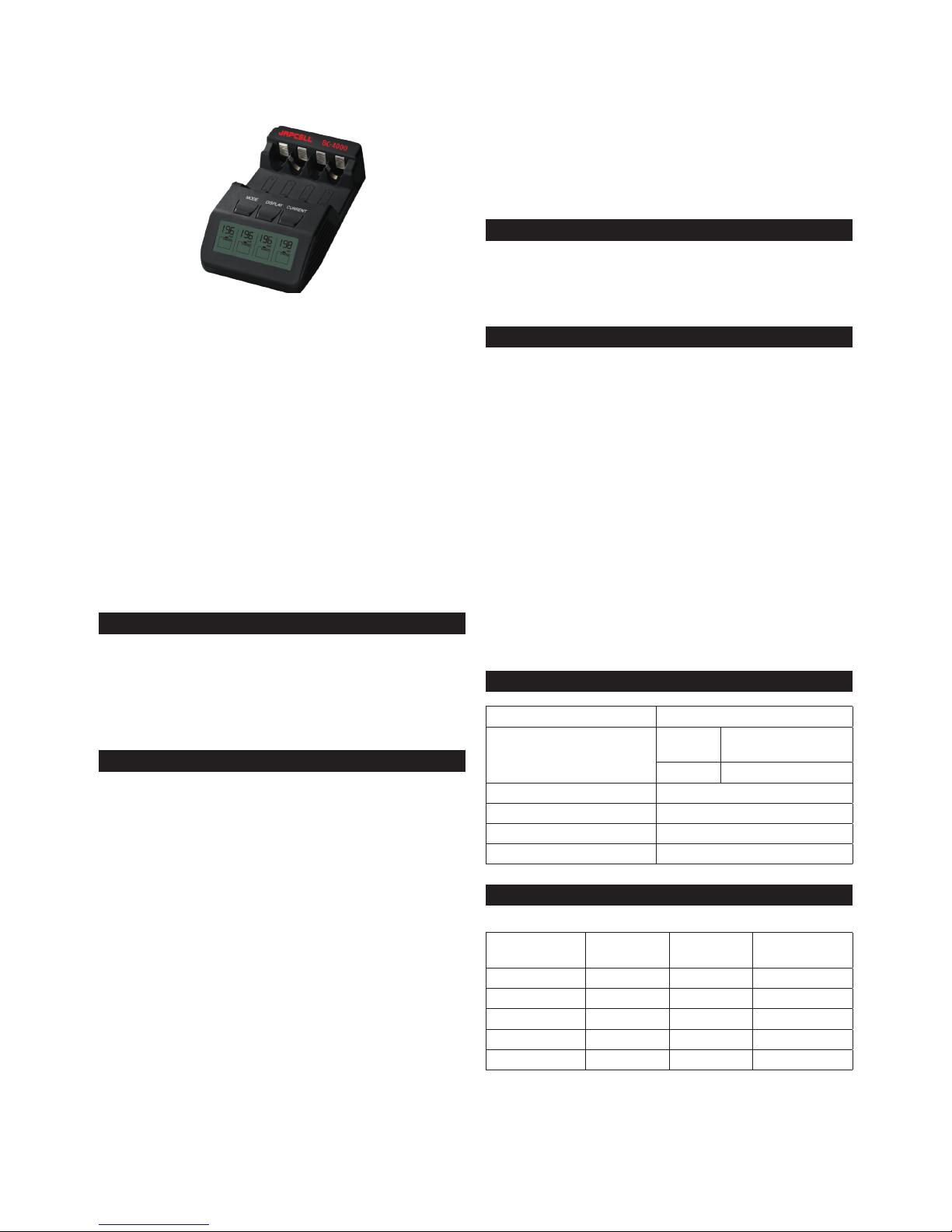
5.1. MODE Selection
Press and hold the “MODE” button for 2 seconds to change the
operating mode for all charging slots.
Press the “MODE” button subsequently to toggle among the
“Charge”, ”Discharge”, ”Test” and “Refresh” mode.
5.2. CURRENT Selection
Within the rst 8 seconds after insert the battery, press the
“CURRENT” button to select desired charge current of 200, 500,
700 or 1000mA for slots inserted with batteries. The current can-
not be altered once the setting has been conrmed in the initial
stage. If one wants to change the applied current afterwards, the
rechargeable battery must be taken out and inserted again. The
maximum charging current is restricted by the current setting of
the rst inserted battery current. Discharge current is automati-
cally set to half of the selected charge current.
If two or less batteries are inserted in slot 1 and/or 4, the charg-
ing current can further be selected for 1500 or 1800mA. Maxi-
mum discharge current is limited to 500mA.
5.3. DISPLAY Selection
During or after the work mode complete, press the “DISPLAY” but-
ton to toggle among the display mode for voltage, current, capacity
and work time.
6. Overheat Protection
When overheating occurs, either batteries temperature over 55˚C
or charger controller board temperature over 70˚C, the charging or
discharging will be stopped immediately and the display will show
“000mA”. The charging process will only resume once the tempe-
rature of the rechargeable batteries drops to 40 degrees or charger
controller board drops to 50 degrees.
7. Operation Modes and Display
7.1. Operation Modes
Charge Mode: The rechargeable battery is charged up to its
maximum capacity.
Discharge Mode: It is used to reduce the memory effect. The
rechargeable battery is discharged to a preset battery voltage
(0.9V). Once discharge is nished, the battery will be charged at
the pre-selected charging current. Discharge current is always
half of the selected charge current.
Refresh Mode: The rechargeable battery is charged and dis-
charged repeatedly to optimize to its maximum capacity. Old
rechargeable batteries or rechargeable batteries that have not
been used for a long period of time can be restored to their rated
capacity. Depends on the selected charge current, it can take 12
hours or even longer time before complete.
Test mode: Checks the present capacity of a rechargeable bat-
tery. The maximum capacity is determined by discharging the
rechargeable battery after it was fully charged. If the maximum
capacity is much lower than the rated capacity then it may reach
the end of its lifetime.
7.2. Display
Charge/Discharge Current: The instantaneous current is dis-
played.
Time Elapsed: The charging/discharging time of the last cycle is
displayed.
Accumulated Capacity: The accumulated battery capacity is
displayed in mAh or Ah.
Charge Voltage: The instantaneous battery voltage is displayed.
Full: After the rechargeable battery is fully charged in any of the
operation modes, trickle charging will be started automatically.
Trickle charging prevents the rechargeable batteries from being
overcharged and compensates for self-discharging of the batteries.
The Timer will resume and count from 0:00 again after the
time elapsed is longer than 20 hours. For example: 1:45 will
be shown if the time elapsed is 21hours and 45 minutes.
8. Maintenance
The device is maintenance-free but should be cleaned occasion-
ally. When cleaning, the device must be removed from any power
source. Only use dry and soft cloth to clear the housing of the
charger. Do not use abrasive or solvents.
9. Disposal
9.1. Disposal of waste electrical and electronic equipment
In order to preserve, protect and improve the quality of environ-
ment, protect human health and utilize natural resources prudently
and rationally, the user should return unserviceable product to rel-
evant facilities in accordance with statutory regulations.
The crossed-out wheeled bin indicates the product needs to be
disposed separately and not as municipal waste.
9.2. Used batteries/rechargeable batteries disposal The user
is legally obliged (battery regulation) to return used batteries
and rechargeable batteries.
Disposing used batteries in the household waste is prohibited!
Batteries/rechargeable batteries containing hazardous substances
are marked with the coursed-out wheeled bin. The symbol indi-
cates that the product is forbidden to be disposed via the domestic
refuse. The chemical symbols for the respective hazardous sub-
stances are Cd= Cadmium, Hg = Mercury, Pb = Lead.
You can return used batteries/rechargeable batteries free of charge
to any collecting point of your local authority.
10. Technical Data
Operating Voltage 3V DC
Power Adapter Input: 100~240V~,
50/60Hz
Output: 3V DC / 4.0A
Charging Current range 200 ~ 1800 mA
Discharging Current range 100 ~ 500 mA
Max. Charging Capacity 3500mAh
Operating Temperature 0 to 40˚C
11. Charging Time
Examples of typical charging times:
Type of
Battery
Charge
Current
Battery
Capacity
Charging time
1-4 Batteries
NiMH AA 1000mA 2700mA 3,0 h
NiMH AA 1000mA 2000mA 2,5 h
NiMH AAA 500mA 800mA 1,9 h
NiCd AA 1000mA 1000mA 1,2 h
NiCd AAA 500mA 300mA 0,7 h
For further information please contact:
www.japcell.eu