manuals.online logo
Brands
  1. Home
  2. •
  3. Brands
  4. •
  5. JBL
  6. •
  7. Subwoofer
  8. •
  9. JBL TLX PS12 User manual

JBL TLX PS12 User manual

Other manuals for TLX PS12

1

Other JBL Subwoofer manuals

JBL CS1215 User manual

JBL

JBL CS1215 User manual

JBL BASSPRO User manual

JBL

JBL BASSPRO User manual

JBL G SUB 10 User manual

JBL

JBL G SUB 10 User manual

JBL ARC SUB 8 User manual

JBL

JBL ARC SUB 8 User manual

JBL G SUB 10 User manual

JBL

JBL G SUB 10 User manual

JBL HTPS-400 User manual

JBL

JBL HTPS-400 User manual

JBL CS1204 User manual

JBL

JBL CS1204 User manual

JBL TLX PS10 User manual

JBL

JBL TLX PS10 User manual

JBL P1220 Instruction manual

JBL

JBL P1220 Instruction manual

JBL VRX915S User manual

JBL

JBL VRX915S User manual

JBL SUB 100P User manual

JBL

JBL SUB 100P User manual

JBL P1222 User manual

JBL

JBL P1222 User manual

JBL NL150 User manual

JBL

JBL NL150 User manual

JBL S2-1024SS User manual

JBL

JBL S2-1024SS User manual

JBL GT1041 User manual

JBL

JBL GT1041 User manual

JBL Control SB-2 User manual

JBL

JBL Control SB-2 User manual

JBL PS1400 User manual

JBL

JBL PS1400 User manual

JBL BASSPRO User manual

JBL

JBL BASSPRO User manual

JBL P-1200 Instruction manual

JBL

JBL P-1200 Instruction manual

JBL HDI-1200P User manual

JBL

JBL HDI-1200P User manual

JBL Synthesis Four S4S User manual

JBL

JBL Synthesis Four S4S User manual

JBL GTO1502D Instruction manual

JBL

JBL GTO1502D Instruction manual

JBL PowerBass PB12 User manual

JBL

JBL PowerBass PB12 User manual

JBL GTX10 User manual

JBL

JBL GTX10 User manual

Popular Subwoofer manuals by other brands

Sony XS-AW8 operating instructions

Sony

Sony XS-AW8 operating instructions

Sony XS-L836 Specifications

Sony

Sony XS-L836 Specifications

B&C Speakers 15 HPL 76W Specifications

B&C Speakers

B&C Speakers 15 HPL 76W Specifications

Velodyne DD-18+ Specifications

Velodyne

Velodyne DD-18+ Specifications

Sonance Cinema Series SUB 10-150 Specifications

Sonance

Sonance Cinema Series SUB 10-150 Specifications

Hifonics HW-12 Owners & installation manual

Hifonics

Hifonics HW-12 Owners & installation manual

Magnat Audio ADR 130 BP user manual

Magnat Audio

Magnat Audio ADR 130 BP user manual

Blitz BZP106 Specifications

Blitz

Blitz BZP106 Specifications

Technics SB-AS500 Operaing instructions

Technics

Technics SB-AS500 Operaing instructions

Lyngdorf BW-2 owner's manual

Lyngdorf

Lyngdorf BW-2 owner's manual

Lyngdorf BW-3 owner's manual

Lyngdorf

Lyngdorf BW-3 owner's manual

Pyle Pro PYLE PRO PDW15125 owner's manual

Pyle Pro

Pyle Pro PYLE PRO PDW15125 owner's manual

REL Acoustics Q Series operating instructions

REL Acoustics

REL Acoustics Q Series operating instructions

L-Acoustics KIVA SB15M Rigging manual

L-Acoustics

L-Acoustics KIVA SB15M Rigging manual

Pioneer Elite S-W1EX Service manual

Pioneer

Pioneer Elite S-W1EX Service manual

B&C Speakers Woofer 12 HPL 76 specification

B&C Speakers

B&C Speakers Woofer 12 HPL 76 specification

KEF KUBE 200 installation manual

KEF

KEF KUBE 200 installation manual

Yamaha SW500 owner's manual

Yamaha

Yamaha SW500 owner's manual

manuals.online logo
manuals.online logoBrands
  • About & Mission
  • Contact us
  • Privacy Policy
  • Terms and Conditions

Copyright 2025 Manuals.Online. All Rights Reserved.

JBL Consumer Products Inc.
250 Crossways Park Drive
Woodbury, N. . 11797
A Harman International Company
1112-TLXPS12 Rev A
SERVICE MANUAL
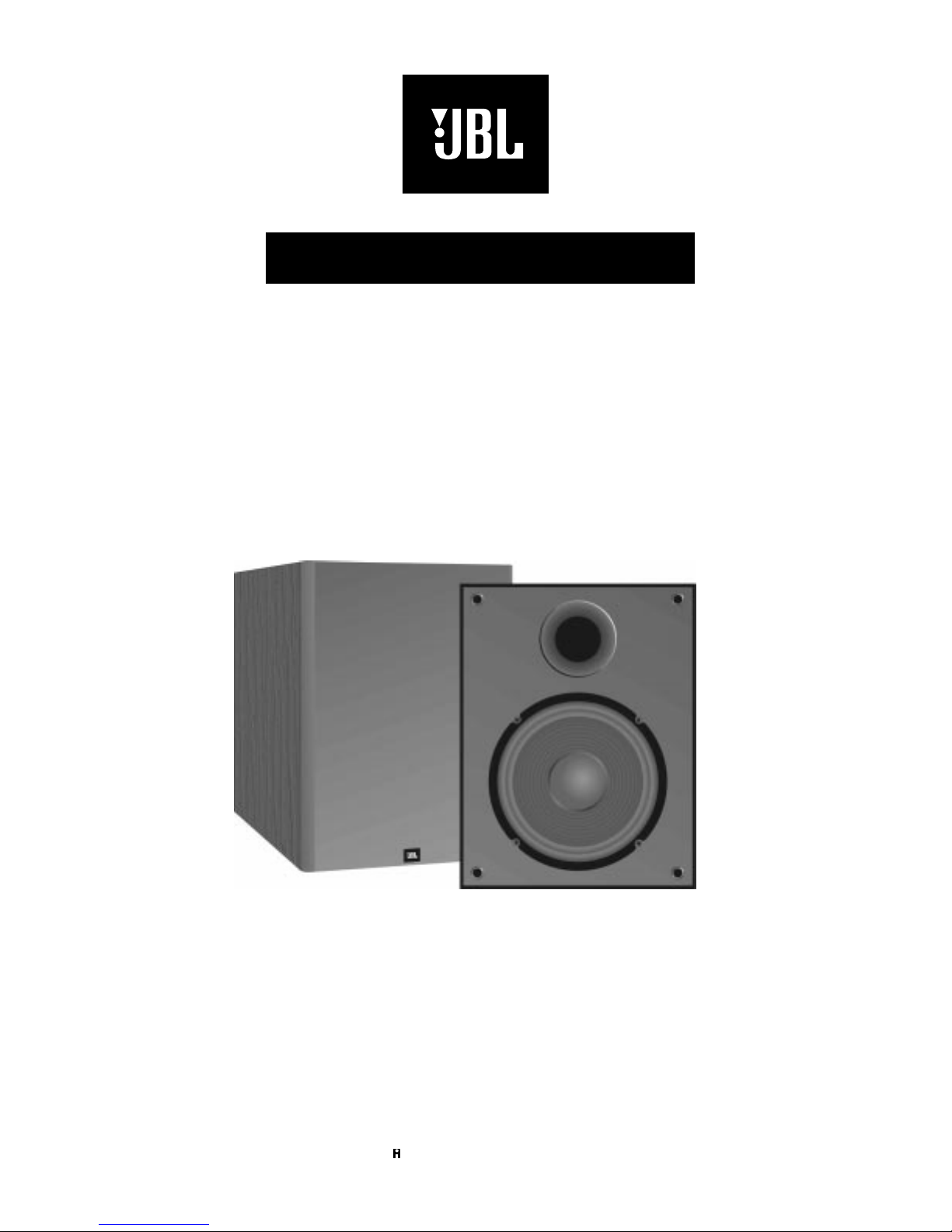
TLX PS12
Discrete Output, High Current
12" Powered Subwoofer
1
Powered Subwoofer TLX PS12
TABLE OF CONTENTS
Specifications .................................................................1
Warranty .........................................................................2
Safety Symbols ..............................................................2
Controls and Their Functions.........................................3
Test Procedure...............................................................4
Trouble Shooting Before pening .................................5
Removing the Amplifier..................................................5
Trouble Shooting After Removal ...................................5
Components Requiring Exact Replacement..................6
Block Diagram ................................................................7
Amplifier Exploded View ................................................8
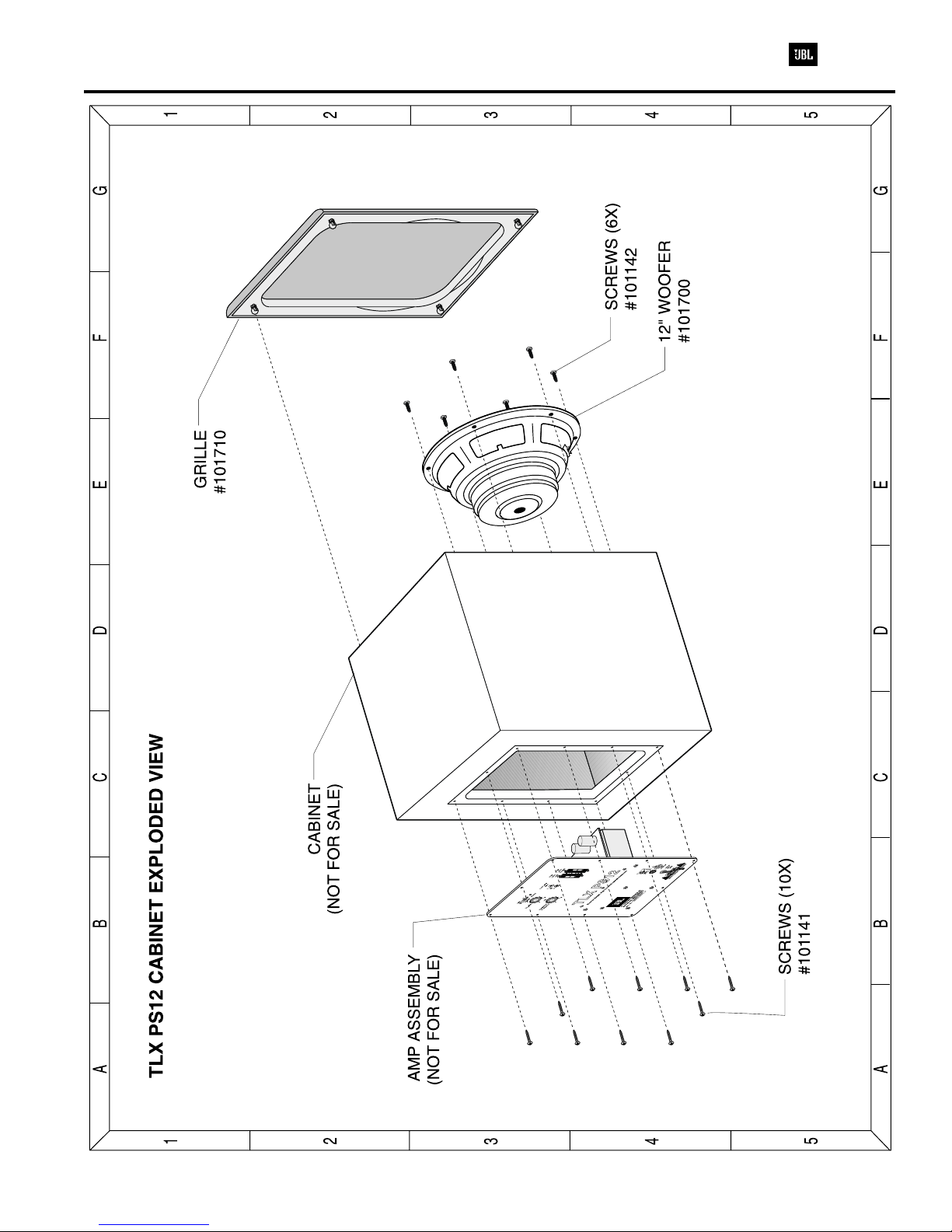
Cabinet Exploded View..................................................9
Parts Lists.....................................................................10
Packaging and Shipping ..............................................12
Integrated Circuit Diagrams .........................................13
Printed Circuit Boards .................................................14
Schematic Diagrams ...................................................16
SPECIFICATIONS
Amplifier Power RMS ...........120Watts
Drivers ................12"with high-polymer-laminated cones
Inputs ................Line level and Speaker Level
utputs* ...............High level with High-Pass filter at 180Hz
Crossover Frequency ...........50-150Hz
(continuosly variable)
Frequency Response ...........23Hz to (50-150Hz)
(-6dB)
External Dimensions (Inches)
Height ................193/4"
Width ................15"
Depth ................163/4"
Weight ................43lbs
Shipping Weight .............49lbs
External Dimensions (mm)
Height ................502mm
Width ................381mm
Depth ................426mm
Weight ................19.5 kg
Shipping Weight .............22.3 kg
* High-Level (speaker) outputs are active only if high-level input are used.
ccasional refinements may be made to existing products without notice, but will always
meet or exceed original specifications unless otherwise stated.
2
Powered Subwoofer TLX PS12
WARRANTY
This amplifier is warranted against defects in material
and workmanship for a period of one year from date of
shipment, when installed in accordance with the owners
manual in a clean, dry, interior home environment. THIS
AMPLIFIER IS NOT SUITABLE FOR OPERATION
OUTSIDE OR IN HARSH ENVIRONMENTS. During the
warranty period, the manufacturer will, at its option, either
repair of replace products which prove to be defective.
For warranty service or repair, this product must be
properly packed and returned to a service facility
designated by the manufacturer. Buyer shall prepay
shipping charges to the designated facility and the
manufacturer shall pay shipping charges to return the
product to buyer. However, Buyer shall pay all shipping
charges, duties and taxes for products returned to the
manufacturer from another country.
The manufacturer does not warrant that the operation of
the product will be uninterrupted or error-free. The Buyer
must determine the suitability of the product for his or her
purposes.
LIMITATION OF WARRANTY
The foregoing warranty shall not apply to defects
resulting from improper or inadequate maintenance by
Buyer, Buyer-supplied interfacing, unauthorized
modification or misuse, operation outside of the
environment specifications for the product including
inadequate ventilation, or improper site preparation,
installation, or maintenance.
NO OTHER WARRANTY IS EXPRESSED OR
IMPLIED. THE MANUFACTURER SPECIFICALLY
DISCLAIMS THE IMPLIED WARRANTIES OF
MERCHANTABILITYAND FITNESS FOR A PARTICULAR
PURPOSE.
EXCLUSIVE REMEDIES
THE REMEDIES PROVIDED HEREIN ARE BUYERS
SOLE AND EXCLUSIVE REMEDIES. THE
MANUFACTURER SHALL NOT BE LIABLE FOR ANY
DIRECT, INDIRECT, SPECIAL, INCIDENTAL, OR
CONSEQUENTIAL DAMAGES, WHETHER BASED ON
CONTRACT, TORT, OR ANY OTHER LEGAL THEORY.
SAFETY SYMBOLS
The following symbols are used throughout this manual
and in the product. Familiarize yourself with each of the
symbols and its meaning before servicing this amplifier.
Instruction manual symbol. The product will be
marked with this symbol when it is necessary for
the user to refer to the instruction manual in order
to protect the unit against damage.
Indicates dangerous voltages are present. Be
extremely careful.
The
CAUTION
sign denotes a
hazard. It calls attention to a
procedure which, if not correctly
performed or adhered to, could result in damage to or
destruction of the amplifier. Do not proceed beyond a
CAUTION
sign until the indicated conditions are fully
understood and met.
The
WARNING
sign denotes a
hazard. It calls attention to a
procedure which, if not correctly
performed or adhered to could
result in injury or loss of life. Do not proceed beyond a
WARNING
sign until the indicated conditions are fully
understood and met.
GENERAL SAFETY CONSIDERATIONS
THIS UNIT DOES NOT HAVE A POWER SWITCH;
HAZARDOUS VOLTAGES ARE PRESENT WITHIN THE
UNIT WHENEVER IT IS PLUGGED IN.
This still applies
when the over-temperature thermostat opens, as it may
automatically reset at any time.
There are voltages and hot components at many points
in the amplifier which can, if contacted, cause serious injury.
Be extremely careful. Any adjustments or service
procedures that require operation of the amplifier out of its
enclosure should be performed only by trained service
personnel.

3
Powered Subwoofer TLX PS12
CONTROLS AND T EIR FUNCTION
1. Output Level - The utput Level adjustment
determines volume level strength.
2. Crossover Frequency - The Crossover Frequency
adjustment determines the highest frequency the
TLX PS10 will reproduce. It allows a seamless
transition from the subwoofer to the satellite
speakers.
3. On (LED) - This LED will light green when the unit is
plugged in and is receiving signal. When in
standby mode the LED is red.
4. Low Level Input - These left and right Line Level
Inputs are normally used when the receiver/
processor has line-level “pre-amp out” or subwoofer
out” jacks.
5. Phase Switch - The Phase switch is used to adjust
the relative polarity of the subwoofer. Normally
this switch is set to “0”.
6. igh Level Inputs - These High Level Inputs are for
receivers that don’t have line-level “pre-amp out” or
“subwoofer out” jacks. When a pair of main or
satellite speakers are attached to the UTPUT
terminals, frequencies below 180 Hz are attenuated
by the high-pass filter.
7. Fuse - Use only a slow-blo 2.0A 250V GMC fuse.
4
Powered Subwoofer TLX PS12
TEST PROCEDURES
General Function
UUT = Unit Under Test
1. Connect both right and left line level inputs (RCA) to signal generator and UUT. Use Y-cable if necessary from
mono source. V LUME control should be full counterclockwise.
2. Turn on generator, adjust to 50mV, 50 z.
3. Plug in UUT; red LED should be N. Turn V LUME control full clockwise.
4. LED should turn Green; immediate bass response should be heard and felt from port tube opening.
5. Turn off generator, turn V LUME control fully counterclockwise, disconnect RCA cables.
6. Connect one pair of speaker cables to either high level input terminal on UUT. Cables should be connected to
an integrated amplifier fed by the signal generator.
7. Turn on generator and adjust so that speaker level output is 2.0V, 50 z. Turn V LUME control full clockwise.
8. Green LED should light, immediate bass response should be heard and felt from the port tube opening.
Sweep Function
1. Follow steps 1-4 above, using a sweep generator as a signal source.
2. Sweep generator from 20 z to 300 z. Listen to the cabinet and drivers for any rattles, clicks, buzzes or any
other noises. If any unusual noises are heard, remove driver and test.
Driver Function
1. Remove driver from cabinet; detach + and - wire clips.
2. Check DC resistance of driver; it should be 3.3 ohms.
3. Connect a pair of speaker cables to driver terminals. Cables should be connected to an integrated amplifier fed by
a signal generator. Turn on generator and adjust so that speaker level output is 5.0V.
4. Sweep generator from 20 z to 1k z. Listen to driver for any rubbing, buzzing, or other unusual noises.
5
Powered Subwoofer TLX PS12
1. TROUBLE S OOTING BEFORE OPENING
Check connections, control settings, driver and other
possible external problems. If there is utput, determine if
all controls and Inputs function properly. Rotate Pots over
full range while applying lateral and vertical oscillating
forces to locate possible intermittent function. High Level
Inputs should be tested individually both differentially
(signal from "-" to "+" with normal output) and in common
mode (signal from low level ground to both "+" and "-"
shorted together, giving virtually no output). While passing
a signal, corner drop the enclosure a few inches to expose
possible intermittent problems. Check woofer for rubbing of
voice coil or tears in cone or surround. Check cabinet for
loose extraneous articles which may have been pushed
into front port.
2. REMOVING T E AMPLIFIER.
There are voltages and hot components at many points
in the amplifier which can, if contacted, cause personal
injury. Be extremely careful. Any adjustments or service
procedures that require operation of the amplifier out of its
enclosure should be performed only by trained service
personnel. Refer to PCB drawings for locations of hazards
and familiarize yourself with their locations before starting.
3. TROUBLE S OOTING AFTER REMOVAL
Verify AC plug is disconnected See WARNINGS in
section 2.
To prevent loose hardware from reducing safety
spacings, it is essential that all hardware be replaced in the
same manner as it was removed, with lock washers under
all nuts, proper torque on screws and thread locking sealer
on the transformer nuts.
If line core, its strain relief, or the AC switch are
replaced, it is necessary to seal them completely to panel
with an approved conformal coating to prevent air
"whistling" through any openings from woofer pressure.
To reduce the risk or electric shock and/or
fire, replace items as marked on schematic
with the safety marking only with the exact
replacements listed in the safety component
list, section 5. If exact replacements are not available,
order them from the factory or an authorized service center.
A.) Check fuse F1. If blown visually check transformer
for discoloration, and large capacitors (C36, C37) for
bulges or venting. Check for shorts in Q3-Q7 with
an hmmeter, (see schematic).
B. With ohmmeter, verify contacts of thermostat are
closed, voice coil of woofer is 3.3 ohms, and
windings of transformer are continuous.
C. Examine board and wiring for obvious damage,
broken or poorly soldered connections, or
discoloration.
D. Repair or replace items identified above. Procedures
for replacing power transistors and removing PCB
are as follows:
Use low power, grounded temperature regulated iron
with small tip such as Weller PTA7 and ESD control.
Use SN63/37 solder 0.032" diameter with "no clean"
flux core, Alpha Metals P2 or equal.
I) Replacing power transistors: Clip all 3 leads
near body of transistor. Remove screw and
discard device (keep hardware and insulator).
Holding each lead in turn with needle nose
BEF RE THIS AMPLIFIER IS PLUGGED IN, make sure its rated voltage corresponds to the voltage of the AC power
source to be employed. Failure to use the correct voltage could cause damage to the amplifier when the AC power cable is
plugged in. Do not exceed the rated voltage by more than 10%; operation below 90% will degrade performance or cause the
unit to shut off.
6
Powered Subwoofer TLX PS12
pliers, gently heat and remove cut lead from
hole in edge or PCB.
Clean insulator and seating area on back of
panel. Coat both sides of insulator with silicon
(white) thermal compound (unless silicone
rubber pads are provided), position it centered
on back of device with holes aligned. Insert
leads into PCB then place pair over hole in
panel; ensure hole in insulator is aligned. Insert
screw from far side, pass shoulder bushing over
screw and carefully seat shoulder in hole in tab,
add flat washer, lock washer and nut (finger
tight). Center insulator tighten screw first then
solder all three leads in respective slots with full
fillet, being careful not to bridge pads. Use
ohmmeter to verify there is no short from tab of
transistor to panel, or between pads.
Never operate amplifier with load connected
when PC assembly is not attached to panel or
when any of output transistors is not properly
screwed to panel.

After repair, inspect for possible safety hazards,
including loose hardware, missing lock washers, correct
fuse and lead dress of primary wires (these must be held in
position with cable ties so that they cannot touch secondary
components). With ohmmeter, check that panel is
connected to signal ground.
It is essential that the following safety insulation test be
performed prior to returning the Power Sub-Woofer to the
customer, using one of the following methods:
A) Insulation Resistance Test
With a 500VDC Insulation Tester, Check
insulation from the outer metal contact of the
RCA jack (chassis) to the line neutral of AC
cord. Resistance should be >100MΩ.
B) i-Pot Test
If a UL approved Hi-Pot tester is available, test
line & neutral of AC cord to outer shell of RCA
jack (chassis) at 1100VAC for 2 seconds.
bserve all of instrument manufacturer's
instructions and safety warnings in performing
this test.
Connect sub-woofer system to a music source. Play at
high level while checking for air leaks around panel edge,
driver, panel jacks and controls, and voice coil problems
such as rubbing or loose turns. With the crossover
"frequency" set to 50Hz, very little of the voice content
should be heard.
4. LIST OF SAFETY COMPONENTS
REQUIRING EXACT REPLACEMENTS
F1 Fuse SL W BL 2.0A 250v GMC 20mm
UL approved.
FH Fuse holder. Use only factory
replacement.
PWR C RD SPT-2 better with polarized plug,
UL appoved wired with the hot side
to fused side. Use with UL approved
panel strain relief only.
XF transformer. use only factory
replacement.
BD1 Bridge diode. Use only factory
replacement.
C36, 37 6800uF, 63V electronic filter caps.
Be sure replacement part is at least the
same working voltage and capacitance
rating. Also the lead spacing is
important. Incorrect spacing may
cause premature failure due to internal
cabinet pressures and vibration.
K1 Safe operating area relay to protect
output devices. Use only factory
replacement.
R64 5.6Ω.5W METAL FILM, non flammable.
7
Powered Subwoofer TLX PS12
TLX PS12 AMPLIFIER BLOCK DIAGRAM
8
Powered Subwoofer TLX PS12
AMPLIFIER EXPLODED VIEW
9
Powered Subwoofer TLX PS12
CABINET EXPLODED VIEW