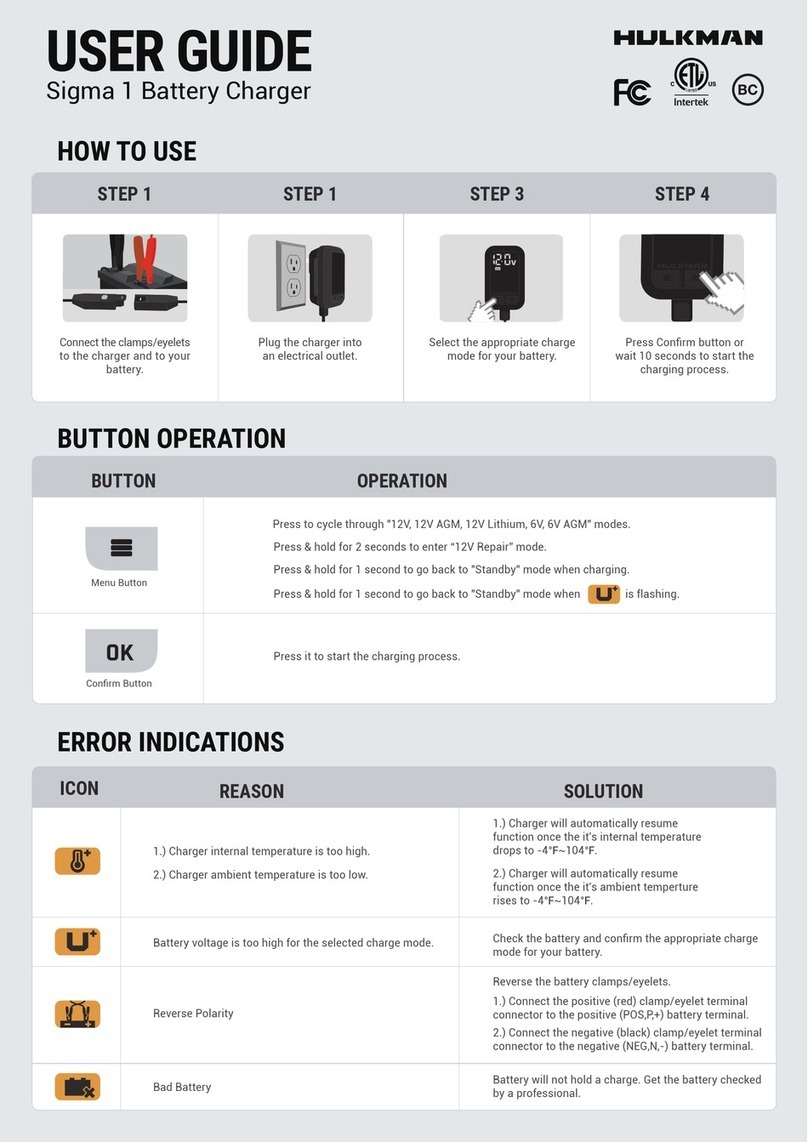
JP EnErG Lipro Quad 6 User manual

Instruction Manual
V10.09

Warranty
J. Perkins Distribution Ltd. guarantee this product to be free of
manufacturing or assembly defects for a period of one year from
time of purchase. This does not affect your statutory rights. This
warranty is not valid for any damage or subsequent damage
arising as a result of a misuse, modification or for damage or
consequential damage arising as a result of failure to observe the
procedures outlined in this manual. Operation of this product is
carried out entirely at the risk of the operator. Please note that,
whilst every effort is made to ensure the accuracy of instructions
and material included with this product, mistakes can occur and
neither J. Perkins Distribution Ltd nor it’s distributors will be held
liable for any loss or damage arising from the use of this product
or for any loss or damage arising from omissions or inaccuracies
in the associated instructions or materials included with this
product.
We reserve the right to modify the design of this product,
contents and manuals without prior notification.
© 2009 J Perkins Distribution Ltd, Lenham, Kent, UK ME17 2DL.
www.jperkinsdistribution.co.uk
EU rEgUlations
J Perkins Distribution Ltd declares that this product is in
compliance with the essential requirements and other relevant
provisions of Directive 2204/108 EC on Electromagnetic
Compatibility. A copy of the declaration(s) of conformity can be
obtained from J Perkins Distribution Ltd, Ashford rd, Lenham,
Kent. UK ME17 2DL. This system complies with the EU directive
on Waste Electrical and Electronic Equipment. Do not dispose of
this product in household waste. At the end of the products’ life,
dispose of it at a designated collection point for the recycling of
waste electrical and electronic equipment.
Please contact your supplier for any advice required on disposal.
Contents
Introduction ...................................................................... 1
Specifications .................................................................. 1
Box Contents .................................................................... 1
Controls ............................................................................. 2
Power supply.................................................................... 2
Special features............................................................... 3
Optimized operating software .................................... 3
Internal independent lithium battery balancer ........ 3
Balancing individual cells battery discharging ....... 3
Adaptable to various types of lithium battery .......... 3
Fast and storage mode of lithium battery ................. 3
Maximum safety ............................................................ 3
Automatic charging current limit ............................... 3
Capacity limit ................................................................. 3
Processing time limit .................................................... 3
Data store/load .............................................................. 4
Cyclic charging/discharging ....................................... 4
Temperature threshold* .............................................. 4
PC based analysis using USB Communication** .... 4
Warning and safety notes .............................................. 5
Charging ......................................................................... 6
Discharging .................................................................... 6
Operating parameters ..................................................... 7
Main menu ........................................................................ 8
Selecting a Program ..................................................... 8
Power supply and final safety checks ........................ 9
Power Supply ................................................................ 9
Final checks before connecting the battery ............ 9
User set program option ............................................... 10
Safe timer Calculation ................................................ 11
Charge & Discharge Programs ................................... 12
Lithium charge program ............................................ 12
Lithium Balance charge program ............................ 14
Viewing the Voltage of Individual Cells ................... 14
Lithium fast charging .................................................. 15
Lithium Storage charging .......................................... 16
Lithium Discharging Program ................................... 17
NiMH and NiCd Charge programs ........................... 18
NiMH and NiCd Discharge programs ...................... 19
NiMH and NiCd Cycle Charge programs ................ 20
Gel cell (pb, lead acid) charge program ................. 21
Gel cell (pb, lead acid) discharge program ............ 22
Save Data Program........................................................ 23
Load Data Program ........................................................ 24
Viewing Extra Charge/Discharge Data ..................... 24
Viewing the “User Set Program” Settings ............. 24
Monitoring the Voltage of Individual Cells ............. 24
Warnings and Error Messages ................................... 25

1
www.jperkinsdistribution.co.uk
IntroductIon
Thank you for purchasing the JP EnErG LiPro Quad 6 balancer charger. This product is a compact
charger with battery management and integral balancer. The unit is simple to use, but the operation
of a sophisticated automatic charger such as the LiPro Quad 6 does require some knowledge on
the part of the user. These operating instructions are designed to ensure that you quickly become
familiar with its functions. It is therefore important that you read right through the Instruction manual
and Warning and Safety Notes before you attempt to use your new automatic charger for the first
time.
The LiPro Quad 6 employs the circuit that features four totally independent but identical power
outputs which are powered 50 watts each. Total power is 200 watts. As a result, it can charge or
discharge up to 4 x 15 cells of NiCd/NiMH or 4 x 6 series of Lithium batteries simultaneously. LiPro
Quad 6 has four individual cell voltage balancers at each output, so it does not required a separate
balancer when charging Lithium batteries (LiPo/LiIon/LiFe) for voltage balancing.
The twin-fan cooling system is so smart and efficient. The fan speed is controlled by internal
temperature sensor.
The following instructions apply to one of the four chargers, as all of them operate according to same
principle. Please BE SURE to read these instructions and Warning and Safety Notes before you use
the charger for the first time.
It can be dangerous to mishandle batteries and battery chargers, as there is always a risk of batteries
catching fire and exploding.
SpecIfIcatIonS
Operating voltage range: 11.0-15.0V
Circuit power: max. 50W (current is regulated accordingly)
Charge current range: 0.1 - 5.0A
Current drain for balancing Lithium: 300mAh/cell
NiCd/NiMH battery cell count: 1-15 cells
Lithium battery cell count: 1-6 cells
Gel cell battery voltage: 2-20V
Weight: 1.09Kg
Dimensions: 226 x 159 x 63 mm
Box contentS
1.
2.
3.
4.
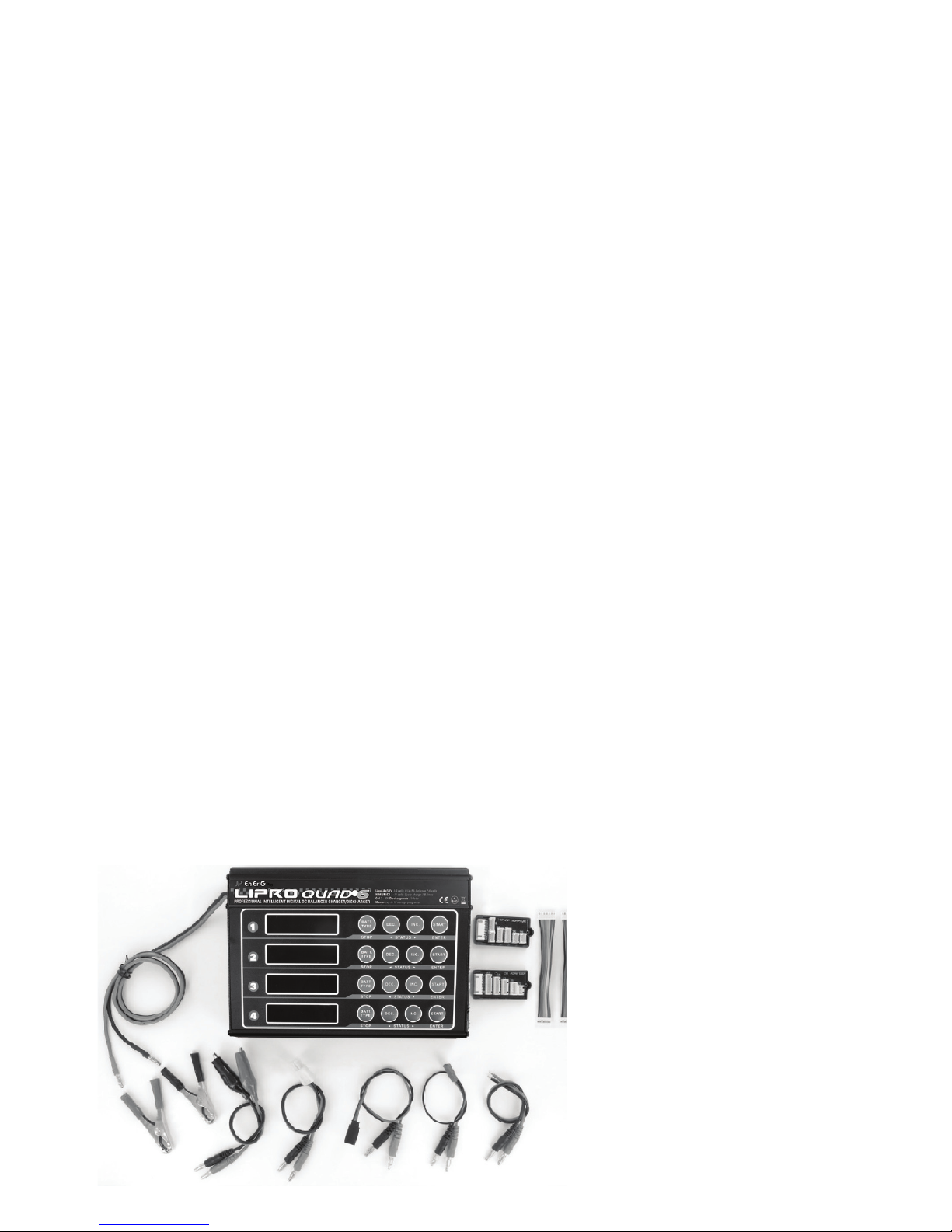
5. 6. 7. 8. 9.
1. LiPro Quad 6
2. Large crocodile clips
3. TP/FP balance board adapter
4. XH balance board adapter
5. Crocodile clip charging cable
6. Tamiya style charging cable
7. Futaba style charging cable
8. JST/BEC charging cable
9. 18AWG wire charging cable

2www.jperkinsdistribution.co.uk
controlS
power Supply
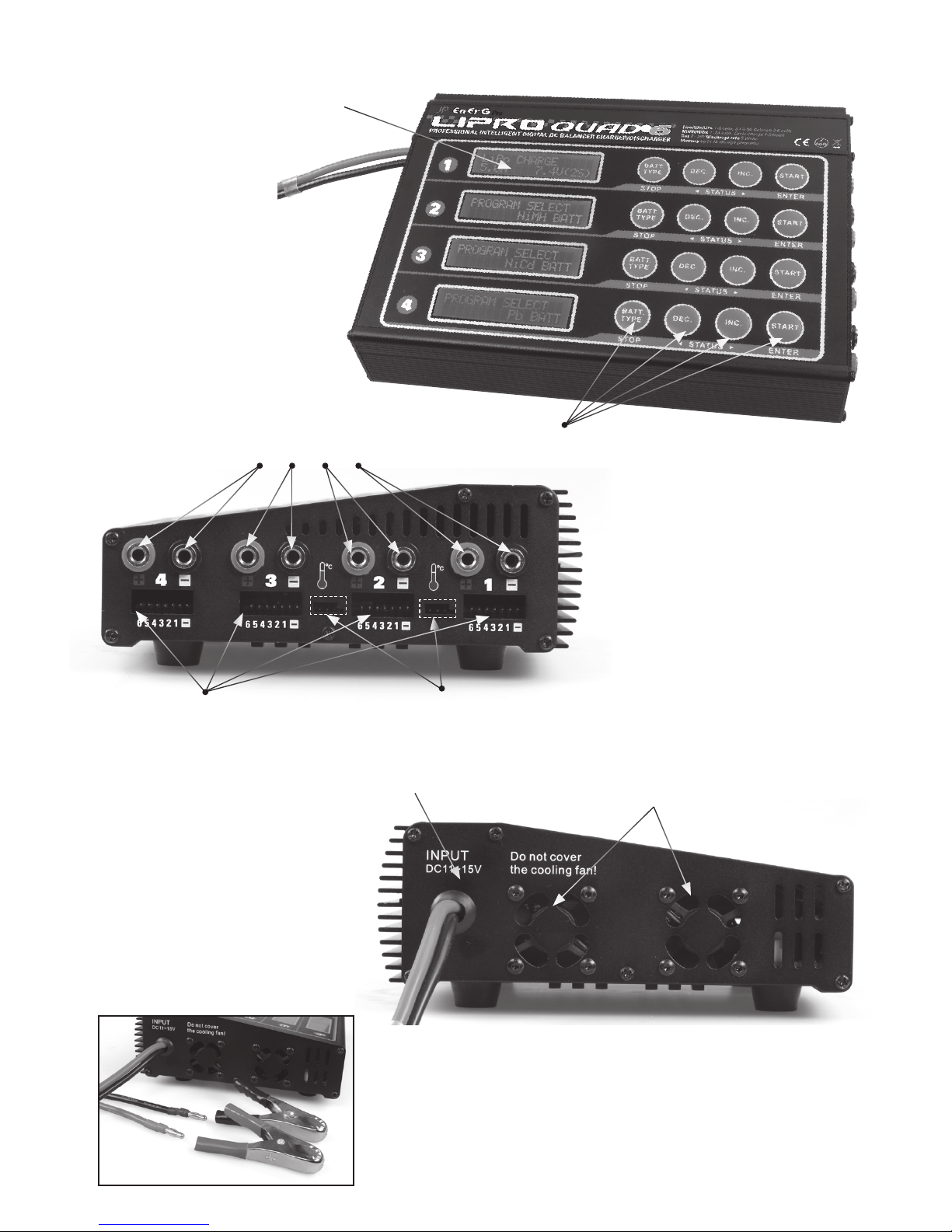
The LiPro Quad 6 comes with 4mm
connectors and crocodile clips for
direct 11-15V DC battery connection.
LCD Screen
Menu control buttons
INPUT 11-15V Twin ventilation fan
with temperature sensor control
Battery sockets
Universal balancing port Temp sensor/PC link
Available for Charger 1 and 2 only

3
www.jperkinsdistribution.co.uk
SpecIal featureS
LiPro Quad 6 allows you to plug 4 batteries into one charger simultaneously, and it will intelligently
and automatically charge all 4 of them at once to their maximum capacity. To top it off, the batteries
being charged do not even need to have the same configuration. You can connect different chemistry
Ni-MH/Ni-CD/LiPo/LiFe batteries into any of the charging ports. No more staying up late for charging
batteries!
OPTIMIZED OPERATING SOFTWARE
LiPro Quad 6 features an AUTO function that sets the feeding current during the process of charging
or discharging. Especially for Lithium batteries, it can prevent overcharging which may lead to an
explosion due to the user’s fault. It can disconnect the circuit automatically and alert the user once
a malfunction is detected. All the programs of this product are controlled through two way linkage
and communication, to achieve the maximum safety and minimize the trouble. All the settings can be
configured by users!
INTERNAL INDEPENDENT LITHIUM BATTERY BALANCER
LiPro Quad 6 features an individual-cell-voltage balancer. It isn’t necessary to connect an external
balancer for balance charging.
BALANCING INDIVIDUAL CELLS BATTERY DISCHARGING
During the process of discharging, the LiPro Quad 6 can monitor and balance each cell of the battery
individually. An error message will be shown and the process will be ended automatically if the
voltage of any single cell is abnormal.
ADAPTABLE TO VARIOUS TYPES OF LITHIUM BATTERY
LiPro Quad 6 is adaptable to various types of Lithium batteries, such as Li-ion, LiPo and the new LiFe
series of batteries.
FAST AND STORAGE MODE OF LITHIUM BATTERY
Lithium battery charge purposes can vary, so you have the option to choose between fast charge
and store charge method. ‘fast’ charge reduces the duration of charging, whereas ‘store’ state
can control the final voltage of your battery, so it can be stored for a period of time and protect the
lifespan of the battery.
MAXIMUM SAFETY
Delta-peak sensitivity: The automatic charge termination program based on the principle of the
Delta-peak voltage detection. When the battery’s voltage exceeds the threshold, the process will be
terminated automatically.
AUTOMATIC CHARGING CURRENT LIMIT
You can set up the upper limit of the charging current when charging your NiCd or NiMH battery; it is
useful for the NiMH battery of low impedance and capacity in the ‘AUTO’ charging mode.
CAPACITY LIMIT
The charging capacity is always calculated as the charging current multiplied by time. If the charging
capacity exceeds the limit, the process will be terminated automatically when you set the maximum
value.
PROCESSING TIME LIMIT
You can also limit the maximum process time to avoid any possible defect.

4www.jperkinsdistribution.co.uk
DATA STORE/LOAD
Five batteries’ data can be stored per charger (20 in total on the LiPro Quad 6). This means you can
store settings for particular batteries charge and discharge often. This data can be loaded at any
time to avoid the need to set program settings every time.
CYCLIC CHARGING/DISCHARGING
1 to 5 cyclic and continuous process of charge>discharge or discharge>charge is operable for
battery refreshing and balancing to stimulate the battery’s activity.
TEMPERATURE THRESHOLD*
The battery’s internal chemical reaction will cause the temperature of the battery to rise. If the
temperature limit is reached, the process will be terminated.
* This function is available by connecting optional temperature probe, which is not included in the
package.
PC BASED ANALYSIS USING USB COMMUNICATION**
LiPro Quad 6 PC based program can analysis the characteristic of the battery via USB port. It shows
a graph of voltage, current, capacity curves. It also shows the individual voltage of each cell in the
Lithium battery pack.
**This function is available by connecting optional PC-LINK USB adaptor, which is not included in the
package.

5
www.jperkinsdistribution.co.uk
warnIng and Safety noteS
These warnings and safety notes are particularly important. Please follow the
instructions for maximum safety; otherwise the charger and the battery can be damaged
or at worst it can cause a fire.
Never leave the charger unsupervised when it is connected to a power supply. If any
malfunction is observed immediately terminate the process and refer to the operation manual.
Keep the unit away from dust, damp, rain, heat, direct sunshine and vibration. Do not drop it.
The circuit of the unit is designed to be powered by an 11-15V power source.
This unit and the battery to charge or discharge should be set up on a heat-resistant,
noninflammable and non-conductive surface. Never place them on a car seat, carpet or similar
surface.
Never use this charger inside a car, van or any other motor vehicle.
Do not cover or close the cooling vent.
Keep all inflammable volatile materials well away from the chargers operating area.
Never charge batteries fitted inside models, always remove them before charging.
Make sure you know the specifications of the battery to be charged or discharged to ensure
it meets the requirements of this charger. If the program is set up incorrectly the battery and
charger may be damaged.
To avoid short-circuits between the charge lead always connect the charge cable to the
charger first, then connect the battery. Reverse the sequence when disconnecting.
Do not connect more than one battery pack to this charger at any one time.
Do not attempt to charge or discharge the following types of battery.
A battery pack which consists of different types of cell (including different
manufacturers)
A battery that is already fully charged or just slightly discharged.
Non-rechargeable batteries (Explosion hazard).
Batteries that require a different charge technique from NiCd, NiMH, LiIo, Li-Poly,
LiFe or Gel cell (Pb, Lead acid).
A faulty or damaged battery.
A battery fitted with an integral charge circuit or a protection circuit.
Batteries installed in a device or which are electrically linked to other components.
Batteries that are not expressly stated by the manufacturer to be suitable for the
currents the charger delivers during the charge process.

6www.jperkinsdistribution.co.uk
CHARGING
A specific quantity of electrical energy is fed into the battery during the charge process. The charge
quantity is calculated by multiplying charge current by charge time. The maximum permissible
charge current varies according to the battery type and performance and can be found in the
information supplied by the battery manufacturer. Only charge batteries at a higher rate than the
standard charge rate if the battery is specifically stated to be capable of quick charge.
Only connect the battery to the output terminal of the charger using a suitable charge lead. They are
red, positive (+) and black, negative (-). Since the charger cannot detect the difference between the
internal resistances of the battery pack, cable resistance and connector transfer resistance, the first
requirement if the charger is to work properly, is that the charge lead should be made of adequate
conductor cross-section. The charge lead must also have high-quality connectors at both ends (gold
connector type).
Refer to the information provided by the battery manufacturer regarding charging methods and verify
the recommended charge current and charge time. Lithium battery packs require the specifications
to be followed strictly.
Do not attempt to disassemble the battery pack.
Lithium battery packs can be wired in parallel or series circuits. Make sure you know which way
your battery pack is wired and be aware of it’s capacity. In a parallel circuit the capacity of the pack
is multiplied by the number of cells but the voltage stays the same. This kind of voltage imbalance
can cause fire or explosion during the charge process, therefore we recommend you only use Lithium
battery packs in series only.
DISCHARGING
The typical purpose of discharge is to determine the residual capacity of the battery or to lower the
voltage to a defined level. When you discharge a battery as much attention should be applied to the
process as if you were charging the battery. To avoid the battery becoming over discharged set the
final discharge voltage correctly. Lithium batteries should not be over discharged lower than the
minimum voltage as this leads to rapid loss of capacity or total failure. Generally you do not need to
discharge lithium battery packs voluntarily.
NiCd and NiMH rechargeable batteries are said to have a “memory effect”. If they are partially used
and recharged before the whole charge is drawn out, they “remember” this and next time will only
use that part of their capacity. For this reason they prefer complete cycles, fully charge then use until
they are empty.
Lithium batteries prefer a partial recharge, frequent discharges should be avoided if possible, instead
charge the battery more often.
Brand new NiCd packs do not perform to full capacity until they have been subjected to 10 or more
charge cycles. The cyclic process of charge-discharge will be useful in this case.

7
www.jperkinsdistribution.co.uk
operatIng parameterS
NiCd/NiMH
Voltage level: 1.2V/cell
Allowable fast charge current: 1-2C (depending on the performance of the cell)
Discharge voltage cut off level: NiCd: 0.85V/cell
NiMH: 1.0V/cell
LiIo
Voltage level: 3.6V/cell
Max charge voltage: 4.1V
Allowable fast charge current: 1C or less
Min. discharge voltage cut off level: 2.5V/cell or higher
LiPo
Voltage level: 3.7V/cell
Max charge voltage: 4.2V
Allowable fast charge current: 1C or less
Discharge voltage cut off level: 3.0V/cell or higher
LiFe
Voltage level: 3.3V/cell
Max charge voltage: 3.6V
Allowable fast charge current: 4C or less
Discharge voltage cut off level: 2.0V/cell or higher
Gel Cell (Pb, Lead Acid)
Voltage level: 2V/cell
Max charge voltage: 2.46V
Allowable fast charge current: 0.4C or less
Discharge voltage cut off level: 1.75V/cell or higher
NOTE: This charger has a maximum output of 50 watts. You can determine the maximum
available current (A) by dividing 50 (W) by the battery pack voltage (V). W/V = A.
The maximum safe charge current that can be set is determined by the type of cells and
the manufacturers recommendation. This is often 1C (1 x capacity of cells) for LiPo and
NiMH batteries.

8www.jperkinsdistribution.co.uk
maIn menu
Please bear in mind the following points before commencing charging:
Did you select the appropriate program suitable for the type of battery you will be charging?
Did you set up correct current for charging or discharging?
Have you checked the type of battery you are charging, i.e. LiPo, NiMH, NiCd, Gel?
Have you checked the battery voltage? Lithium battery packs can be wired in parallel and in
series, i.e. a 2 cell pack can be 3.7V (in parallel) or 7.4V (in series).
Have you checked that all connections are firm and safe? Make sure there are no intermittent
contacts at any point in the circuit.
SELECTING A PROGRAM
By pressing the “Batt Type/Stop” button repeatedly the main menu will scroll through the different
charge program options and the user settings option.
To select an option from the main menu press the “Start/Enter” button.
Page 10Page 12
Page 18
Page 18 Page 23
Page 24
PROGRAM SELECT
Pb BATT
Page 21
PROGRAM SELECT
SAVE DATA
PROGRAM SELECT
NiCd BATT
PROGRAM SELECT
LiXX BATT
USER SET
PROGRAM
PROGRAM SELECT
LOAD DATA
PROGRAM SELECT
NiMH BATT
Table of contents