Dewert User Manual 2800XL and 4000E Series –Updated 03.2023/4 MDR Page 7 of 18
lifted slowly to the positive end position. To lower, press down the head part and operate the release lever at
the same time. Once the desired position has been reached, let go of the release lever.
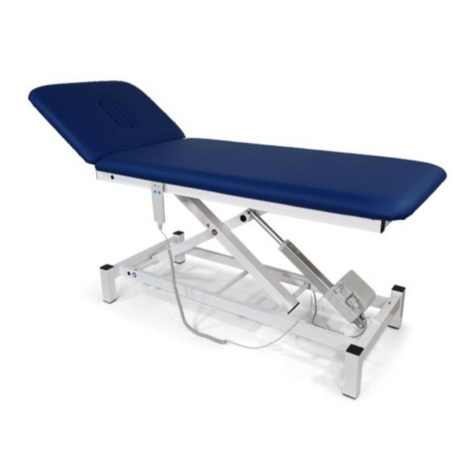
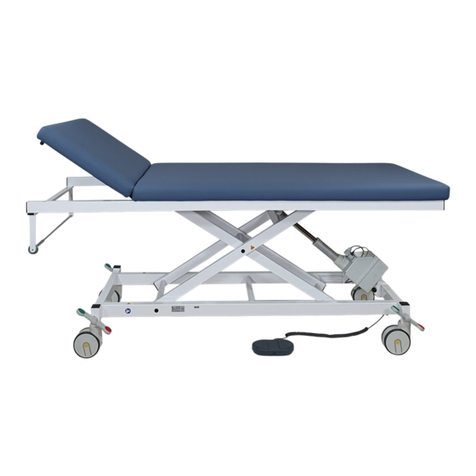
Head part adjustment using ratchets
Head part adjustment is enabled by two metal ratchets. Grasp the top of the head part in the centre and lift it
up to the desired inclination, the ratchets engage automatically. To lower the head part, lift it up as far as it will
go, the ratchets thus disengage. Subsequently lower the head part to the bottom end position.
Head part adjustment using an electric motor (optional)
The head part is adjusted using a separate electric motor. By operating the hand switch, the inclination of the
head part can be varied steplessly and adjusted according to your needs. Please observe section 7 “Safety
devices” (double-tap). Depending on the respective design, the motor is equipped with a freewheeling device.
As a result, the motor declutches automatically if an obstacle is encountered. Always observe: There must be
no persons in the adjustment range of the head part.
2.4 Adjustment of other sections
Despite their robust and strong design, the adjustable sections may only be used by the patient to
climb onto the table in a horizontal (non-adjusted) position. When inclined, the individual sections
must not be used for sitting.
Lying surface adjustment to the inclined position using a gas spring (model 2810XL/H)
Adjustment to the Trendelenburg position takes place using a gas spring. Grasp the push handle with your
hands. Then pull the release lever at the end of the foot part towards you. The lying surface (at the foot part)
is lifted slowly to the positive end position (= head down - feet up - inclined position). To lower, press down the
lying surface and operate the release lever at the same time. Once the desired position has been reached, let
go of the release lever. The strength of the gas spring ensures ease of adjustment to the inclined position
despite the patient’s weight. Consequently, when unloaded, more force is required to adjust the lying surface
horizontally again.
Lying surface adjustment to the inclined position using an electric motor (model 2910XLE)
The foot part is adjusted using a separate electric motor. By operating the hand switch, the inclination of the
foot part can be varied steplessly. Please note: The inclination adjustment of the foot part also influences the
inclination of the head part (as they are interconnected). With the head part in downwards adjustment
(negative position), at maximum inclination and when lowering the table at the same time to the lowest
position, attention must be paid to the head part. Should the head part come into contact with the floor, the
gas spring is automatically triggered and the head part is lifted in the positive direction. This is for emergency
use only and is associated with noise.
Always observe: There must be no persons in the adjustment range of the entire lying surface. Caution is
advised, especially with infusions. Please observe section 7 “Safety devices" (double-tap).
Foot part adjustment using a gas spring (models 2815XLE, 4815E, 2815XL/H)
The foot part is adjusted using a gas spring. To operate, press the release lever at the end of the foot part in
the direction of the upholstery.
The foot part is lifted slowly to the positive end position. To lower, press down the foot part upholstery and
operate the release lever at the same time. Once the desired position has been reached, let go of the release
lever.
The strength of the gas spring ensures ease of adjustment despite the patient’s weight. Consequently, when
unloaded, more force is required to adjust the foot part horizontally again.
Models 2820XLE and 2820XL/H:
In addition, the foot part is divided lengthwise; operation is carried out in the same way.
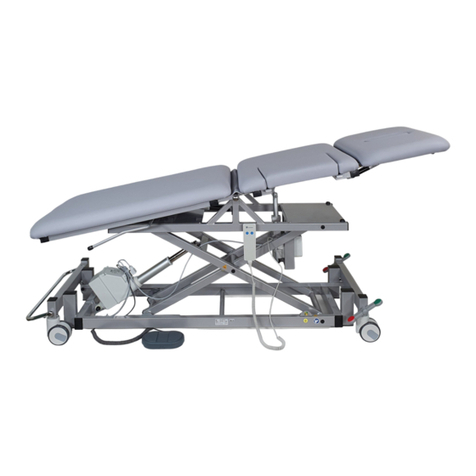
Middle part adjustment, so-called roof position
(only models 2830XLE, 2830XL/H up to 2880XLE, 2880XL/H)
Adjustment of the middle part is supported by two parallel gas springs. The upholstery segments may only be
adjusted to the roof position when not loaded by the patient’s weight. To adjust to the roof position, release
both rotary levers. To lower, push the middle part down or into the desired position and tighten one (!) rotary
lever when the desired position has been reached. Only one clamping lever may be used for locking at a time.
Model 4840E: Alternatively, the roof position can be steplessly adjusted directly using two gas springs. To
operate, press the release lever in the direction of the upholstery. The upholstery part is lifted slowly to the