8 of 71 IGB010.E8 – December 2020
2 GENERAL INFORMATION
2.1 Definitions, basic principles, terminology used and correlated documents
Point 3.1 of the UNI EN ISO 13349 standard defines a fan as “rotary-bladed machine which receives
mechanical energy and utilizes it by means of one or more impellers fitted with blades to maintain a
continuous flow of air or other gas passing through it and whose work per unit mass does not normally
exceed 25 kJ/kg.”
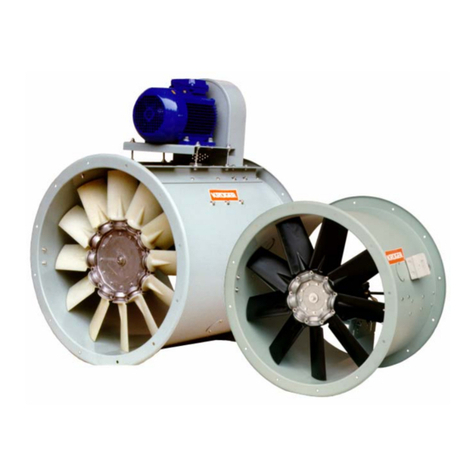
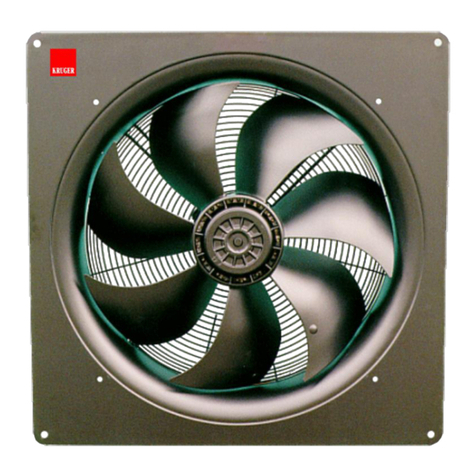
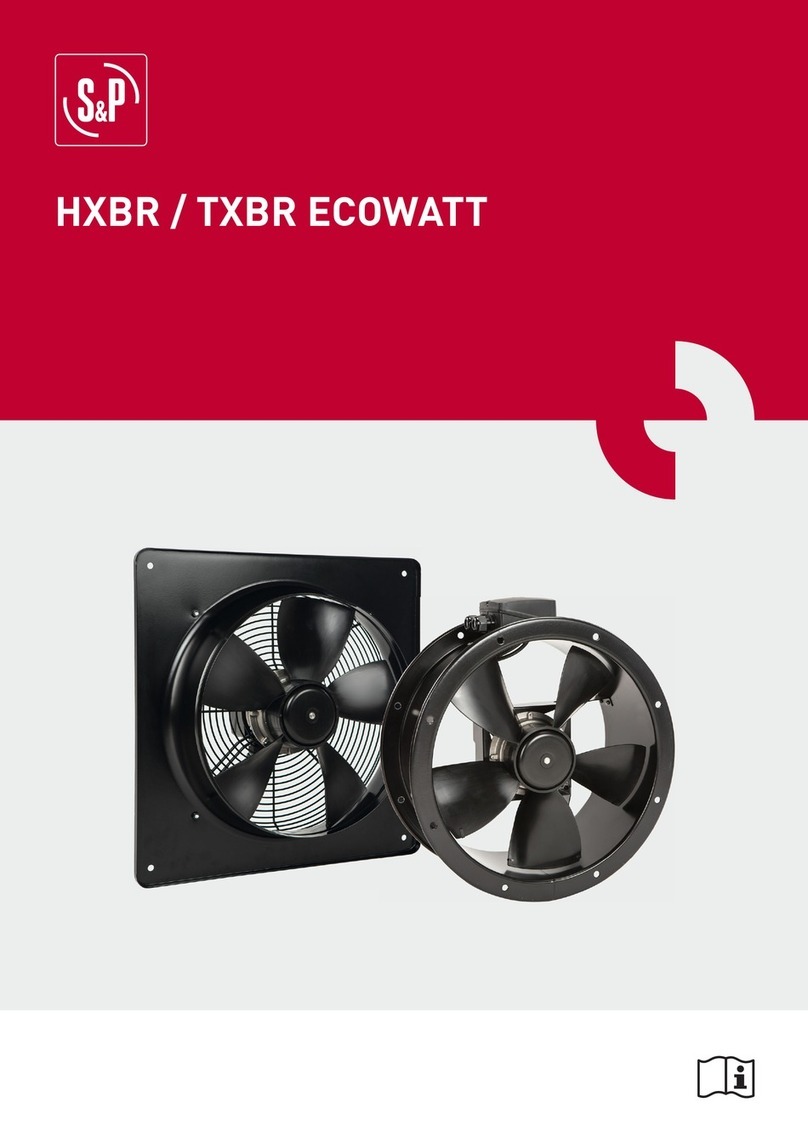
Point 3.6.1 of the UNI EN ISO 13349 standard defines an axial-flow fan as “a fan in which the air enters
and leaves the impeller along essentially cylindrical surfaces with the fan.”
The blades may have the following shapes: flat (obtained directly by pressing sheet steel) or more
frequently a wing profile (obtained with aluminium).
The fundamental dimensions that define a fan are as follows:
Volumetric flow: this is the volume of fluid passing through the fan in a certain period of time - one second
(m3/s), one minute (m3/min) or one hour (m3/h);
Static pressure: this is the energy imparted by the impeller to overcome the resistance offered by the
system to the passage of fluid (measured in mm of water column = mm w.c. or Pascal = Pa);
Dynamic pressure: this is the energy possessed by the fluid as a result of the speed imparted by the
impeller at the output opening of the fan (measured in mm w.c. or Pa);
Total pressure: this is the arithmetical total of static pressure and dynamic pressure (measured in mm
w.c. or Pa);
Flow: two directions for the fluid moved are identified for an axial fan, either from the motor towards the
impeller (flow A) or from the impeller towards the motor (flow B), see Fig. 2-2;
Rotation speed: this is the rotation speed of the impeller, and is measured in revolutions per minute (RPM);
Efficiency: this is the percentage ratio between the energy that the fan manages to transmit to the fluid
and the energy supplied by the motor to the impeller; it depends on impeller characteristics, and has no
measurement units;
Power absorbed: this is the power needed (provided by the motor) by the fan for correct operation, and is
measured in kW;
Name plate motor power: this is the nominal power that the motor can provide; it must always be greater
than the power absorbed by the fan, and is measured in kW;
Sound pressure level: this is the energy propagated into the channel of the external ear and that generates
vibrations of the ear drum, namely the level of noise emitted by the fan; it is measured in decibels using
scale A (a scale that allows the impact of noise on the human ear to be assessed, according to the
frequency of the noise);
Sound power: this is the index of emission of sound power, and constitutes an intrinsic and constant
characteristic of a sound source; it is expressed in watts.
The following documents are correlated to this manual:
Kruger fan selection sheet for the fan, which lists dimensions, weights, rotation speeds, fluid types and
data on flexible couplings and vibration dampeners.
Kruger Product Traveller and Finished Goods Card, which indicates the characteristics of the
transmission installed on the fan.
The instruction and warnings manual of the manufacturer of the electric motor (if supplied together
with the fan).