8
Spreader Calibration
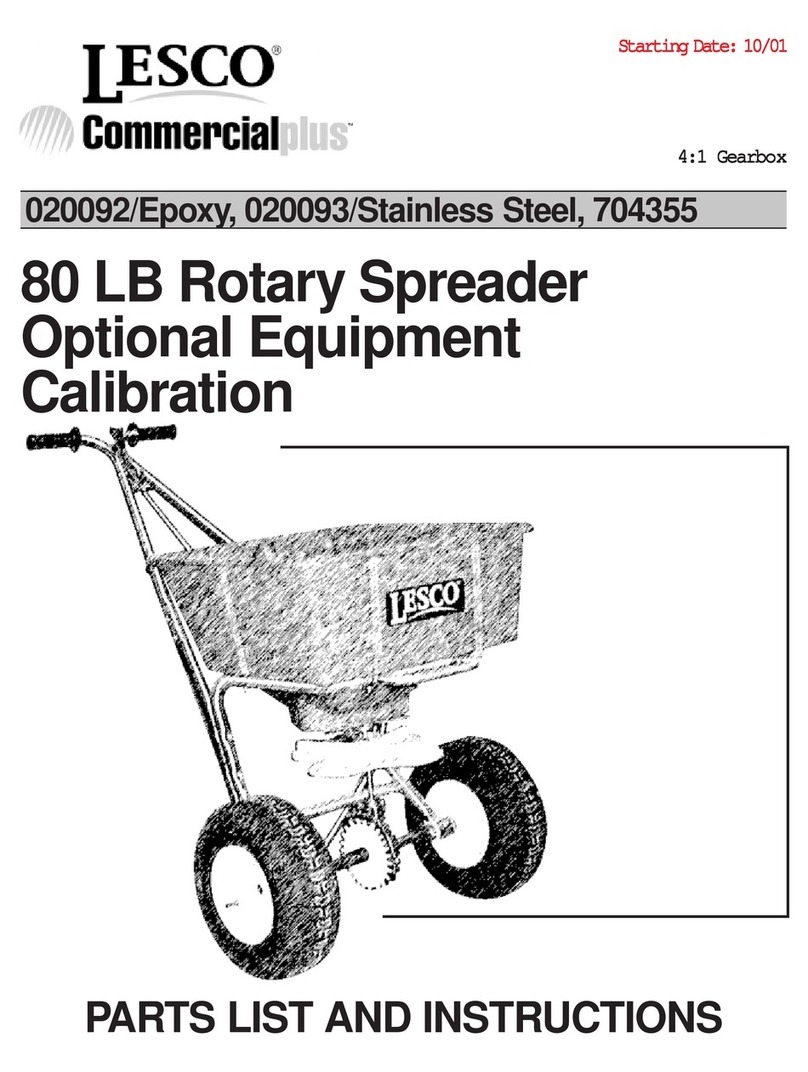
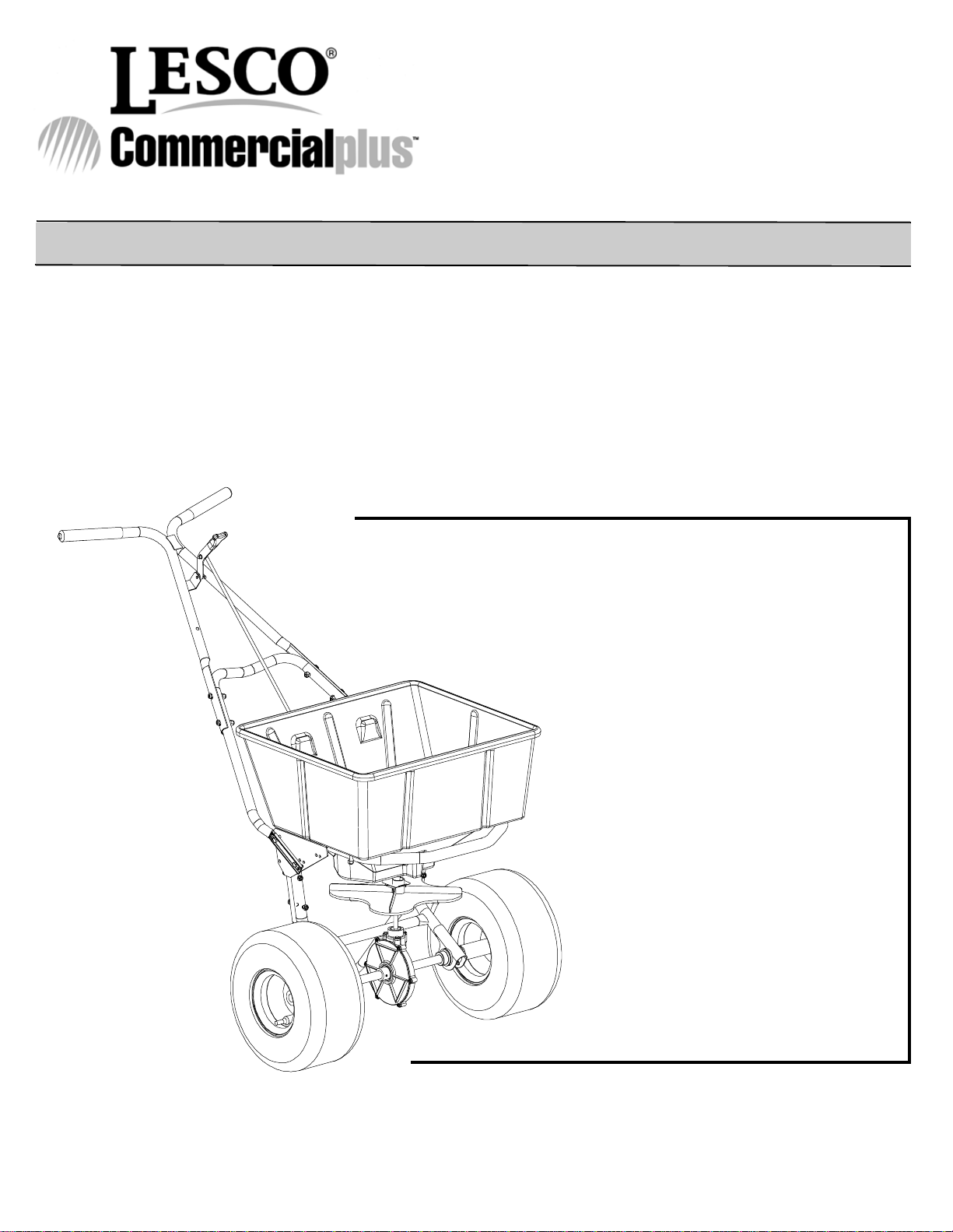
Spreader calibration is simplified using the LESCO
Professional Granular Applicator Calibration Kit
LESCO No. 011900.
Two items must be considered when calibrating a spreader. The first
is the distributionpattern ofthe spreader. That is, thepattern the prod-
uct makes as it strikes the ground after being thrown out by the
spreader's impeller. There are many factors which affect the distribu-
tion pattern of a rotary spreader and some of them relate directly to
the product. For this reason, we recommend that the spreader be cal-
ibrated separately for every product to be applied. Spreader calibra-
tionshould be checked at least once a month, or more often when the
spreader is used frequently.
The second item is the productapplication rate, that is the amount of
product applied per thousand square feet. This is important because
over-application can be costly and may cause plant injury, while un-
der-application will reduce the effectiveness of the product.
TO CALIBRATE A SPREADER, FOLLOW THESE
STEPS:
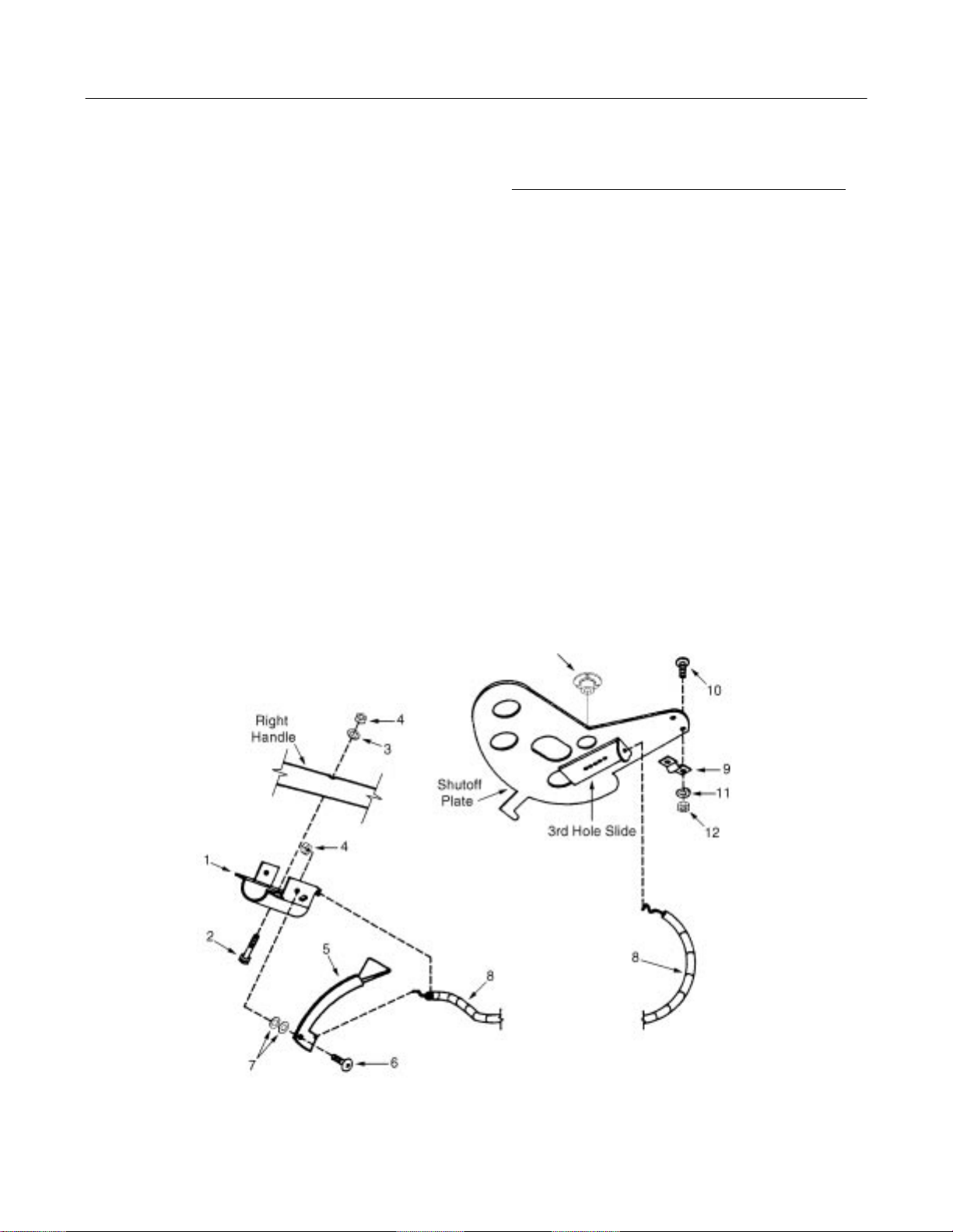
Check the spreader discharge holes with the operating lever in the
closed position. If the discharge holes are not fully closed, thread the
upper jam nut on the operating lever rod further up the rod. Tighten
the lower locknut and recheck. Repeat this procedure until the holes
are fully closed.
TO ACHIEVE A UNIFORM DISTRIBUTION PATTERN:
The accurate method for checking pattern uniformity is to lay out shal-
low boxes or pans in a row on a line perpendicular to the direction of
spreader travel. Eleven boxes or pans, two inches high placed on
one-foot centers willprovide accurate calibration. To conduct the test,
begin with the pattern slide completely open and set the rate control
arm at the suggested approximate setting. Make three passes over
the boxes, pushing the spreader in the same direction each time.The
product caught in each box is then evaluated to determine the distri-
bution pattern. Weighing the product in eachbox isthe mostaccurate,
but a simpler method is to pour the contents of each box into a sepa-
rate small vial or bottle. Then set the eleven vials or bottles side-by-
side in order. This makes the pattern variation quite visible.
To reduce the amount of discharge to the right side (operator's right)
the pattern slide shouldbe partiallyclosed andthe test repeated until
the distribution pattern is uniform.
TO ACHIEVE THE CORRECT PRODUCT APPLICATION RATE:
The approximate spreader settings printed on any product label
should only be used as the initial setting for calibration. Set the rate
control arm at this approximate setting. Using the collection boxes or
pans,makea single pass over themto determine the effective pattern
width.The effectivepatternwidth istwice (2x) thedistance to thepoint
where the rate drops to one-half the average rate at the center. Ex-
ample: If the product in the vials from the center boxes averages two
inches in depth, count out to the vial which has one inch of product. If
thisis the fifth vial from the center and the boxes were on one-foot
centers, the effective pattern width is ten feet (2 x 5 ft.).
Knowing the effective pattern width (ten feet), measure out a lineal
distance to equal 1,000 sq. ft. (10 ft. x 100 ft. = 1,000 sq. ft.). Weigh
20 lbs. of product and place it in the spreader hopper and spread it
over the distance necessary to equal 1,000 sq. ft. (100 ft.). Then
weigh the product leftin the hopper and subtractthis amount from the
amount with which you started. The result is the application rate for
this product in pounds per 1,000 sq. ft. that your spreader is currently
adjusted to disperse. Adjustthe rate control arm upor down as need-
ed and repeat this procedure until the correct application rate is
achieved.
TO USE THE LESCO CALIBRATION GAUGES:
The LESCO Calibration Gauges provide a series of "steps", num-
bered in 1/32-inch increments, that will allow you to "fine-tune" the
LESCO spreader. Once you have calibrated your LESCO rotary
spreader for the product chosen, open the operating lever and insert
the calibration gaugesuntil you determine which step fits tightly into
one of the open holes in the hopper bottom. Record that step number
for future reference when using that product. You may choose to set
other LESCO rotary spreadersfor application of the sameproduct by
adjusting the shutoff plate to that calibration gauge step. This will pro-
vide consistent settings for all of your LESCO spreaders. To recali-
brate your LESCO rotary spreader after a period of use, adjust the
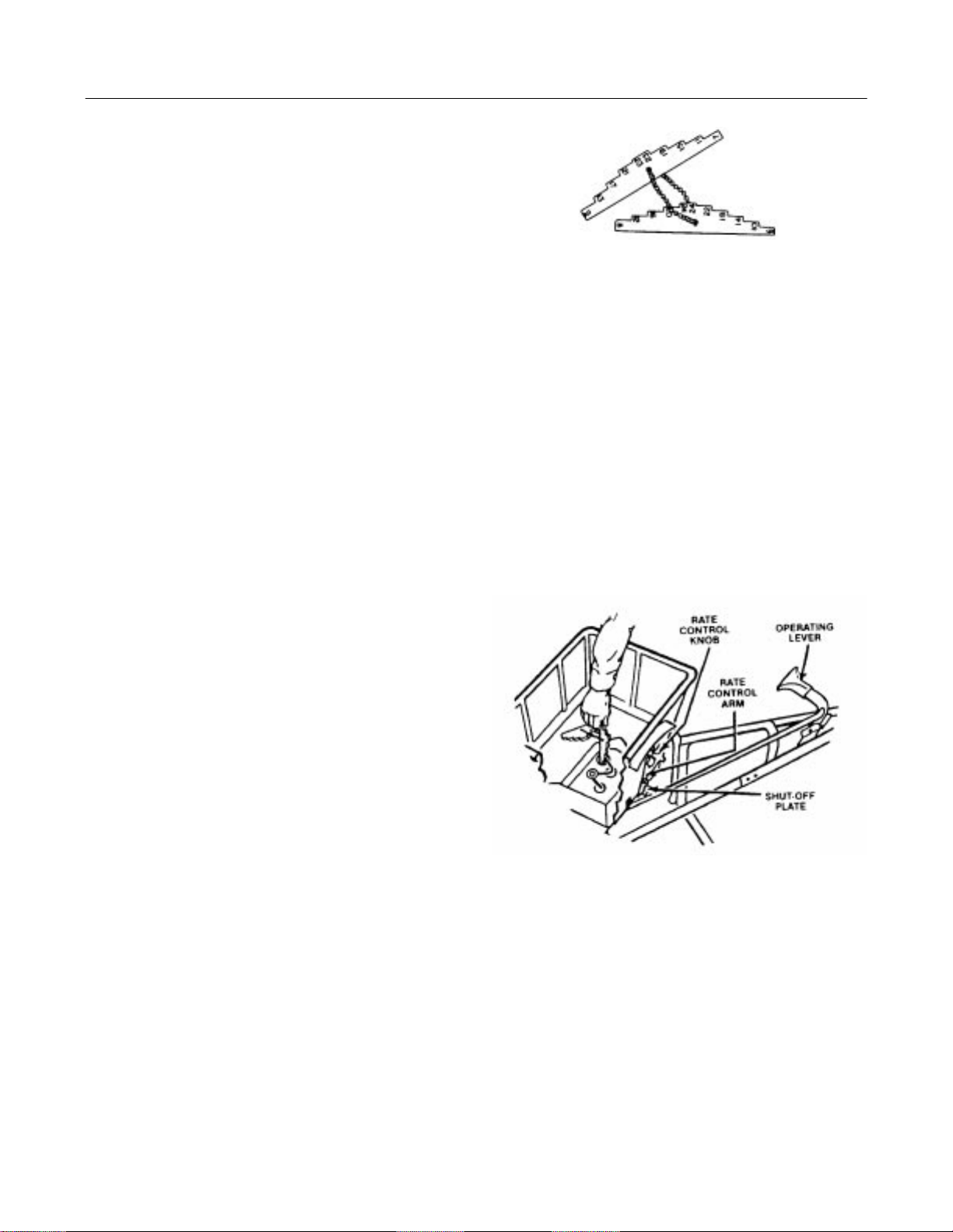
rate control arm to the "24" position. Open the operating lever and in-
sert the even-numbered LESCO Calibration Gauge into one of the
openholes in the hopper bottom. Close the operating lever andlet the
shut off plate on the underside of the hopper make contact with the
number 10 step on the LESCO Calibration Gauge. Move the rate con-
trolarmbacktowardthe "6" position until thebottom of the arm makes
contact with the shut off plate. If your spreader is properly adjusted,
the top of the rate control arm should be at setting "10". To correct
variances, remove the rate control arm, place the bottom of the arm
(up to the bolt hole) in a vise, and bend either to the right or the left.
SPREADER TIPS:
1. Always push the spreader; do not pull.
2. Pushthe spreader ata consistent speed (approximately 3m.p.h.is
recommended).
3. Always close the operating lever before filling the hopper.
4. Besurethescreenisinplacetopreventlumpsorpaperscrapsfrom
plugging the holes in the hopper bottom.
5. Always startwalkingforward beforeopening the operating lever;
close the operating lever before forward motion is stopped.
6. Hold the handle at a height that will keep the impeller level.
7. Empty the spreader after each use. Wash the spreader thoroughly
and allow it to dry. Keep the impeller clean.
8. Lubricate all moving parts. Apply grease to the five grease fittings;
two inthe axle supports,two in the gearsupport and one in the idler
wheel (if the idler wheel has a steel hub).