Page Number - 4 Form 403662
ALWAYS check equipment for proper operation before each use,
making sure safety devices are in place and operating properly. DO
NOT alter or modify any part of the equipment as this may cause a
malfunction and result in serious bodily injury.
BEFORE CONNECTING AIR MOTOR TO AIR
LINE
LINCOLN SERIES Ill AIRMOTORS are fully pneumatic and require a
minimum specied size of air supply hose for proper operation. Check
specication for minimum ID. of the air supply hose and select cor-
responding sizes of air controls and accessories for non-restrictive air
ow. Lincoln lter, regulator with gauge and lubricators are available
as combination units (FRL).
For 3/8” air line - Model 85387-6
For 1/2” air line - Model 85387-8
For 3/4” air line - Model 85387-12
If quick disconnect coupling should be used, install supplied coupler to
insure proper airmotor operation.
NOTE: Whenever ammable materials are pumped, ground Airmotor
according to Local Codes.
OPERATING PRECAUTIONS
Use Lincoln replacement parts to assure compatible pressure rating.
Heed ALL warnings.
DO NOT OPERATE Airmotor in excess of recommended pressure
ALWAYS read and follow the uid and solvent manufacturer’s rec-
ommendations regarding the use of protective clothing and equip-
ment.
To reduce the risk of serious bodily injury or property damage.
NEVER exceed the maximum air or uid working pressure of the
lowest rated system component.
ATTACHING AIRMOTOR TO PUMPTUBE
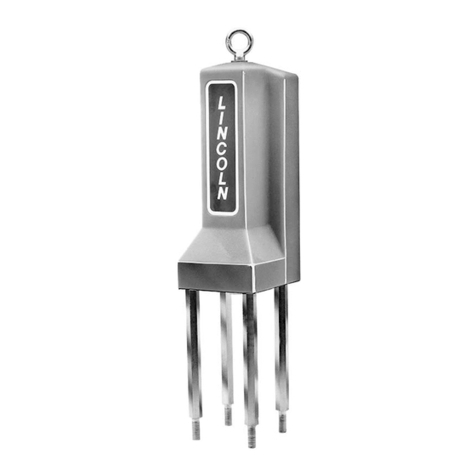
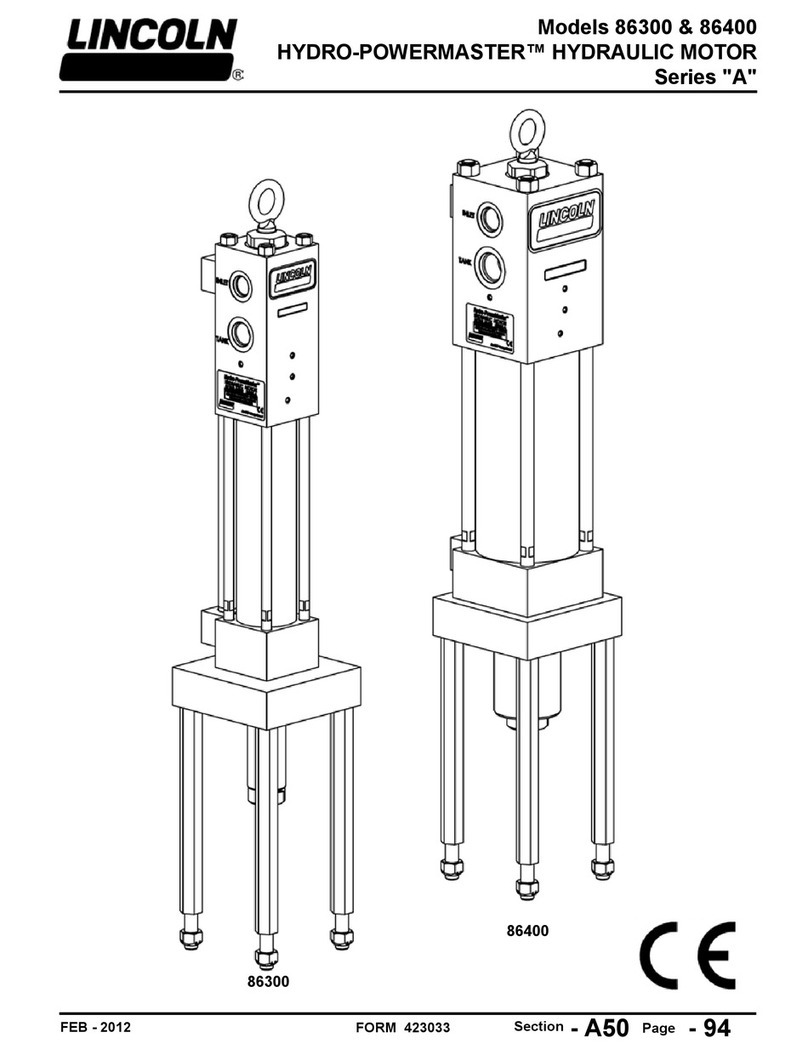
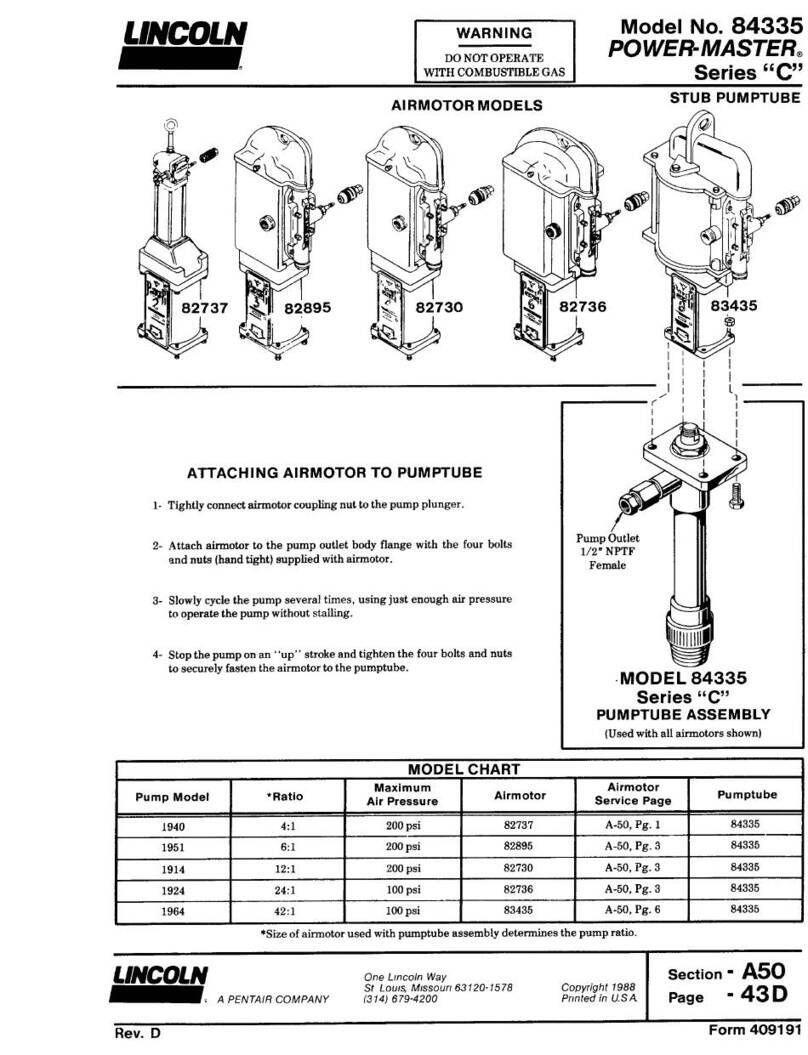
1 Tightly attach the tie rods (ltem 41) to the Airmotor lower casting.
Use short threaded end of tie rods.
2. Mount Airmotor on top of pump tube outlet and tightly connect
pump tube coupling nut to Airmotor Piston Rod (Item 5).
3. Hand tighten tie rods to the pump tube with four nuts (Item 42)
supplied with Airmotor.
4. Connect air supply and slowly cycle pump several times using only
enough air pressure to operate pump without stalling.
5. STOP pump on “UP” stroke and tighten four nuts to securely fas-
ten Airmotor to pump tube.
range.
Disconnect air line and relieve (vent) pressure when Airmotor sits idle
for long periods of time and before servicing.
SERVICE AND DISASSEMBLY PROCEDURE
TOOLS REQUIRED
1. 7/64 (.109) Hex Wrench
2. 5/32 (.156) Hex Wrench
3. 3/16 (.189) Hex Wrench
4. 3/4 (.750) Open End Wrench (for 6” Airmotor)
5. 15/16” (.937) Open End Wrench (for 8” Airmotor)
6. 1/2” (.500) Open End Wrench (for 4-1/4” and 3” Airmotor)
7. 1-1/8” (1.125) Open End Wrench (for 10” Airmotor)
8. Pliers
The modular design of the Airmotor and accessibility of vital opera-
tion parts make service available without taking Airmotor out of line or
without complete disassembly.
Power Valve
1. Remove four screws (Items 27 & 34) with 3/16” hex wrench (2 on
each side).
2. Remove End Caps (Items 10 & 14).
3. Push out Valve Spool (Item 13).
4. Remove Spool Bumpers (ltem 9) (One from each end).
5. Remove “O” Ring (Item 11) (One from each end of valve body).
6. Remove four Screws (Item 37) with 3/16” hex wrench and lift valve
body (Item 12).
7. Remove Gasket (Item 15) to complete valve disassembly.
8. To REASSEMBLE, REVERSE procedure.
Pilot Bar Subassembly
1. Remove four Screws (Item 23)(two on each end) with 3/16” hex
wrench and pull out Pilot Bar Subassembly.
2. Remove two Screws (Item 39), with 7/64” hex wrench and lift out
Valve Body (Item 17).
3. Remove four Screws (Item 40)(two on each side of Pilot Bar) and lift
off Upper Bracket (Item 31) and Lower Bracket (Item 32).
4. Remove Air Signal Valves (Item 20).
5. To REASSEMBLE, REVERSE procedure.
Cylinder Tube and Mufer
1. Remove Air Brakes Subassembly (See previous instructions).
2. Remove two Screws (Item 30) with 3/16” hex wrench and pull off
Muer (item 29).
3. Remove Gasket (Items 28).
4. Remove four Nuts (Item 26) with open end wrench.
5. Lift upward and remove Upper Casting (Item 8).
6. Remove four Tie Rods (Item 25).
7. Remove Air Tube (Item 7).
8. Lift upward and remove Cylinder Tube (Item 6).
9. Remove Piston and Piston Rod (Item 5).
10. Remove four Connecting Rods (Item 41) with open end wrench.
11. To REASSEMBLE, REVERSE procedure.
NOTE: Align two holes on the the Cylinder
Tube (Item 6) with two holes on the Pilot Bar
(Item 24) before tightening Tie Rods (Item 25)
so that proper seal with “O”-rings is acheived.
Always disconnect air supply to Airmotor and relieve pressure
before checking, servicing, or repairing any part of Airmotor