7
Observe the System’s Operation
The CO2 Safety System is packaged with its sensor,
central unit, warning lamp (beacon), siren (optional),
power supply (transformer) and connection cables.
It is immediately operational when connected to
normal 100-240 VAC power supply. Please observe
that you have to connect the appropriate plug
adaptor to the power supply depending on in which
country you are.
To become familiar with the system’s operation,
carefully remove its components from the box and
plug the power supply into an electrical supply
outlet. Notice that a yellow and a green LED will
illuminate, shortly followed by the red LED on the
CO2 sensor unit. When the red LED lights, the
relays will activate the external and internal siren/
buzzer and the external beacon. This test startup
procedure takes about 10 seconds. On the display
the word HEAT is shown while the sensor is in
startup mode. The unit is in normal running mode
when only the green LED is on.
On the Central Unit the red, yellow and green LED
will light up. MiniC followed by the software version
number is shown on the display, this is followed by
the display indicating the default sensor number (1-
4 pcs), this is followed by indicating Startup. When
the Central Units startup procedure is finished, the
display will show OnLine and measured sensor
values.
Determine Proper Location for System
Components
• The CO2 sensor should be placed in the room
where CO2 equipment is being used or where
CO2 is likely to accumulate in the event of leak.
Please observe, that this does not necessarily
have to be where the CO2 is stored, for example
when the CO2 is stored outside. NOTE: CO2 is
a heavy gas and it will collect in low areas
and confined spaces.
- One sensor unit will monitor a room of up
to approximately 100m2 / 1000 ft2 (without
functioning natural ventilation or open
entry way). NOTE: If the room has only
mechanical ventilation it should have a
sensor.
- The sensor should be installed so it has
clear exposure to room air but is away from
ventilation inlets or outlets. Its digital display
should be visible.
• A warning beacon, if equipped, must be located
where its flash is visible at any entrance to the
area being monitored. This may require more
than one beacon.
• The horn/strobe should be mounted on the wall
above the sensor.
• The central (control) unit must be placed outside
the room being monitored, preferably in the
managers office. If the Central unit is placed
in the manager’s office there should also be
a warning lamp outside the door to make the
personnel observant that there is a alarm
situation.
• NOTE: The central unit and sensor unit are
connected to each other by conductor cable
that may need to be disconnected for purposes
of cable routing or installing a longer cable.
When reconnecting cable leads make sure
they are securely connected to their proper
terminals. Refer to the diagram on page 9
for assistance.
Try to route all conductor cables in cable conduits
for a neat appearance.
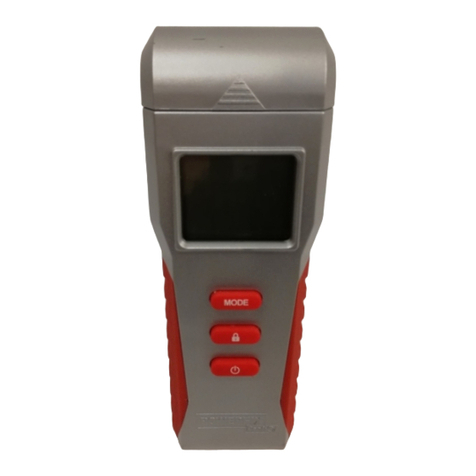
Install the (black) Sensor Unit
Try to position the unit where it will be out of the way
of moving objects and where its digital display is
visible. Use the supplied screws and wall anchors.
The stainless steel protection should be mounted so
that it does not block the view of the display.
Install the (blue) Central Unit
Place the central unit in a dry location. It should be
placed at a height where it can be easily seen but
where it is least likely to be damaged by items such
as mop handles or boxes being moved. Use the
supplied screws and wall anchors as necessary.
• Be sure the reset button can be pushed without
obstructions.
• Mount the Pluglock so that the power supply
cannot be disconnected without the use of
mechanical tools.
• Be sure the central unit is not placed in the
risk area that is being monitored!
Installation III