Make Noise 0-CTRL User manual

0-CTRL

2
Table of Contents
3
4
5
8
9
10
11
13
14
15
16
17
19
21
25
26
FCC Rules
Warranty
Overview
Panel Controls
Connecting Power
Patching
Quick Start Guide: Sequencing with 0-Coast
Quick Start Guide: Sequencing Overview
Quick Start Guide: Manual Control of the 0-Coast
What is Control Voltage?
What are Gates?
The Touchplates of the 0-CTRL
The Channels of the 0-CTRL
The Gates and Clocks of the 0-CTRL
Tips and Tricks
Patch Corner

This device complies with Part 15 of the FCC Rules. Operation is subject to the following two
conditions: (1) this device may not cause harmful interference, and (2) this device must accept
any interference received, including interference that may cause undesired operation.
to operate the equipment.
This equipment has been tested and found to comply with the limits for a Class A digital
device, pursuant to part 15 of the FCC Rules. These limits are designed to provide reasonable
protection against harmful interference when the equipment is operated in a commercial
environment. This equipment generates, uses, and can radiate radio frequency energy and, if
not installed and used in accordance with the instruction manual, may cause harmful
interference to radio communications.
makenoisemusic.com
Make Noise Co., 414 Haywood Road, Asheville, NC 28806
3

Limited WARRANTY: 4
About This Manual:
Written by Walker Farrell
Illustrated by Walker Farrell and Lewis Dahm
Spiritual Adviser: Tony Rolando
0-CTRL Hardware Design: Tony Rolando
Thanks to the Beta Testers!
Make Noise warrants this product to be free of defects in materials or construction for a period of one year from the date of
purchase (proof of purchase/invoice required).
Malfunction resulting from wrong power supply voltages, backwards or reversed eurorack bus board cable connection, abuse of
the product, removing knobs, changing face plates, or any other causes determined by Make Noise to be the fault of the user are
not covered by this warranty, and normal service rates will apply.
During the warranty period, any defective products will be repaired or replaced, at the option of Make Noise, on a return-to-Make
Noise basis with the customer paying the transit cost to Make Noise.
Make Noise implies and accepts no responsibility for harm to person or apparatus caused through operation of this product.
Please contact [email protected] with any questions, Return To Manufacturer Authorization, or any needs &
comments.
http://www.makenoisemusic.com

5
“All control systems try to make control as tight as possible, but at the same time, if they succeeded
completely there would be nothing left to control.”
- William S. Burroughs
The Make Noise 0-CTRL is a patchable, clockable controller and step sequencer for voltage controlled
synthesizer systems. Designed to be friends with the 0-Coast, it is a tabletop device whose inputs and outputs
follow Eurorack standards, making it also a great partner for a modular system or another patchable tabletop
synth.
The core of the 0-CTRL is the eleven touchplates that are activated by contact with the player’s fingers.
The eight Step touchplates are used to manually select Steps and activate the Pressure CV and Gate outputs.
Internal or external Clock will run the sequencer through the steps. With the combination of touch and clock
control, the 0-CTRL makes a highly playable step sequencer: one with Time, Gate, Envelope, and Envelope
Strength controls per step. The second and third CV Channels control Strength (of the Dynamic Gate and
Envelope outputs) and Time (between pulses of the internal Clock) for each Step of the sequence. Use the
Strength and Time input attenuators to control the depth of these modulations. You may also use a different
signal to control Strength or Time, by patching to the respective CV input jack and breaking the wired
connection.
The three touchplates at bottom left are used for macro control of the Sequence (Clock On/Off, Direction,
Interrupt).
Clock Direction Interrupt
Overview

6
The Pitch, Strength, and Time Channels are each controlled by a row of eight knobs corresponding to the
eight Steps. The rows of knobs are placed in boxes whose legending match those of their respective output
jacks. Without any patching, the Strength and Time Channels can control the Strength and Time of the
sequence per step.
Like many classic sequencers, the 0-CTRL is a 100% analog device, and therefore has no pitch quantization
on its CV outputs. They can certainly be used to control the pitch of oscillators, but there is no arbitrary limit
to the precision of values they can create. Instead, the 0-CTRL encourages you to use your hands and ears to
find frequencies, and your imagination to decide where to patch this control voltage.
The Dynamic Gate and Dynamic Envelope outputs can be used for note generation by patching them to
envelope generators, VCAs, or filters.
Pitch Strength Time
Pitch
Strength
Time
Overview (cont.)

7
There are no preset behaviors on the 0-CTRL. There are no "modes.” Instead you patch program the
sequence behaviors using the eight Step Gate outputs, along with the touch plates, and the control inputs:
Strength, Time, Clock, Dynamic Reset, Stop, and Direction.
The Interrupt Touchplate allows you to enable or disable the Step Touchplates’ ability to Interrupt the
sequence.
When Interrupt is ON you will be able to force the 0-CTRL to any step by touching the
corresponding touchplate. When Interrupt is OFF, you will be able to generate touch CV and touch
gates without interrupting the clocked sequence.
The Clock Input makes it easy to sync the 0-CTRL to another device. The Clock Output is complex:
it contains both internal and external clocks, and is affected by the Time parameter.
It is of course possible to use Internal and External clocks simultaneously, creating hybrid rhythms in the
0-Ctrl’s sequence, and ??? at the Clock Output.
Overview (cont.)

8
Panel controls, Inputs and Outputs
1. Clock Input. Advances sequence upon rising edge of clock, pulse or trigger signal of at least 2.0V
2. Clock Output. Output containing gates associated with Internal and/or External Clocks. 0V or 8V.
3. Dynamic Reset Input. Resets sequence to last touched Step upon rising edge of clock, pulse or trigger signal of at least
2.0V
4. Stop Input. Stops clock (internal and external) from advancing sequence for as long as input is >2.0V.
5. Direction Input. Changes/toggles sequence direction upon rising edge of clock, pulse or trigger signal of at least 2.0V.
6. Pitch Channel CV Output. Outputs CV at value of Pitch Channel knob for currently selected Step. 0-5V.
7. Strength Channel CV Output. Outputs CV at value of Strength Channel knob for currently selected Step. 0-5V.
8. Time Channel CV Output. Outputs CV at value of Time Channel knob for currently selected Step. 0-5V.
9. Pressure CV Output. Outputs CV according to amount of pressure applied to Step Touchplate(s). 0-5V.
10.Touch Gate Output. Outputs Gate signal when one or more Step Touchplate is being touched. 0V or 8V.
11.Dynamic Gate Output. Outputs Dynamic Gate Signal based on Strength and Time of current Step. 0-8V.
12.Dynamic Envelope Output. Outputs Dynamic Envelope based on Strength and Time of current Step. 0-8V.
13.Strength CV Input attenuator. Sets depth of Strength modulation from Strength Channel or signal at Strength CV Input.
14.Speed Panel Control. Sets Speed of Internal Clock and length of Dynamic Envelopes and Gates.
15.Strength CV Input. Modulates Strength of Dynamic Envelope and Gate outputs. Normalled to Strength Channel CV
Output.
16.Time CV Input Attenuator. Sets depth of Time modulation from Time Channel or signal at Time CV Input.
17.Time CV Input. Modulates Clock Time. Normalled to Time Channel CV Output.
18.Step Gate Outputs. Gate outputs that go high when respective Step is active. 0V or 8V.
19.Pitch Channel Knobs. Set Pitch Channel CV Output for the eight steps.
20.Strength Channel Knobs. Set Strength Channel CV Output for the eight steps.
21.Time Channel Knobs. Set Time Channel CV Output for the eight steps.
22.Step Touchplates. Clocks Sequence to respective Step (if Interrupt ON) and generate Pressure CV and Touch Gates.
23.Clock Touchplate. Turns Internal Clock On and Off.
24.Direction Touchplate. Changes/Toggles Direction of Sequence.
25.Interrupt Touchplate. Determines whether Step Touchplates will Interrupt the Sequence when touched.

9
Connecting Power
It is recommended that the 0-CTRL AC Adapter is plugged into a fuse-protected power strip with an On/Off
switch; however, if that is not available, it is OK to plug it into a wall outlet. Use only the Make Noise 0-
CTRL/0-Coast 15VDC Center Positive AC Adapter to power the 0-CTRL. To turn on your 0-CTRL, once you
have plugged the AC Adapter into your AC outlet, attach the other end of the AC Adapter to the jack on the
side of the 0-CTRL.

10
Patching
Jacks
Every jack in the 0-CTRL is either an input or an output. Jacks are patched together with cables. Simply plug
one end of the cable into an input and the other end into an output. You must patch at least two cables
between the 0-CTRL and the device to be controlled. Patching an input to another input has no effect,
and patching an output to another output has unpredictable effects and is generally not recommended.
However, there are exceptions to these guidelines when using stacking patch cables (see below).
Multing and Gate-Stacking
The 0-CTRL comes with twostacking patch cables. These cables have not only a plug but also a jack built
in, which allows you to patch a second cableinto the firstand thus connect three or four jacks together.
Because the built-in jack increases the height of this cable and adds to the sideways motion of the cable in
the jack,we recommend against patching the stacking cables into each other. Instead, patch the
standard cables in. You can patch at either end (or both) of the stacking cable - both ends do the same
thing regardless of where it is patched. As long as all jacks you want to connect are connected, the “order”
of the chain does not matter. You may use the other end of the standard cable to connect the second
stacking patch cable, if you need more than four connections in one chain.
The stacking patch cables allow you to do two things:
1. Multing: Send a single signal (CV or Gate) to multiple destinations
For example, if you would like to use the Pitch CV to control the pitch of two oscillators simultaneously, or
the pitch of one oscillator and a timbral control such as the 0-Coast’s MULTIPLY, use the stacking patch
cable to connect the Pitch CV Output to both destinations.
2. Gate-Stacking: Send multiple GATE outputs to a single destination
For example, if you would like to have the sequence automatically stop when it gets to step 4 or step 8, use
the stacking patch cable to connect those steps’ Gate outputs to the Stop input.
The 0-CTRL (and all Make Noise) Gate outputs are designed to be combined in this way. Using stacking
patch cables to combine CV (or Audio) outputs may have unexpected results.
This manual suits for next models
1
Table of contents
Other Make Noise Recording Equipment manuals

Make Noise
Make Noise PHONOGENE User manual
Make Noise
Make Noise RxMx User manual

Make Noise
Make Noise MATHS User manual
Make Noise
Make Noise MATHS User manual
Make Noise
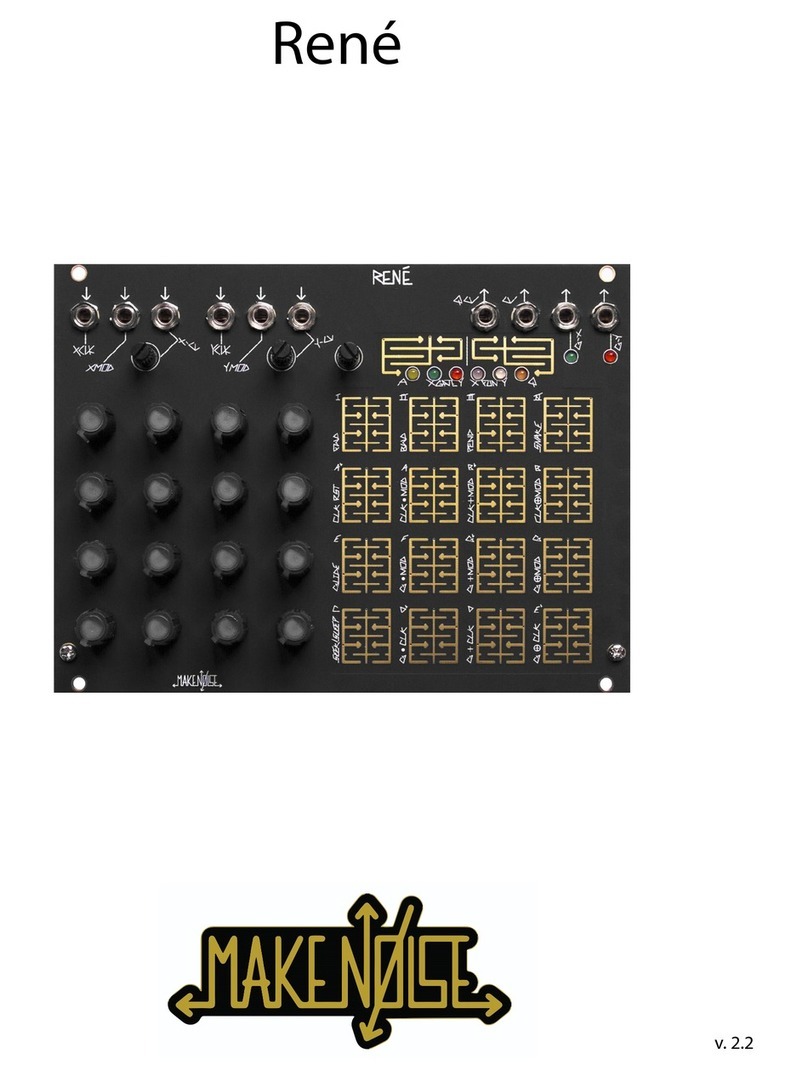
Make Noise Rene User manual
Make Noise
Make Noise XPO User manual
Make Noise
Make Noise modDemix User manual
Make Noise
Make Noise 7U 4 ZONE CV BUS CASE User manual
Make Noise
Make Noise DPO User manual
Make Noise
Make Noise Rene User manual