the membranes because there would be no water left to flush away the solids, which do
not pass through the membranes.
Normal recoveries for small seawater conversion units are in the range of 15-30%. At
20% recovery, for every 100 gallons of raw water fed to the RO system, 20 gallons are
recovered as purified water and 80 gallons are routed to waste as concentrated rejected
salts (brine). The same concept holds true for numbers expressed as gallons per minute,
cubic meters per hour, etc.
The rate at which water flows through the membrane is directly proportional to the driving
force available. The driving force is basically the difference between the pressure on the
feedwater (system pressure) and product water sides of the membrane and the difference
in osmotic pressure of the solutions on opposite sides of the membrane. The greater the
feed pressure the greater the driving force and product flow rate will be. Increasing the
pressure on the product side of the membrane decreases the driving force and therefore
lowers the product flow. The difference in salt concentration between the feedwater and
product water also reduces the driving force due to the difference in osmotic pressure,
which must be overcome.
It follows that if the pressure is raised and the concentrate flow rate consequently
decreases, the recovery increases. On the other hand, if the system pressure is held
fixed and the concentrate flow rate is made to decrease, the recovery also goes up. If, at
constant pressure, the concentrate flow is stopped altogether, the recovery is 100%. This
condition cannot last long. Most of the solid materials in the feedwater will adhere to the
membrane if not flushed from the membrane surface and vessel. Eventually, these
materials will so heavily coat the membrane that all flow will cease. This will result in the
rapid deterioration of the membrane. There must always be sufficient concentrate flow
to carry away the rejected dissolved solids and prevent concentrations that would
allow precipitation and resulting scaling of the membranes.
Pressure is not the only factor, which affects the product flow rate of the RO system.
Temperature of the feedwater can change the output by as much as 50% in the range
from nearly freezing to 95 degrees F (35 degrees C). As a general rule of thumb, product
flow from thin film composite RO systems will decrease by approximately 1.5% per 1
degree C decrease in feedwater temperature unless pressure corrections are made. The
capacity of the system therefore may vary seasonally with temperature.
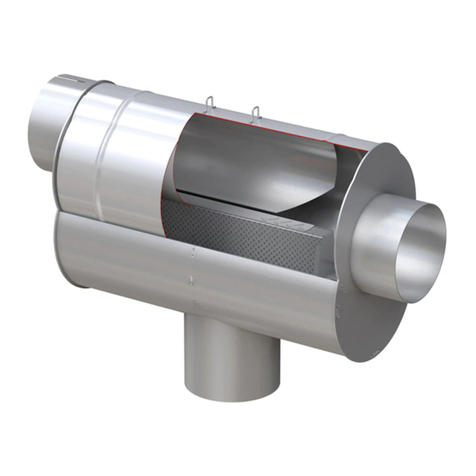
The physical or chemical nature of many natural waters and industrial process waters is
such that it is not suitable to pump some waters directly into a Reverse Osmosis system.
Among the characteristics of water that may necessitate pre-treatment are suspended
solids (turbidity), the limited solubility of some salts, and strong chemicals such as acid or
chlorine, which chemically attack the membrane. Suspended solids (not to be confused
with dissolved solids) within the spiral wound element may gradually clog the flow path.
Some salts will crystallize from solution when concentrated, and may also clog the flow
paths.