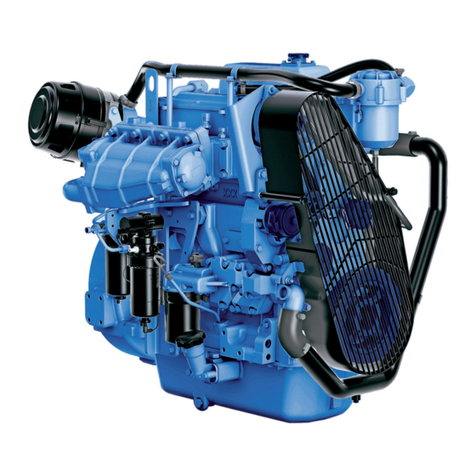
Mazda L8 Instruction manual

CONTENTS
Engine
Workshop
Manual
L8
LF
L3
FOREWORD
This manual explains the disassembly,
inspection, repair, and reassembly
procedures for the above-indicated engine.
In order to do these procedures safety,
quickly, and correctly, you must first read
this manual and any other relevant service
materials carefully.
The information in this manual is current
up to March, 2002. Any changes that occur
after that time will not be reflected in
thisparticularmanual.Therefore,thecontents
of this manual may not exactly match
the mechanism that you are currently
serving.
Mazda Motor Corporation
HIROSHIMA, JAPAN
© 2002 Mazda Motor Corporation
PRINTED IN The Netherlands, MARCH 2002
1731–1E–02C
Title Section
General Information GI
Engine B
Technical Data TD
Special Tools ST
1731‑1E‑02C(INDEX).fm1ページ2002年3月13日 水曜日 午後5時8分

WARNING
Servicing a vehicle can be dangerous. If you have not received
service-related training, the risks of injury, property damage, and
failure of servicing increase. The recommended servicing procedures
for the vehicle in this workshop manual were developed with
Mazda-trained technicians in mind. This manual may be useful to
non-Mazda trained technicians, but a technician with our
service-related training and experience will be at less risk when
performing service operations. However, all users of this manual are
expected to at least know general safety procedures.
This manual contains "Warnings" and "Cautions" applicable to risks
not normally encountered in a general technician's experience.
They should be followed to reduce the risk of injury and the risk that
improper service or repair may damage the vehicle or render it unsafe.
It is also important to understand that the "Warnings" and "Cautions"
are not exhaustive. It is impossible to warn of all the hazardous
consequences that might result from failure to follow the procedures.
The procedures recommended and described in this manual are
effective methods of performing service and repair. Some require tools
specifically designed for a specific purpose. Persons using procedures
and tools which are not recommended by Mazda Motor Corporation
must satisfy themselves thoroughly that neither personal safety nor
safety of the vehicle will be jeopardized.
The contents of this manual, including drawings and specifications, are
the latest available at the time of printing, and
Mazda Motor Corporation
reserves the right to change the vehicle designs and alter the contents
of this manual without notice and without incurring obligation.
Parts should be replaced with genuine Mazda replacement parts or
with parts which match the quality of genuine Mazda replacement
parts. Persons using replacement parts of lesser quality than that of
genuine Mazda replacement parts must satisfy themselves thoroughly
that neither personal safety nor safety of the vehicle will be
jeopardized.
Mazda Motor Corporation is not responsible for any problems which
may arise from the use of this manual. The cause of such problems
includes but is not limited to insufficient service-related training, use of
improper tools, use of replacement parts of lesser quality than that of
genuine Mazda replacement parts, or not being aware of any revision
of this manual.
1731‑1E‑02C(WARNING).fm1ページ2002年3月13日 水曜日 午後5時9分

GI–1
GI
GI
GENERAL INFORMATION
HOW TO USE THIS MANUAL ............................. GI-2
RANGE OF TOPICS.......................................... GI-2
SERVICE PROCEDURE ................................... GI-2
SYMBOLS.......................................................... GI-3
ADVISORY MESSAGES ................................... GI-4
UNITS ................................................................... GI-5
UNITS ................................................................ GI-5
FUNDAMENTAL PROCEDURES ........................ GI-6
PREPARATION OF TOOLS AND
MEASURING EQUIPMENT............................ GI-6
SPECIAL SERVICE TOOLS.............................. GI-6
DISASSEMBLY.................................................. GI-6
INSPECTION DURING REMOVAL,
DISASSEMBLY............................................... GI-7
ARRANGEMENT OF PARTS ............................ GI-7
CLEANING OF PARTS...................................... GI-7
REASSEMBLY................................................... GI-7
ADJUSTMENT................................................... GI-8
RUBBER PARTS AND TUBING........................ GI-8
HOSE CLAMPS ................................................. GI-8
TORQUE FORMULAS....................................... GI-9
VISE................................................................... GI-9
SST.................................................................... GI-9
ELECTRICAL SYSTEM...................................... GI-10
ELECTRICAL PARTS...................................... GI-10
CONNECTORS................................................ GI-10
NEW STANDARDS ............................................ GI-13
NEW STANDARDS.......................................... GI-13
ABBREVIATIONS .............................................. GI-15
ABBREVIATIONS............................................ GI-15
1731‑1E‑02C.book1ページ2002年4月26日 金曜日 午前10時30分

GI–2
HOW TO USE THIS MANUAL
RANGE OF TOPICS A6E201000001E01
•This manual contains procedures for performing all required service operations. The procedures are divided
into the following five basic operations:
— Removal/Installation
— Disassembly/Assembly
— Replacement
— Inspection
— Adjustment
•Simple operations which can be performed easily just by looking at the vehicle (i.e., removal/installation of
parts, jacking, vehicle lifting, cleaning of parts and visual inspection) have been omitted.
End Of Sie
SERVICE PROCEDURE A6E201000001E02
Inspection, adjustment
•Inspection and adjustment procedures are divided into steps. Important points regarding the location and
contents of the procedures are explained in detail and shown in the illustrations.
Repair procedure
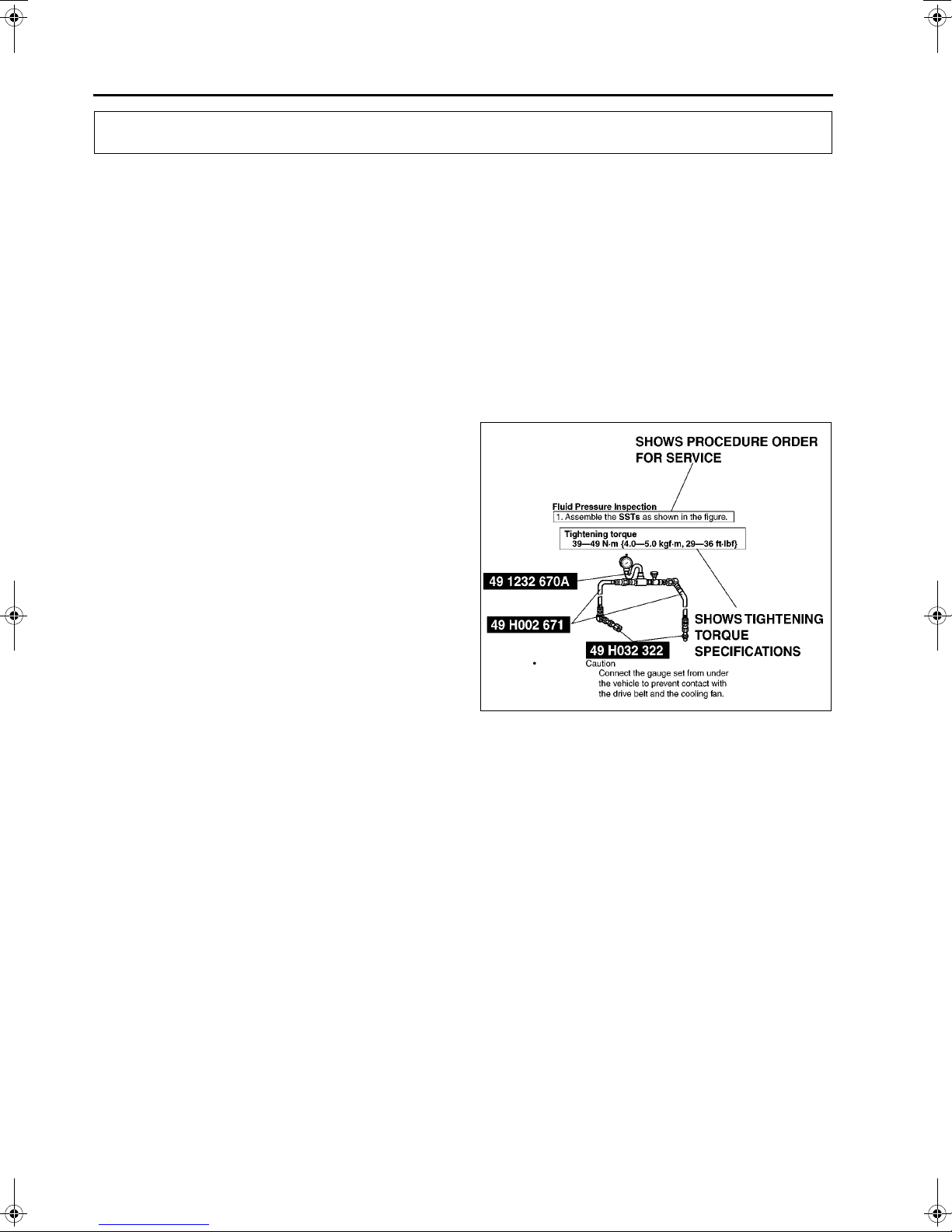
1. Most repair operations begin with an overview illustration. It identifies the components, shows how the parts fit
together and describes visual part inspection. However, only removal/installation procedures that need to be
performed methodically have written instructions.
2. Expendable parts, tightening torques and symbols for oil, grease, and sealant are shown in the overview
illustration. In addition, symbols indicating parts requiring the use of special service tools or equivalent are also
shown.
3. Procedure steps are numbered and the part that is the main point of that procedure is shown in the illustration
with the corresponding number. Occasionally, there are important points or additional information concerning a
procedure. Refer to this information when servicing the related part.
HOW TO USE THIS MANUAL
XME2010001
1731‑1E‑02C.book2ページ2002年4月26日 金曜日 午前10時30分

HOW TO USE THIS MANUAL
GI–3
GI
4.
End Of Sie
SYMBOLS A6E201000001E03
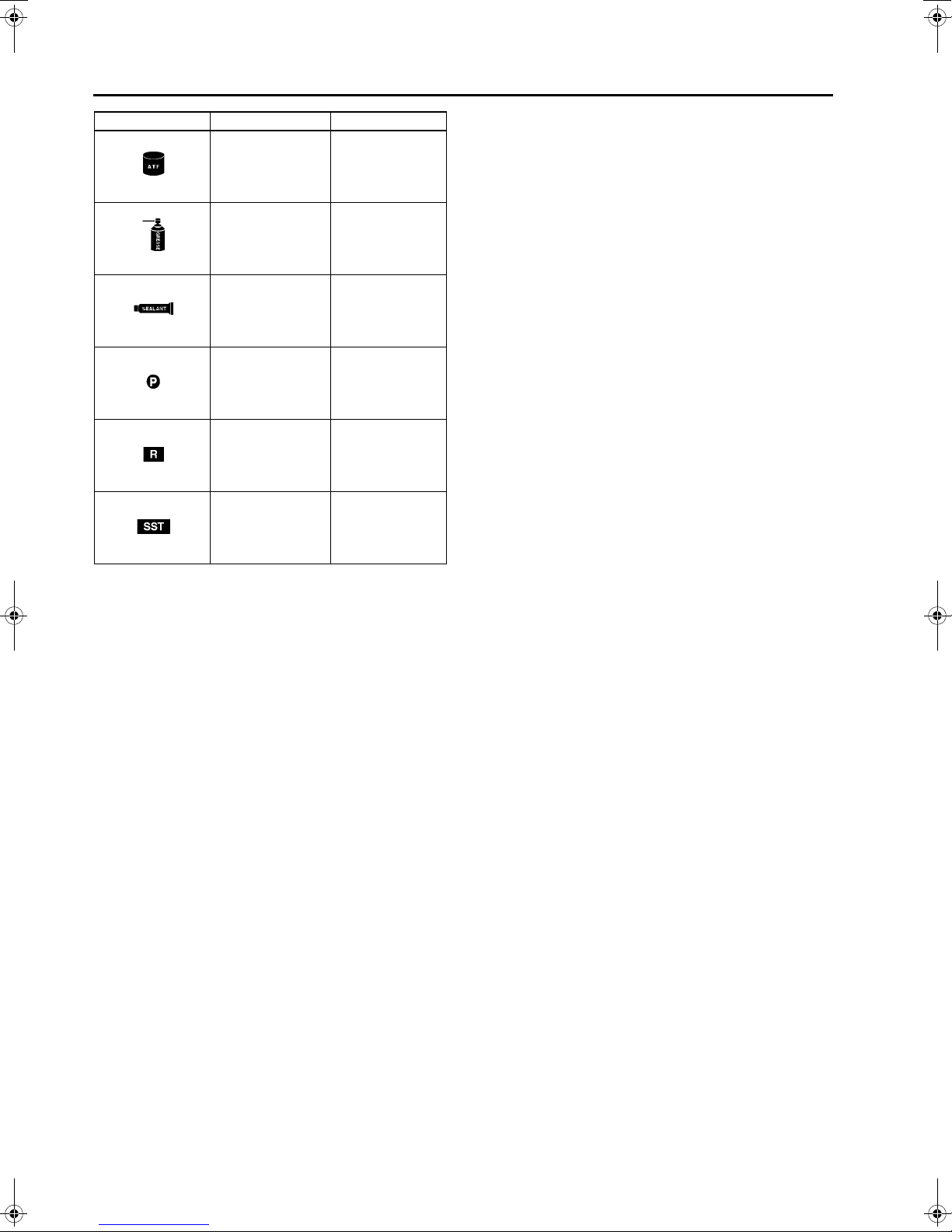
•There are eight symbols indicating oil, grease, fluids, sealant, and SST or equivalent use. These symbols show
application points or use of these materials during service.
XME2010010
Symbol Meaning Kind
Apply oil New appropriate
engine oil or gear
oil
Apply brake fluid New appropriate
brake fluid
1731‑1E‑02C.book3ページ2002年4月26日 金曜日 午前10時30分

GI–4
HOW TO USE THIS MANUAL
End Of Sie
ADVISORY MESSAGES A6E201000001E04
•You'll find several Warnings, Cautions, Notes, Specifications and Upper and Lower Limits in this manual.
Warning
•A Warning indicates a situation in which serious injury or death could result if the warning is ignored.
Caution
•A Caution indicates a situation in which damage to the vehicle or parts could result if the caution is ignored.
Note
•A Note provides added information that will help you to complete a particular procedure.
Specification
•The values indicate the allowable range when performing inspections or adjustments.
Upper and lower limits
•The values indicate the upper and lower limits that must not be exceeded when performing inspections or
adjustments.
End Of Sie
Apply automatic
transaxle/
transmission fluid
New appropriate
automatic
transaxle/
transmission fluid
Apply grease Appropriate
grease
Apply sealant Appropriate
sealant
Apply petroleum
jelly Appropriate
petroleum jelly
Replace part O-ring, gasket,
etc.
Use SST or
equivalent Appropriate tools
Symbol Meaning Kind
1731‑1E‑02C.book4ページ2002年4月26日 金曜日 午前10時30分

UNITS
GI–5
GI
UNITS A6E201200002E01
Conversion to SI Units (Système International d'Unités)
•All numerical values in this manual are based on SI units. Numbers shown in conventional units are converted
from these values.
Rounding Off
•Converted values are rounded off to the same number of places as the SI unit value. For example, if the SI unit
value is 17.2 and the value after conversion is 37.84, the converted value will be rounded off to 37.8.
Upper and Lower Limits
•When the data indicates upper and lower limits, the converted values are rounded down if the SI unit value is
an upper limit and rounded up if the SI unit value is a lower limit. Therefore, converted values for the same SI
unit value may differ after conversion. For example, consider 2.7 kgf/cm2in the following specifications:
210—260 kPa {2.1—2.7 kgf/cm2, 30—38 psi}
270—310 kPa {2.7—3.2 kgf/cm2, 39—45 psi}
•The actual converted values for 2.7 kgf/cm2are 264 kPa and 38.4 psi. In the first specification, 2.7 is used as
an upper limit, so the converted values are rounded down to 260 and 38. In the second specification, 2.7 is
used as a lower limit, so the converted values are rounded up to 270 and 39.
End Of Sie
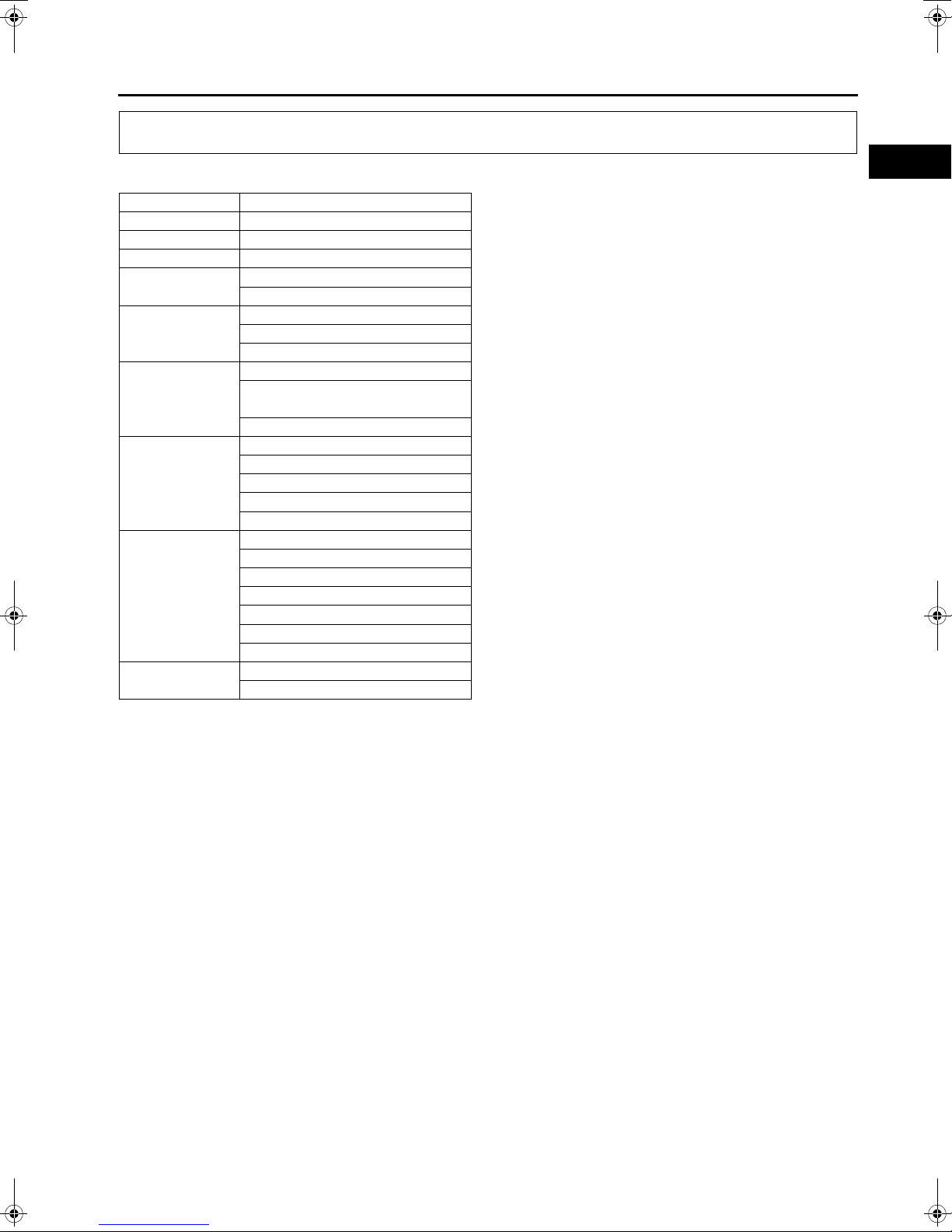
UNITS
Electrical current A (ampere)
Electric power W (watt)
Electric resistance ohm
Electric voltage V (volt)
Length mm (millimeter)
in (inch)
Negative pressure kPa (kilo pascal)
mmHg (millimeters of mercury)
inHg (inches of mercury)
Positive pressure
kPa (kilo pascal)
kgf/cm2(kilogram force per square
centimeter)
psi (pounds per square inch)
Torque
N·m (Newton meter)
kgf·m (kilogram force meter)
kgf·cm (kilogram force centimeter)
ft·lbf (foot pound force)
in·lbf (inch pound force)
Volume
L (liter)
US qt (U.S. quart)
Imp qt (Imperial quart)
ml (milliliter)
cc (cubic centimeter)
cu in (cubic inch)
fl oz (fluid ounce)
Weight g (gram)
oz (ounce)
1731‑1E‑02C.book5ページ2002年4月26日 金曜日 午前10時30分

GI–6
FUNDAMENTAL PROCEDURES
PREPARATION OF TOOLS AND MEASURING EQUIPMENT A6E201400004E02
•Be sure that all necessary tools and measuring
equipment are available before starting any work.
End Of Sie
SPECIAL SERVICE TOOLS A6E201400004E03
•Use special service tools or equivalent when they
are required.
End Of Sie
DISASSEMBLY A6E201400004E07
•If the disassembly procedure is complex,
requiring many parts to be disassembled, all parts
should be marked in a place that will not affect
their performance or external appearance and
identified so that reassembly can be performed
easily and efficiently.
End Of Sie
FUNDAMENTAL PROCEDURES
X3U000WAH
X3U000WAJ
X3U000WAL
1731‑1E‑02C.book6ページ2002年4月26日 金曜日 午前10時30分

FUNDAMENTAL PROCEDURES
GI–7
GI
INSPECTION DURING REMOVAL, DISASSEMBLY A6E201400004E08
•When removed, each part should be carefully
inspected for malfunction, deformation, damage,
and other problems.
End Of Sie
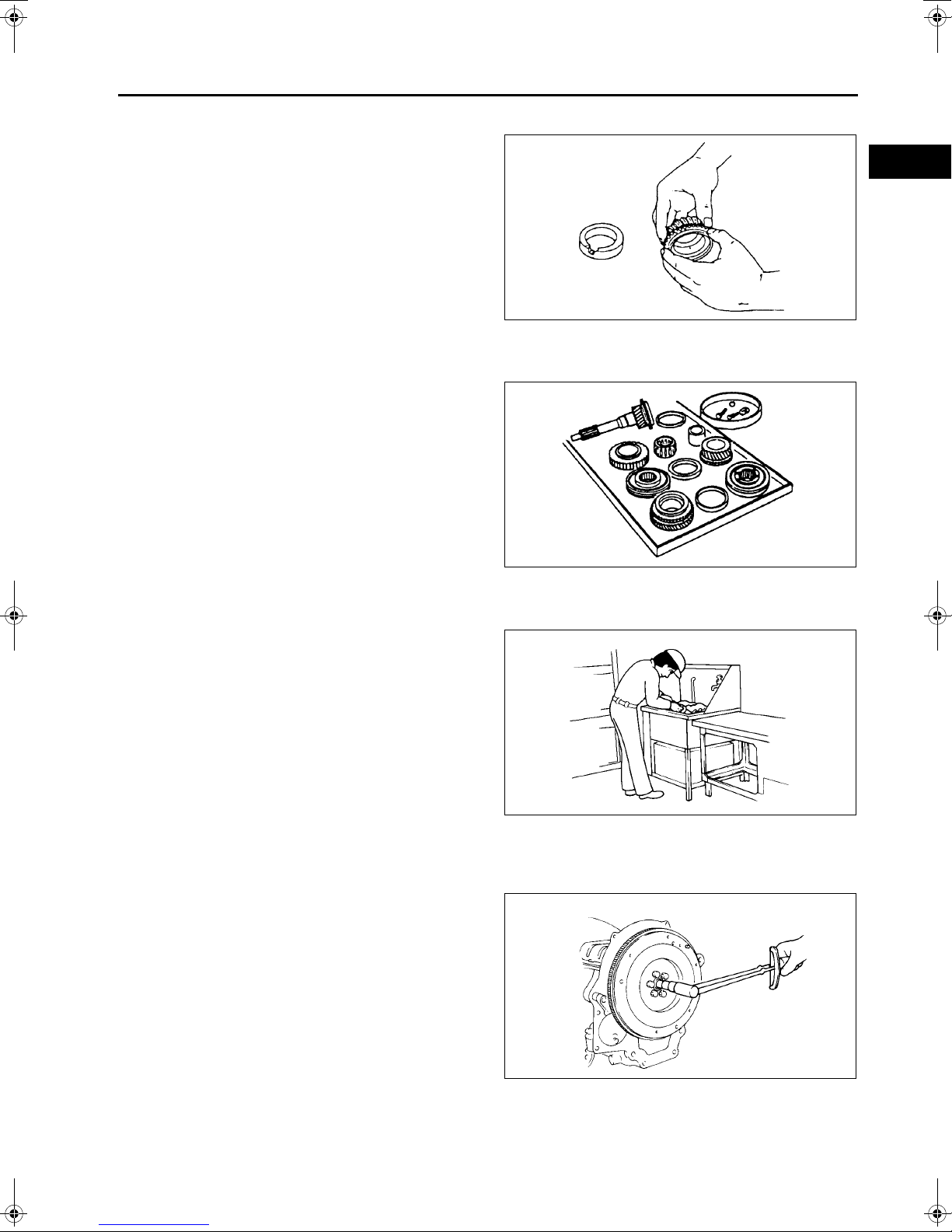
ARRANGEMENT OF PARTS A6E201400004E09
•All disassembled parts should be carefully
arranged for reassembly.
•Be sure to separate or otherwise identify the parts
to be replaced from those that will be reused.
End Of Sie
CLEANING OF PARTS A6E201400004E10
•All parts to be reused should be carefully and
thoroughly cleaned in the appropriate method.
Warning
•
••
•Using compressed air can cause dirt and
other particles to fly out causing injury to
the eyes. Wear protective eye wear
whenever using compressed air.
End Of Sie
REASSEMBLY A6E201400004E11
•Standard values, such as torques and certain
adjustments, must be strictly observed in the
reassembly of all parts.
•If removed, these parts should be replaced with
new ones:
—Oil seals
—Gaskets
—O-rings
—Lockwashers
—Cotter pins
—Nylon nuts
X3U000WAM
X3U000WAN
WGIWXX0030J
WGIWXX0031J
1731‑1E‑02C.book7ページ2002年4月26日 金曜日 午前10時30分

GI–8
FUNDAMENTAL PROCEDURES
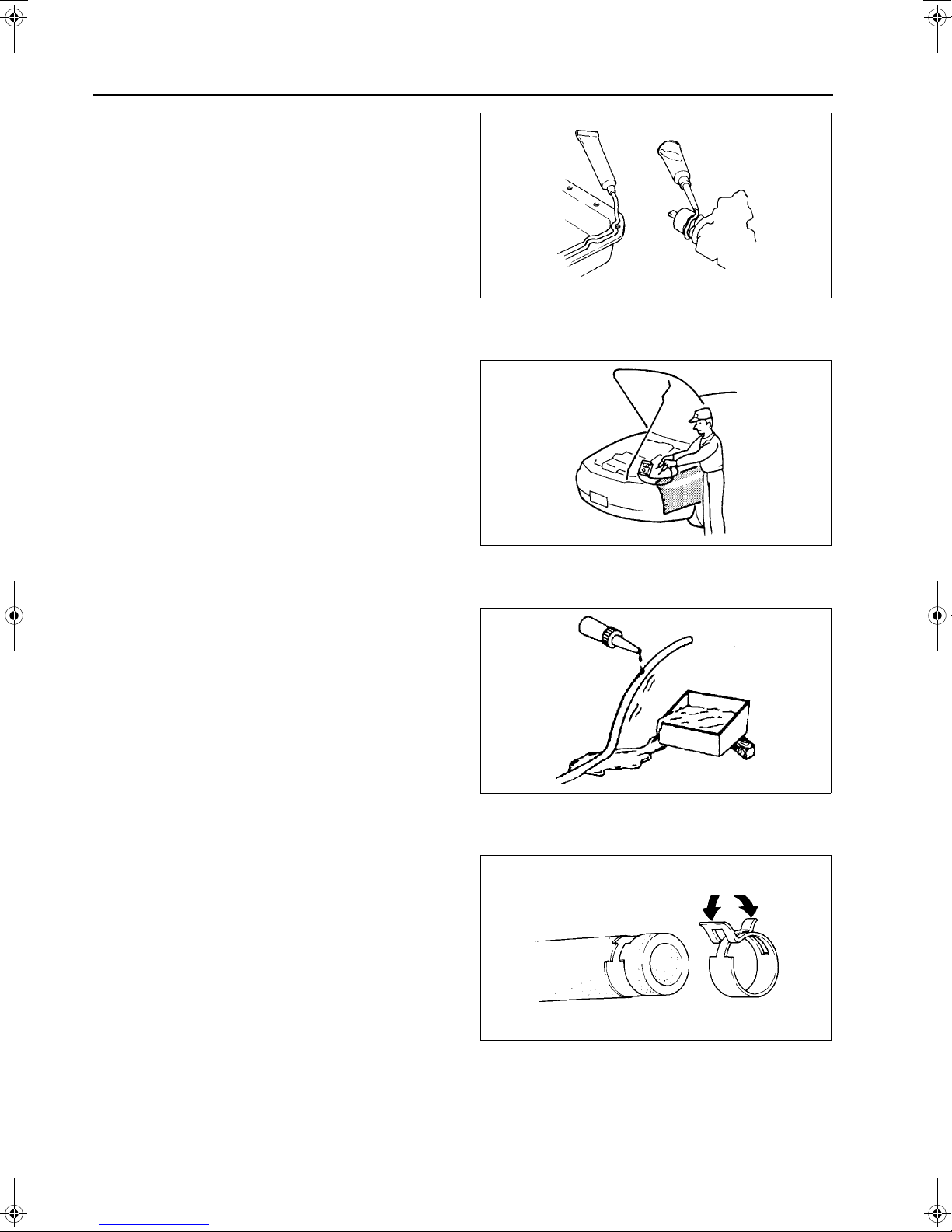
•Depending on location:
—Sealant and gaskets, or both, should be
applied to specified locations. When sealant
is applied, parts should be installed before
sealant hardens to prevent leakage.
—Oil should be applied to the moving
components of parts.
—Specified oil or grease should be applied at
the prescribed locations (such as oil seals)
before reassembly.
End Of Sie
ADJUSTMENT A6E201400004E12
•Use suitable gauges and/or testers when making
adjustments.
End Of Sie
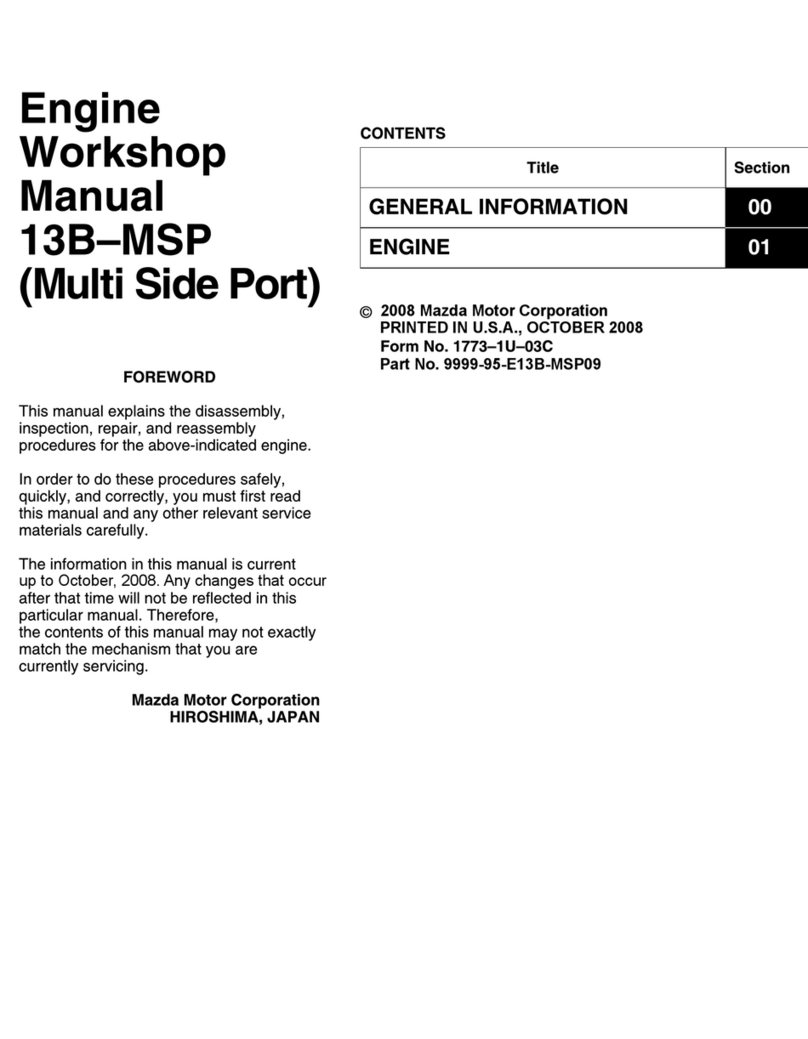
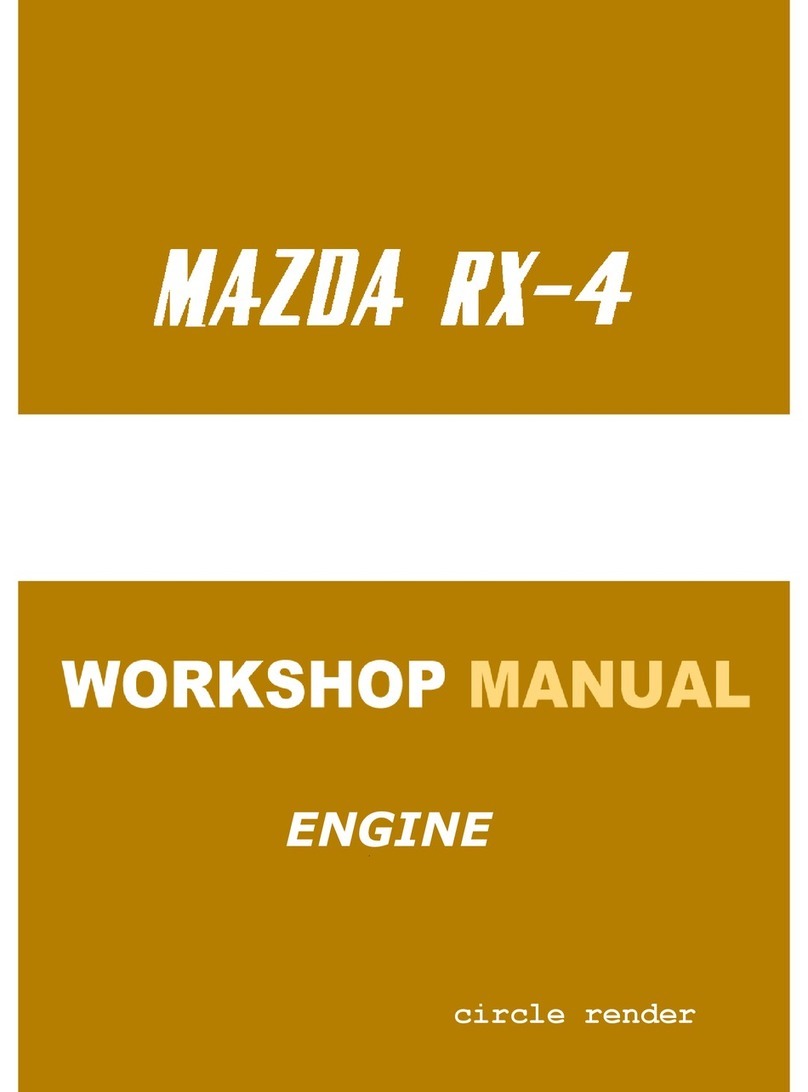
RUBBER PARTS AND TUBING A6E201400004E13
•Prevent gasoline or oil from getting on rubber
parts or tubing.
End Of Sie
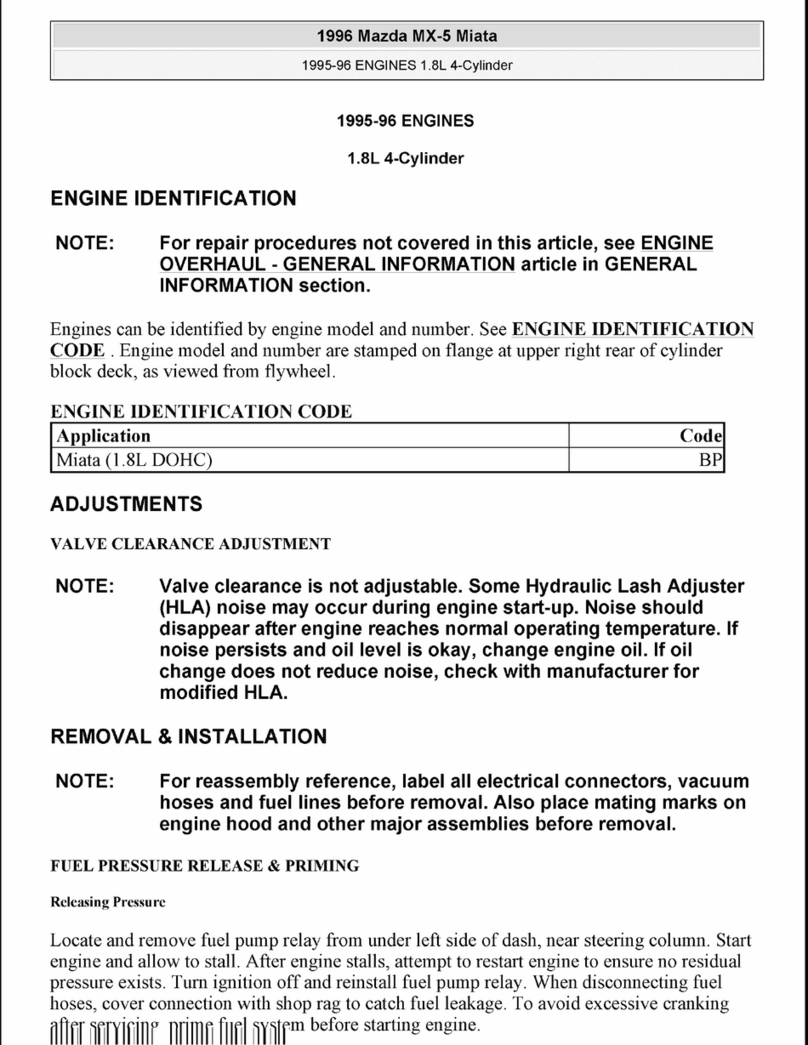
HOSE CLAMPS A6E201400004E14
•When reinstalling, position the hose clamp in the
original location on the hose and squeeze the
clamp lightly with large pliers to ensure a good fit.
End Of Sie
WGIWXX0032J
X3U000WAS
WGIWXX0034E
WGIWXX0035J
1731‑1E‑02C.book8ページ2002年4月26日 金曜日 午前10時30分
This manual suits for next models
2
Table of contents
Other Mazda Engine manuals