Page 4 2 Meinberg GPS Antenna/Converter Unit
2.1 Mounting the GPS Antenna
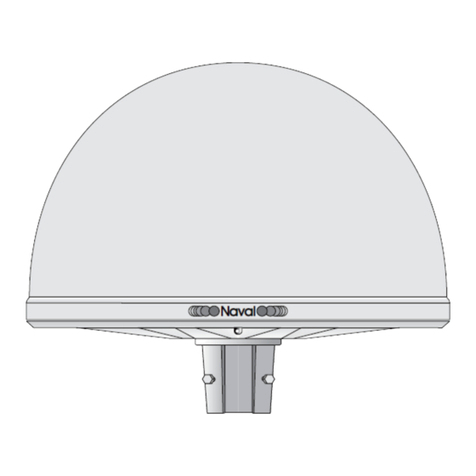
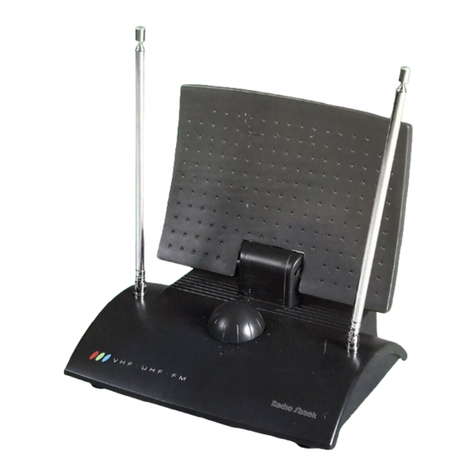
The GPS satellites are not stationary, but circle round the globe with a period of about 12 hours. They can only
be received if no building is in the line-of-sight from the antenna to the satellite, so the antenna/downconverter
unit must be installed in a location that has as clear a view of the sky as possible. The best reception is achieved
when the antenna has a free view of 8
◦
angular elevation above the horizon. If this is not possible, the antenna
should be installed with the clearest free view to the equator, because the satellite orbits are located between
latitudes 55
◦
North and 55
◦
South. If this is not possible, you may experience diculty receiving the four satellites
necessary to complete the receiver's position solution.
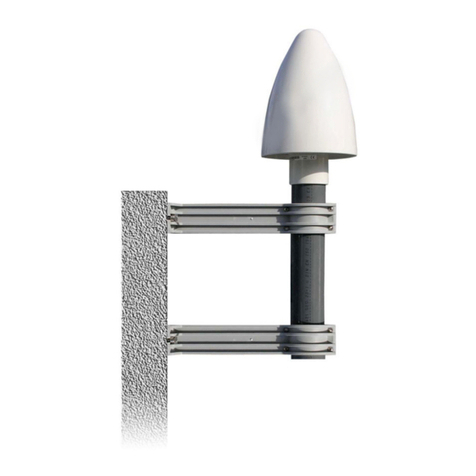
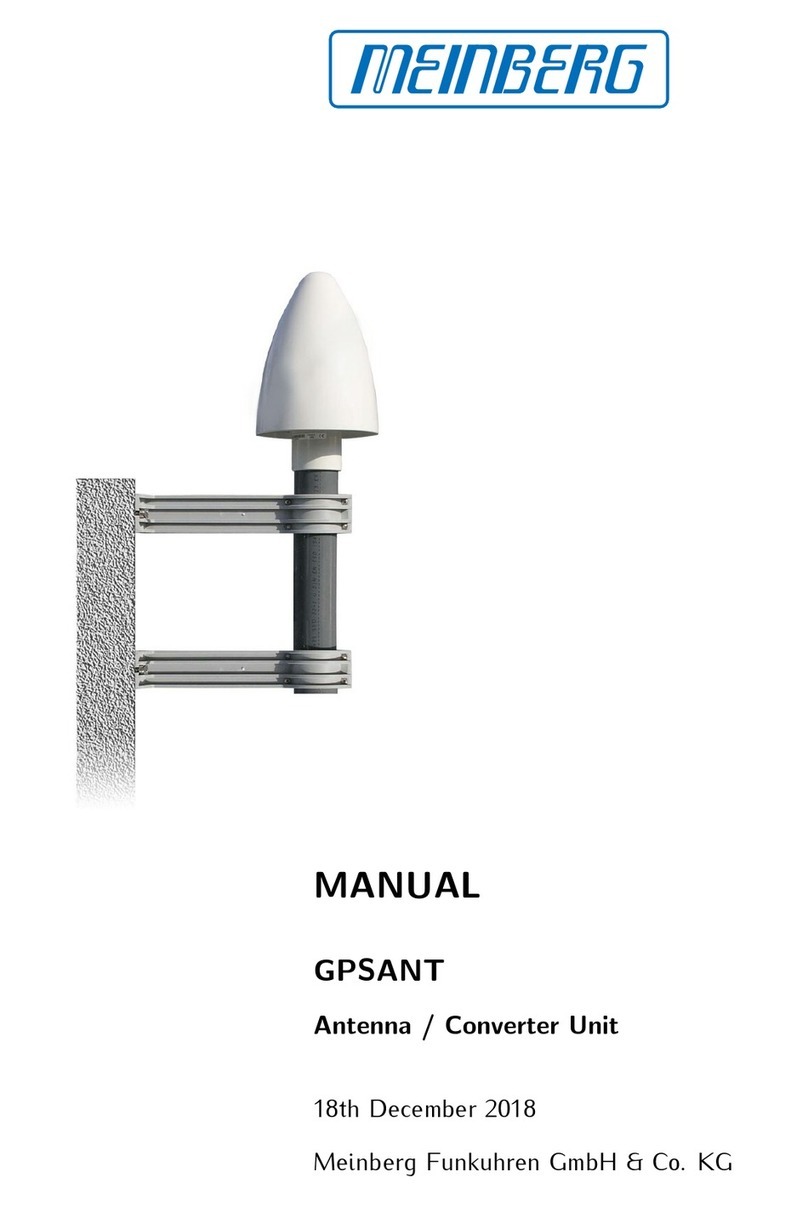
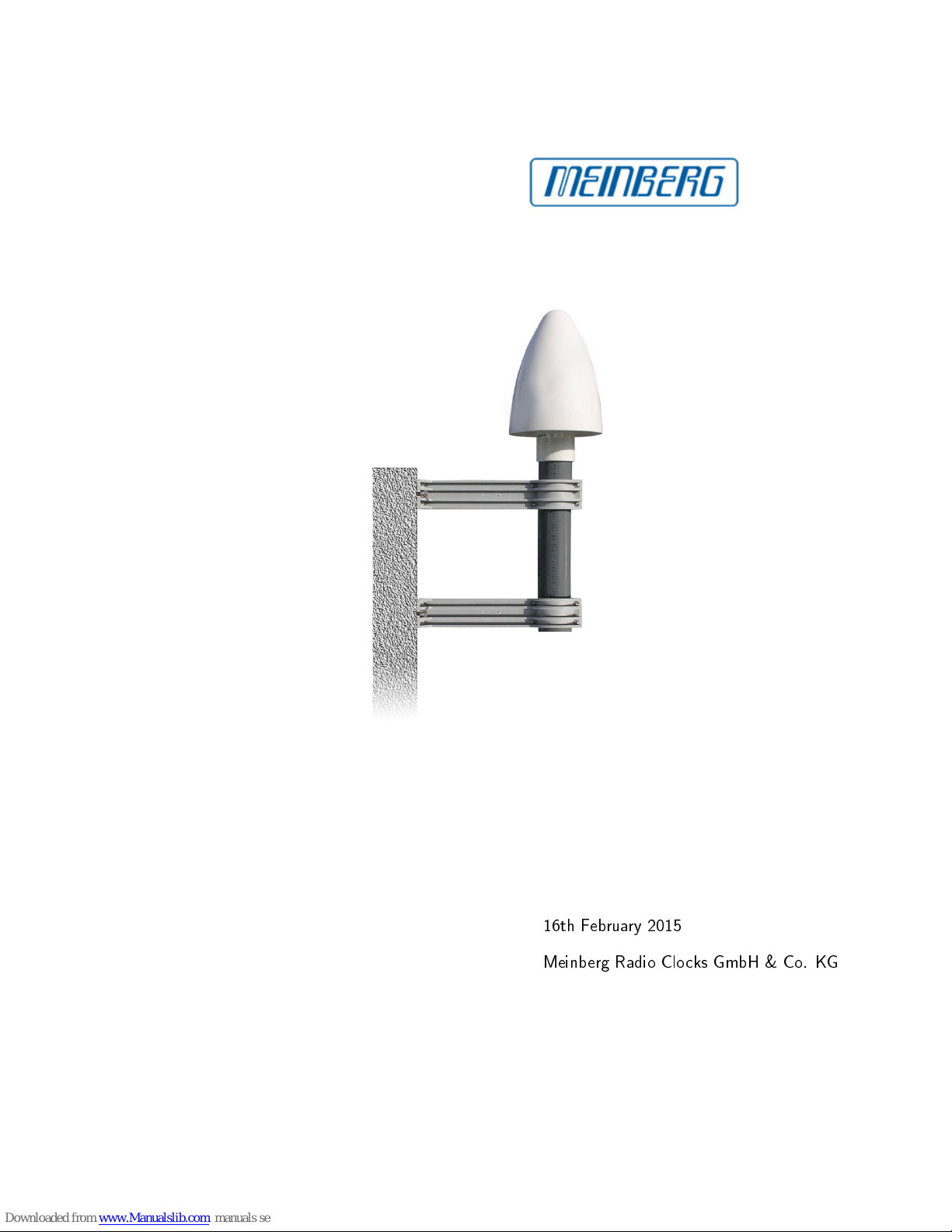
The antenna/converter unit can be mounted on a wall, or on a pole up to 60 mm in diameter. A 50 cm
plastic tube, two wall-mount brackets, and clamps for pole mounting are included. A standard RG58 coaxial
cable should be used to connect the antenna/downconverter unit to the receiver. The maximum length of cable
between antenna and receiver depends on the attenuation factor of the coaxial cable.
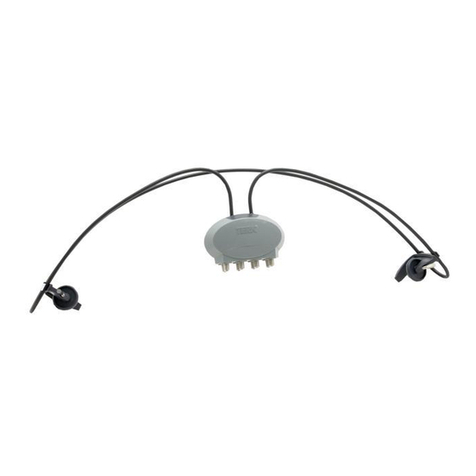
Up to four receivers can be run with one antenna/downconverter unit by using an optional antenna splitter.
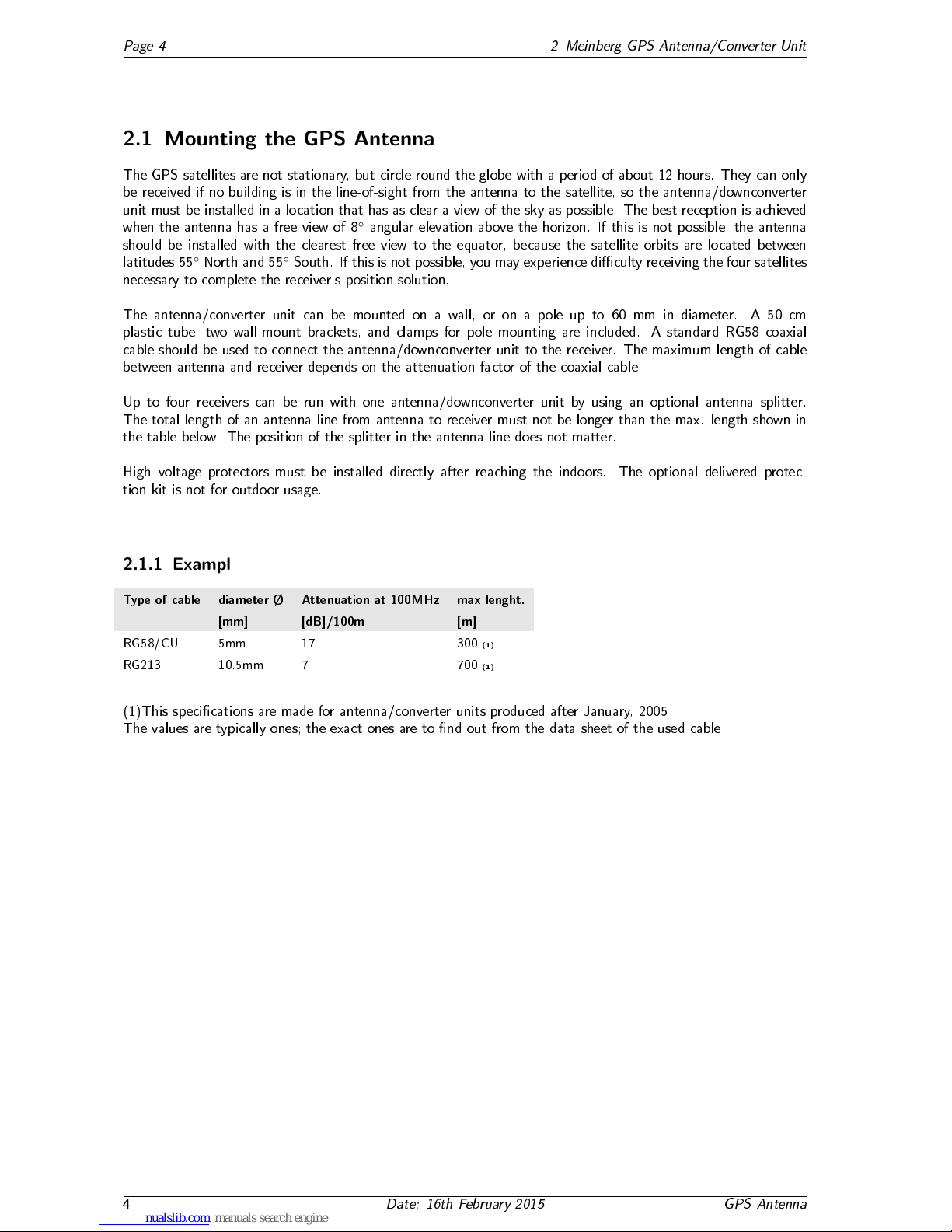
The total length of an antenna line from antenna to receiver must not be longer than the max. length shown in
the table below. The position of the splitter in the antenna line does not matter.
High voltage protectors must be installed directly after reaching the indoors. The optional delivered protec-
tion kit is not for outdoor usage.
2.1.1 Example:
Type of cable diameter Ø Attenuation at 100MHz max lenght.
[mm] [dB]/100m [m]
RG58/CU 5mm 17 300
(1)
RG213 10.5mm 7 700
(1)
(1)This specications are made for antenna/converter units produced after January, 2005
The values are typically ones; the exact ones are to nd out from the data sheet of the used cable
4
Date: 16th February 2015 GPS Antenna