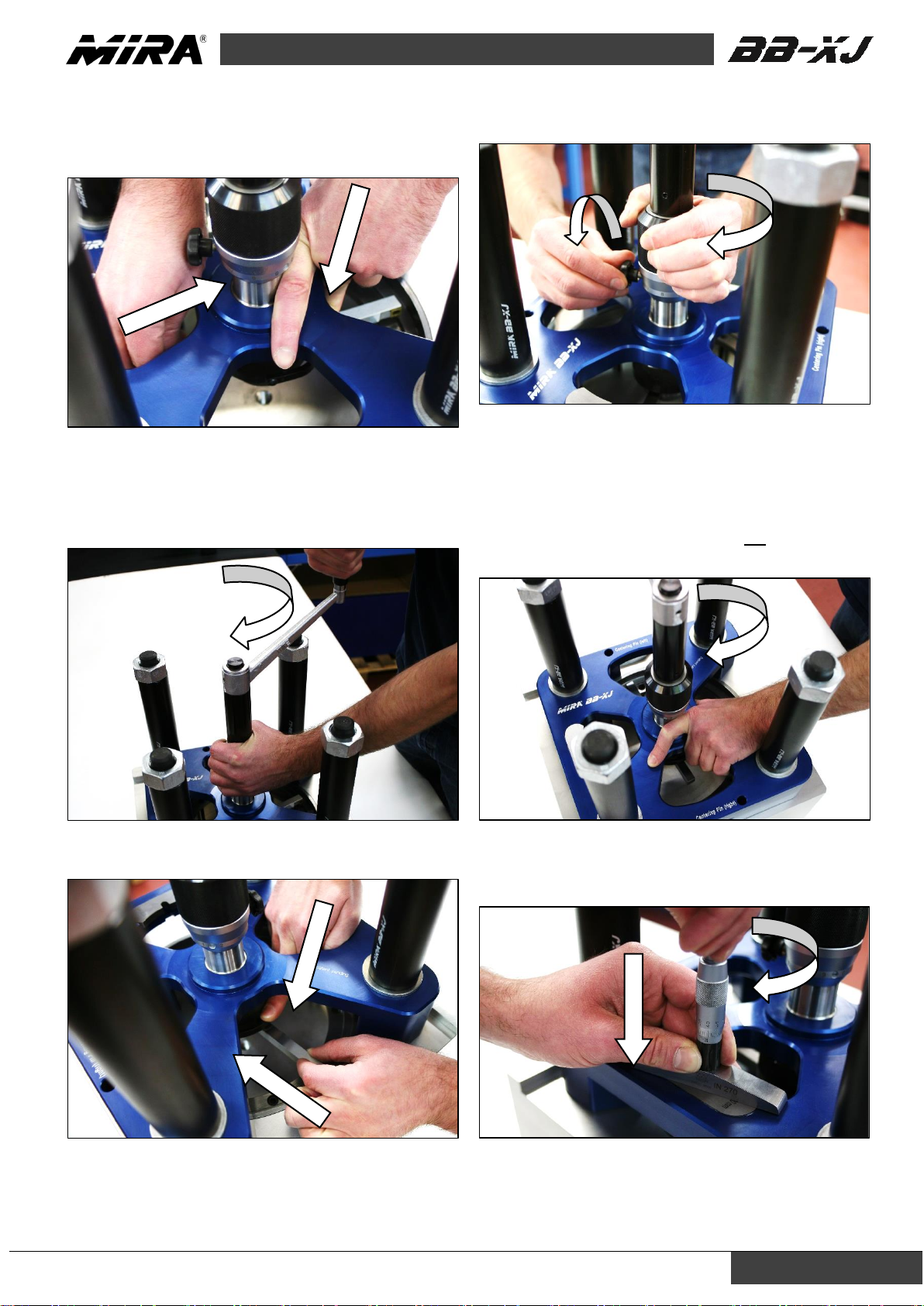
7. Press the clamp down and position the turning tool with the
cutting edge over the middle of the counterbore diameter. If
the turning tool is set too low, release the locking screw and
twist the feed nut upwards anticlockwise.
8. If not yet done, release the blocking screw. Turn the crank
handle clockwise and slowly move the feed nut off and on in
the same direction. Stop when the turning tool is slightly
touching the counterbore seat (spotting). Gently tighten the
locking screw.
9. Press the clamp down and position the turning tool just
before the counterbore seat. Release the clamp.
10. Release the locking screw. Set the desired seat depth
using the feed nut. Gently tighten the locking screw once
again. Do not feed more than 0,1mm in a single step!
11. Hold the gear sleeve on the knurled surface with your
thumb and index finger. Turn the crank handle evenly
clockwise. Once the turning tool has reached the wall of the
counterbore, slow down the rotation slightly and allow the
gear sleeve to gently make contact with your fingers. As
soon as the cutting edge is reaching the sidewall of the
counterbore, the cutting pressure and therefore the
rotational resistance will increase. Do not turn the crank
handle anticlockwise in this step!
12. Check the deployment of the BB-XJ using a depth
gauge bolt. Reference height (gauge slide) to contact
surface => 60,000mm. The measurement is made to check
the depth of the counterbore after refacing the seat.
13. If final depth has not been achieved yet, repeat steps
9-12. If the final depth has been achieved, press the clamp
down and carefully slide back the turning tool up to the front
of the counterbore seat.
For further refacing of outstanding counterbore seats:
Repeat steps 3-13