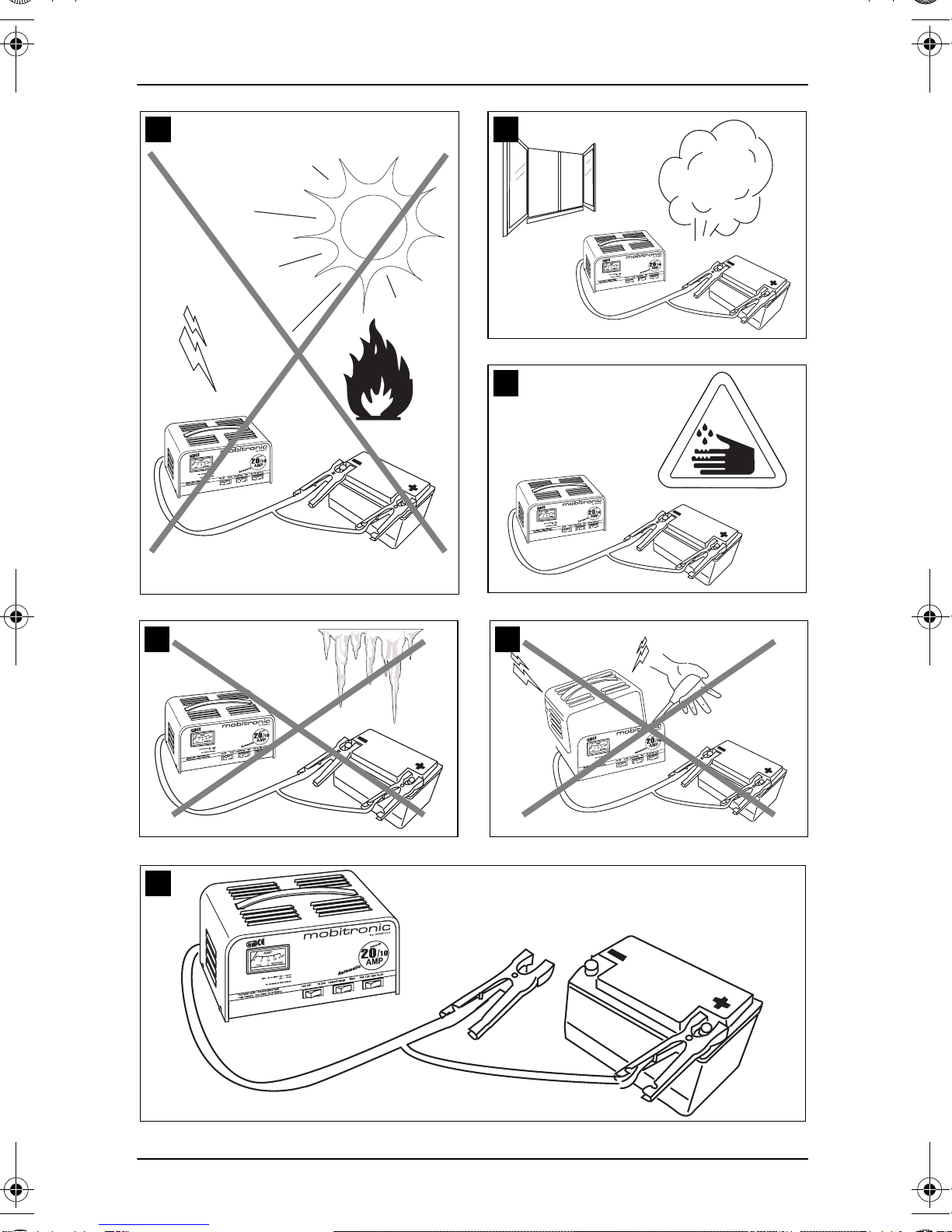
Using the battery charger battery charger
10
➤Check the level of the battery fluid.
If the fluid is below the minimum level in one or more cells, add distilled
water until the fill mark is reached.
Never use normal tap water.
➤During the entire charging procedure, leave the cells open so that any
gases produced can dissipate.
Clamping the battery charger
➤Make sure that the device is notconnected to the 240-V mains connec-
tion.
➤Set the Bswitch (Fig. 8, page 3) to “Laden/Charge”.
➤Determine whether you are charging a 12-V or 24-V battery.
➤Set the Cswitch (Fig. 8, page 3)
– to “14 A/12 V” for a 12-V battery
–to “8A/24 V” for a 24-V battery
➤Connect the red plus clamp of the battery charger to the positive pole (+)
of the battery (see Fig. 6, page 2).
When connected as normal, the positive pole is not connected
with the vehicle body.
➤Connect the black minus clamp of the battery charger to the negative pole
(-) of the battery (see Fig. 7, page 3).
When connected as normal, the negative pole is connected with
the vehicle body.
➤Now plug the mains plug into an earthed and properly fuse-protected
240-V mains socket.
If you are uncertain, consult a specialist.
✓The batteryis then charged.
Depending on the charge level and battery type, it can take up to 20 hours
to completely charge the battery.
✓The ammeter displays the actual charging current.
MBC-2000.book Seite 24 Mittwoch, 30. Juni 2004 5:19 17