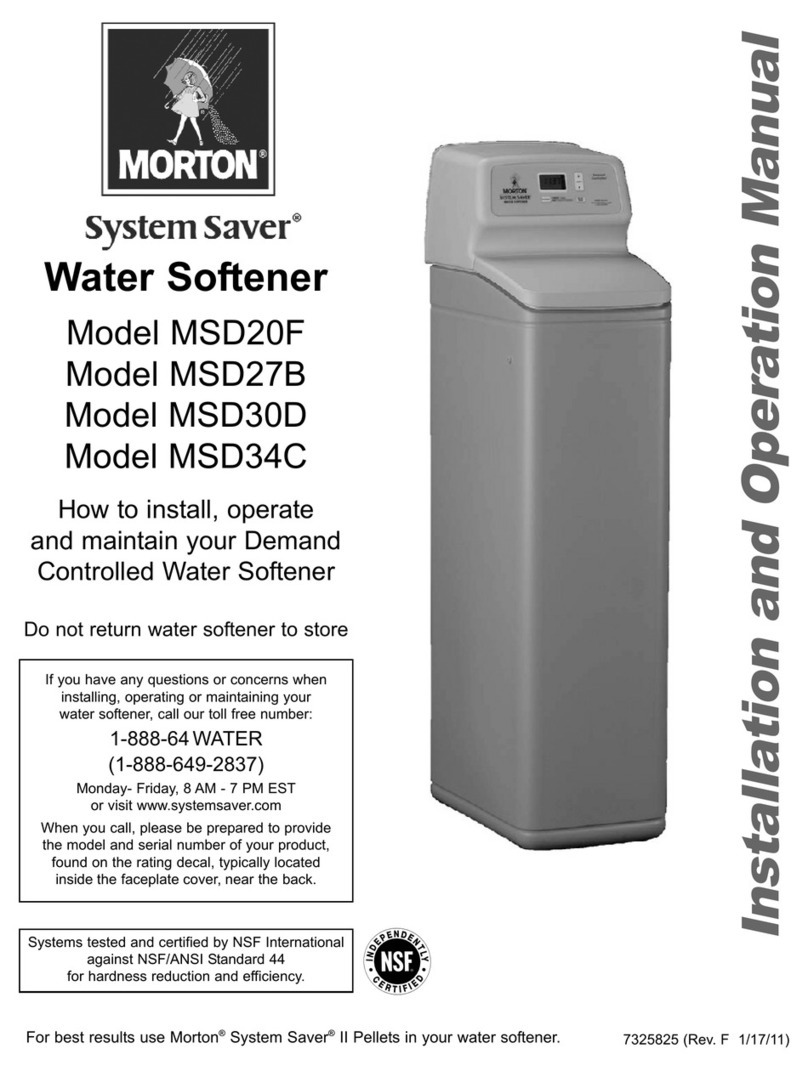
MortonrWater Softener Installation & Operation Manual 7
BEFORE STARTING INSTALLATION
"WHERETOINSTALLTHESOFTENER ................................................
Place the softener as close as possible to the
pressure tank (well system) or water meter (city
water).
Place the softener as close as possible to a floor
drain, or other acceptable drain point (laundry
tub, sump, standpipe, etc.).
Connect the softener to the main water supply
pipe BEFORE or AHEAD OF the water heater.
DO NOT RUN HOT WATER THROUGH THE
SOFTENER. Temperature of water passing
through the softener must be less than 120_F
(49_C).
Keep outside faucets on hard water to save soft
water and salt.
Put the softener in a place water damage is least
likely to occur if a leak develops. The manufac-
turer will not repair or pay for water damage.
A 120V, 60 Hz electrical outlet, to plug the in-
cluded power supply into, is needed near the
softener. Be sure the electrical outlet and
power supply are in an inside location, to
protect from wet weather.
If installing in an outside location, you must take
the steps necessary to assure the softener,
installation plumbing, wiring, etc., are as well
protected from the elements, contamination,
vandalism, etc., as when installed indoors.
Keep the softener out of direct sunlight. The
sun’s heat may soften and distort plastic parts.
"TOOLS,PIPEandFITTINGS,OTHERMATERIALSYOUWILLNEED ....................
GPlastic inlet and outlet fittings included with the
softener allow water flow equivalent to 1” (nominal)
pipe. To maintain full valve flow, 1” pipes to and from
the softener fittings are recommended. You should
maintain the same, or larger, pipe size as the water
supply pipe, up to the softener inlet and outlet.
GUse copper, brass, or galvanized pipe and fittings.
Some codes may also allow PVC plastic pipe.
GALWAYS install the included bypass valve, or 3
shut-off valves. Bypass valves let you turn off water
to the softener for repairs if needed, but still have
water in the house pipes.
GA length of 3/8” inside diameter flexible hose is pro-
vided for the valve drain. See step 6 on page 10.
NOTE: Avoid drain hose runs longer than 30 feet.
Avoid elevating the hose more than 8 feet above the
floor. Make the valve drain line as short and direct as
possible.
GIf local codes do not allow use of a flexible drain
hose, a rigid valve drain run must be used. Purchase
a compression fitting (1/4 NPT x 1/2” minimum tube)
and 1/2” copper tubing from your local hardware
store. Plumb a rigid drain line as needed (See Fig-
ure 3 on page 10). Comply with plumbing codes.
GA length of 3/8” inside diameter hose is provided for
the salt tank drain. See step 7 on page 11. If a longer
length is needed, you can buy good quality, thick--
wall, flexible hose at most hardware stores or supply
houses.
GNugget or pellet water softener salt is needed to fill
the brine tank (see page 11 and 15).
"PLANHOWYOUWILLINSTALLTHESOFTENER .....................................
You must first decide how to run in and out pipes to
the softener. Look at the house main water pipe at
the point where you will connect the softener. Is the
pipe soldered copper, glued plastic, or threaded
brass/galvanized? What is the pipe size?
Now look at the typical installation illustration on
page 6. Use it as a guide when planning your partic-
ular installation. Be sure to direct raw, hard water
to the softener valve inlet fitting. The valve is
marked IN and OUT.