DM805-AI Digital Stepper Drive Hardware Operation Manual
Motion Control Products Ltd. P a g e | 1www.motioncontrolproduts.com
1. INTRODUCTION, FEATURES AND APPLICATIONS
Introduction
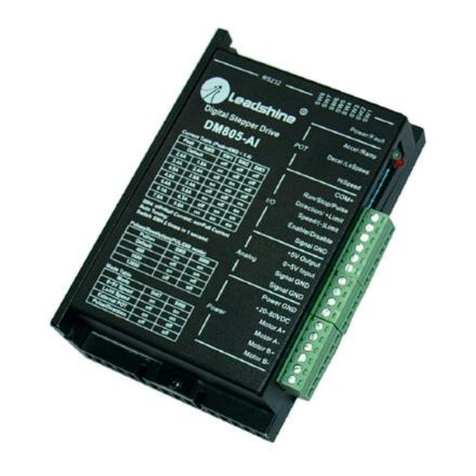
Motion Control Products Ltd (MCP)’s digital stepper drive DM805-AI is a digital stepper
drive with built-in oscillator, featured in supporting 0-5V analogue signal for speed
controls. Using the latest digital control algorithm, it brings a unique level of system
smoothness, providing optimum torque and nulls mid-range instability. The self-test and
auto-configuration technology offers optimum responses with different motors and easy-
to-use. The driven motors can run with much smaller noise, lower heating, smoother
movement than most of the drivers on the markets.
The three built-in potentiometers are used to pre-set and adjust the velocity, acceleration
and deceleration. In 0-5V speed mode, the motor speed is controllable and follows the
analogue 0-5V input. In high/low speed mode, the motor speed is selected by digital input
and adjusted by the high/low speed potentiometers. The user can run the motor with the
least configuration and connection. In position mode, the DM805-AI digital stepper drive
can be used as a traditional stepper drive. There is a 5V power supply output for
customer’s use.
Features
Anti-Resonance, provides optimum torque and nulls mid-range instability
Motor self-test and parameter auto-setup technology, offers optimum responses
with different motors
Multi-Stepping allows a low resolution step input to produce a higher microstep
output for smooth system performance
Command Source: 0-5V, built-in potentiometer and pulse
Two preset velocity and adjust by built-in potentiometer
Preset acceleration/deceleration and adjust by built-in potentiometer
Velocity control mode via 0-5V and position control mode via pulse Built-in pulse
generator nulls external motion controller
Supply voltage up to +80 VDC
Output current programmable, from 0.3A -5.0A (RMS)
TTL compatible and optically isolated digital input
Automatic current reduction
Over-voltage, over-current, phase-error protections