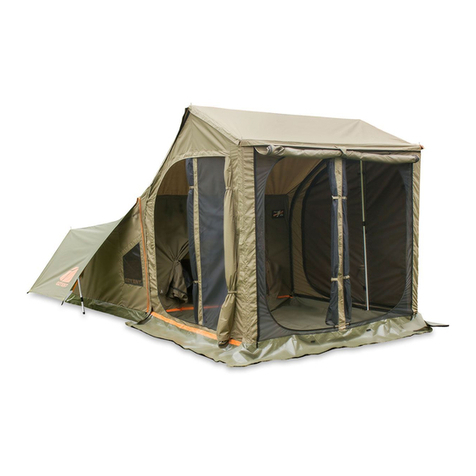
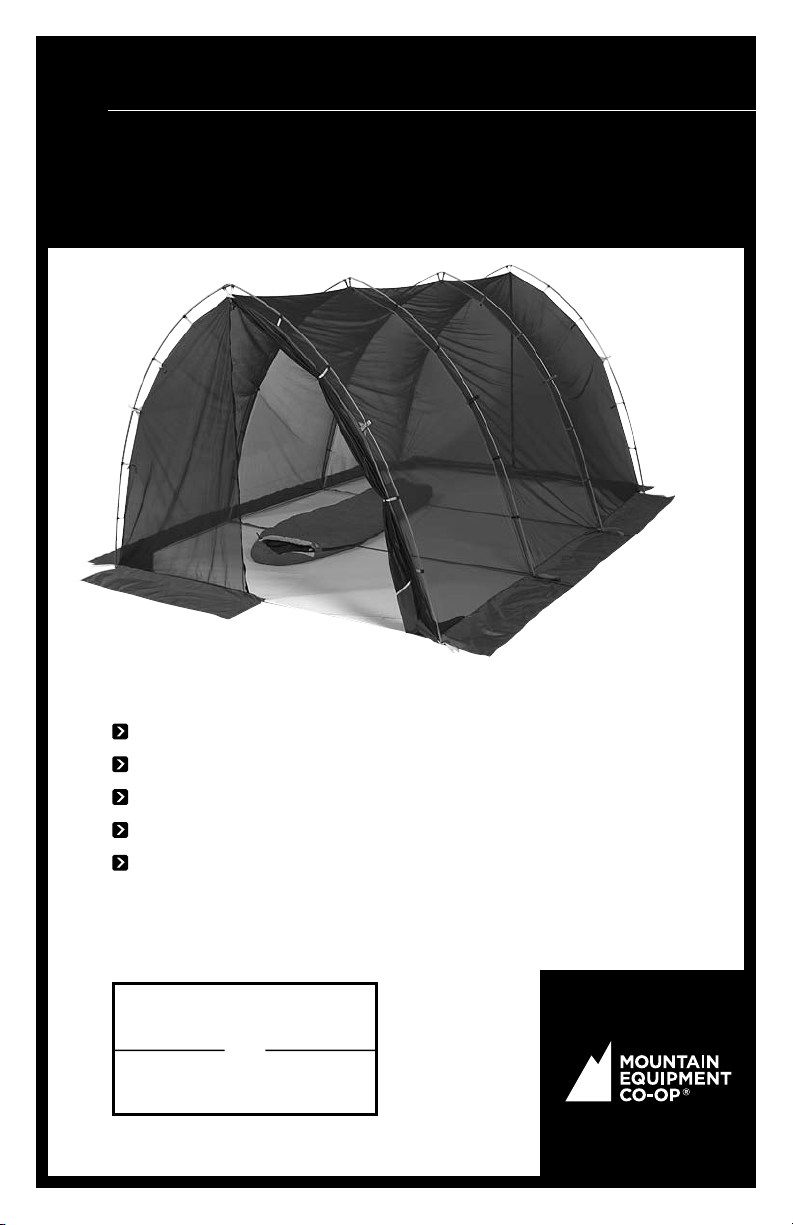
The Mesh Hall has oor-level ground aps, which seal the bottom against
most ying insects, such as mosquitoes. Lay them inside or outside of the
shelter as desired: laying them on the inside gives the easiest seal against
bugs because the aps overlap more in the corners; this arrangement also
provides a small “oorspace” around the perimeter of the inside of the shelter.
Laying the aps on the outside keeps them out of the way of stomping feet
(a consideration if you have a large group of campers). In either case, dead
wood, sand, duff, pebbles or other natural materials may be placed on the
aps to improve the seal against bugs and help anchor the shelter down.
Please restore the appearance of the shelter site as you break camp.
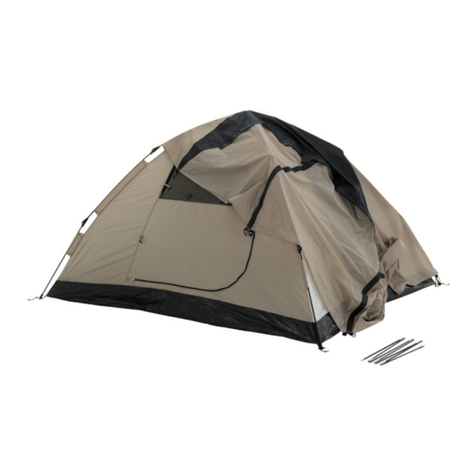
The wire stakes supplied are suitable for general use on relatively soft ground.
Where better holding power is required, use the supplied tubing stakes.
For really hard-packed ground you may wish to get a few stronger (and
heavier!) stakes that can withstand the more forceful hammering needed
to drive them in. On sand, snow, or other loosely-packed surfaces, wider
T-Stakes or aluminum snow stakes will hold better. These stakes hold best
if buried horizontally — dead-man style.
For even more solid anchors, experiment with hiking staffs, ski poles,
ice axes, branches, rocks, trees, or logs; t these improvised “stakes”
directly through the shelter’s stake loops, or attach them with cord as
required. When packing for your trip, think about the conditions you’ll
likely encounter and what sort of anchors you’ll be using. In many cases
six pegs, plus materials available at the site will be enough.
When taking down the shelter, be careful not to stress the poles and
fabrics. Disassemble the shelter by reversing the assembly instructions
above. The ap fabric is strong, but care is still required not to tear it
when taking the shelter down if it has become frozen in, or has wood or
sand piled on it.
The shelter and poles may be carried separately for easier packing or
load sharing. If carrying the pole sack on the outside of a pack, be sure
the drawcord is securely attached to the pack to prevent loss. A pole tip:
the short angled middle section of each pole has one longer and one
shorter adjoining section. If you leave the angled section plugged into the
shorter section rather than into the longer one, the nal pole package will
be shorter; experiment to see which side is the correct one to unplug. You
may wish to mark the shorter section with a piece of tape as a reminder.