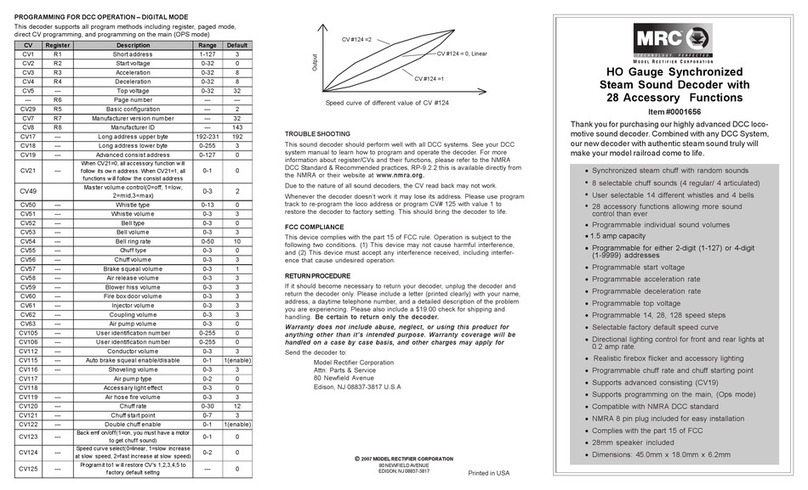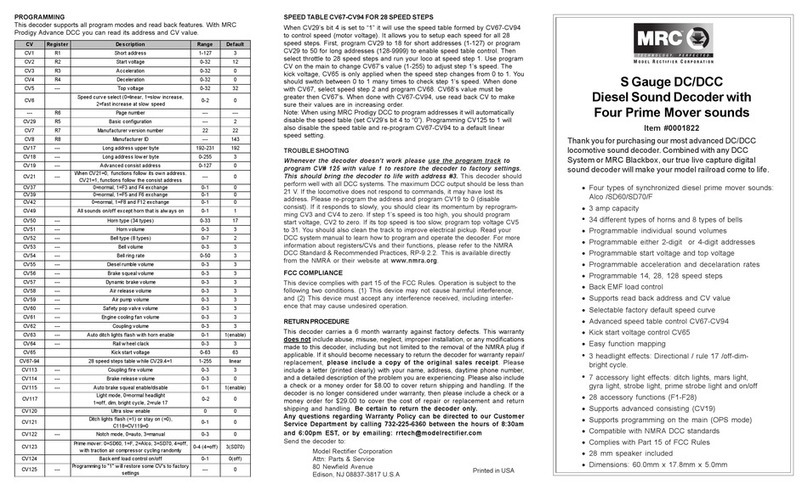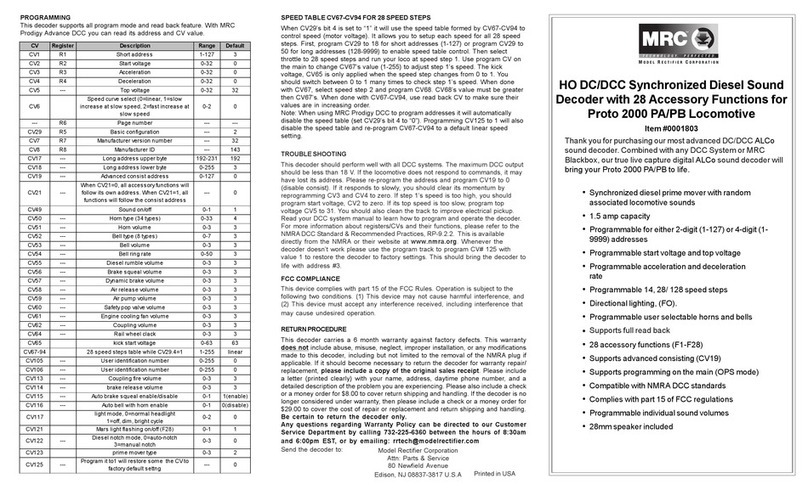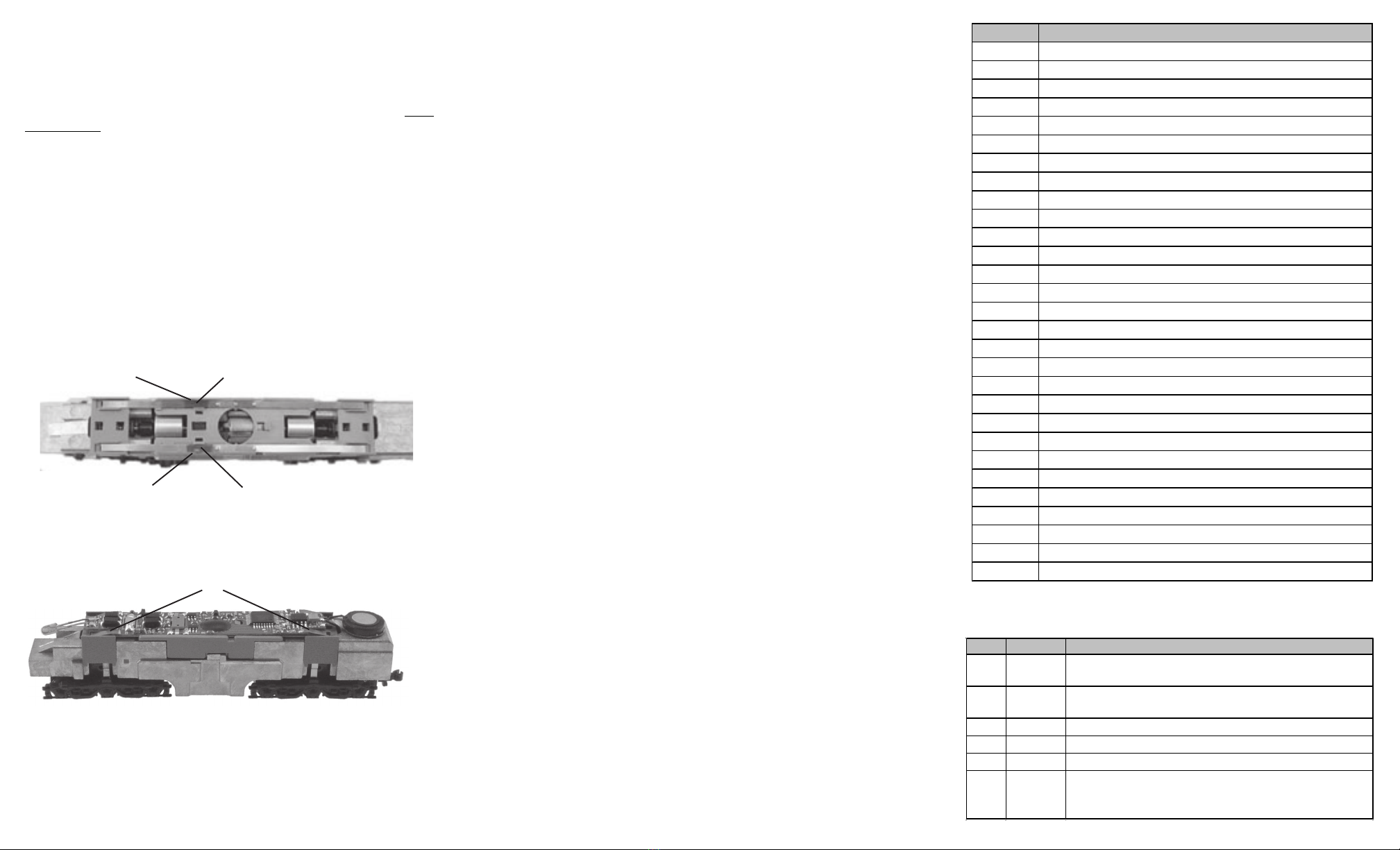
Function Idle/Moving
F0 Headlight On/Off [only forward]
F1 Bell on/off
F2 Horn
F3 air release
F4 Coupling 1
F5 Brake release (idle) / brake squeal (moving)
F6 Dynamic brake on/off
F7 Air hose firing/uncoupling lever
F8 3 times will shut down when in idle / Manual notch down
F9 Engine cooling fan / Manual notch up
F10 Rail wheel clack (only moving)
F11 Traction air compressor
F12 Change prime diesel mover type (CV123, 6 types)
F13 Master volume reduce by 1 / air release when reach minimal
F14 Master volume increase by 1/ air release when reach maximal
F15 Air compressor
F16 Flange squeal
F17 Air release
F18 Change bell type (8 types plus off)
F19 Horn type s elect (total 22 different horns plus off)
F20 Associated loco sound
F21 Change bell volume and turn on the bell
F22 Change horn volume
F23 Change diesel rumble volume
F24 Safety valve pop
F25 Air release
F26 Flange noise
F27 Sand drop
F28 Air release
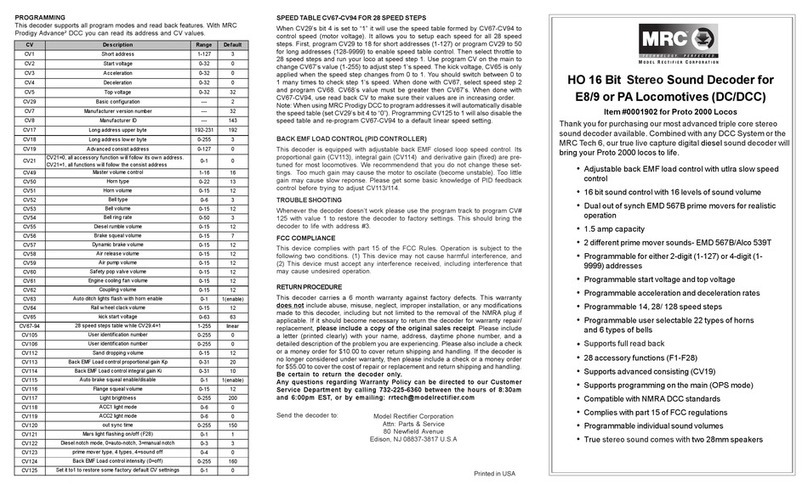
CV123 Prime mover
SD39, SD40, SD40A, SD40-2, SD40T-2, SD45. SDP45, SD45X, SD45-2,
SD45T-2, F45, FP45, DDA40X, GP15T, GP39, GP39-2, GP40, GP40-2
SW1000, SW1001, SW1500, SW1504, MP15DC, MP15AC, MP15T,
GP38, GP38-2, SD38, SD38-2, GP15AC, GP15-1
2 EMD710 SD70AC, SD70M-2
3 ALCO 244
4 ALCO 539T
F2A/B, F3A/B, F7A/B, F9A/B, BL1, BL2, FP7, FL9, FT, GP7, GP9, GP18,
GP28, E6, E7, E8, E9, NW2, NW3, NW4, SW1, SW7, SW8, SW9, SW600,
SW900, SW1200
5 EMD567
0 EMD645E
1 EMD645
Suitable for the locomotive
RS-3, PA1, PB1
S-2, S-4, RS-1, RSC-1, RSD-1, DL-105, DL107, DL-108, DL-109, DL-110
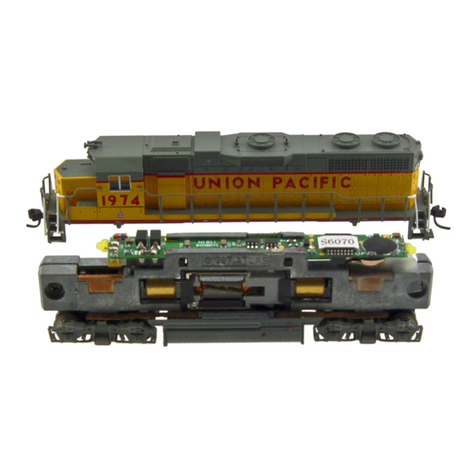
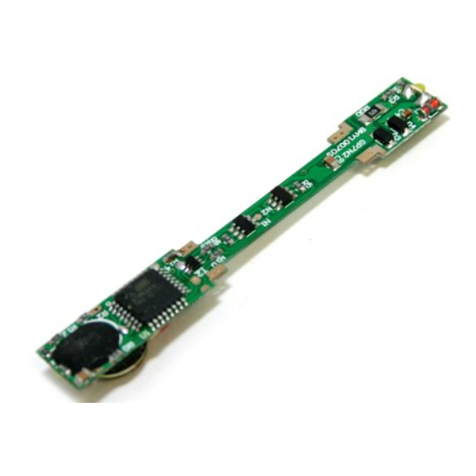
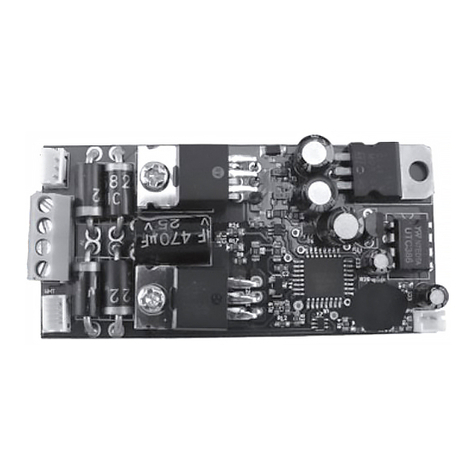
bend the 4 spring contacts on the PCB
Figure 2.
Figure 1.
trim off some plastic apply tape
apply tape
trim off some plastic
INSTALLATION
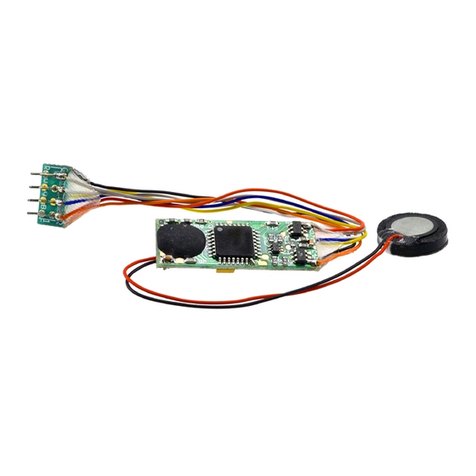
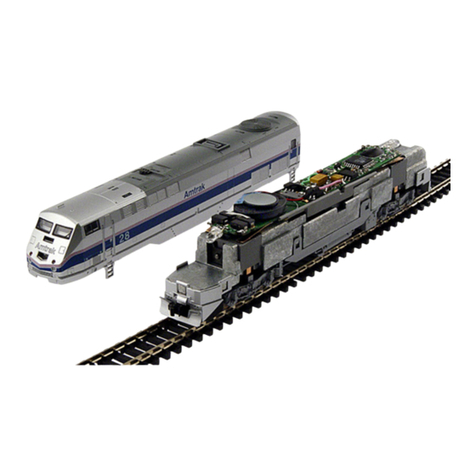
Your new Sound Decoder will virtually “drop-in” to a your Kato N scale PA1
series diesel locomotive. It may fit in many other N scale locomotives with slight
modification. Refer to the instructions that came with your Kato PA1
locomotive for removal of the body shell. Remove the original circuit board
by very carefully removing the plastic clip and sliding the PCB out. Don’t
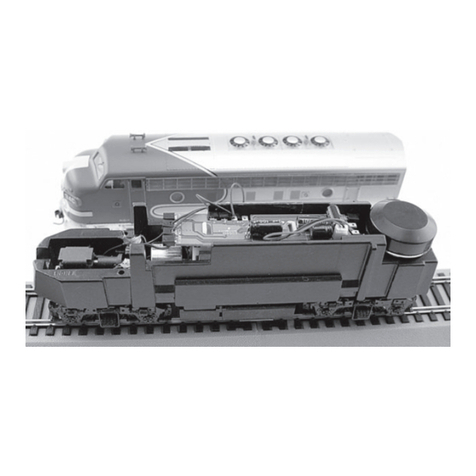
lose the clip. There are two wheel pickup contact strips. These strips
must be wrapped with tape approx. 1/4 wide (as shown in the image
below) to prevent them from touching the motor leads. Trim off some
material from the plastic cradle under the motor brush tab area to
compensate for the tape thickness. After applying the tape and trimming
the plastic, reinstall the strips. before installing the new decoder, bend the
spring contacts under the rear of the decoder approx 45 degrees to
provide correct contact. Now, install the decoder in place of the original
PCB and reinstall the plastic clip you removed earlier. Apply a strip of tape
over the clip & down the chassis sides to help hold the decoder in place.
Re-install the body shell. Now your loco is ready to go to work on your
railroad.
DCC OPERATION
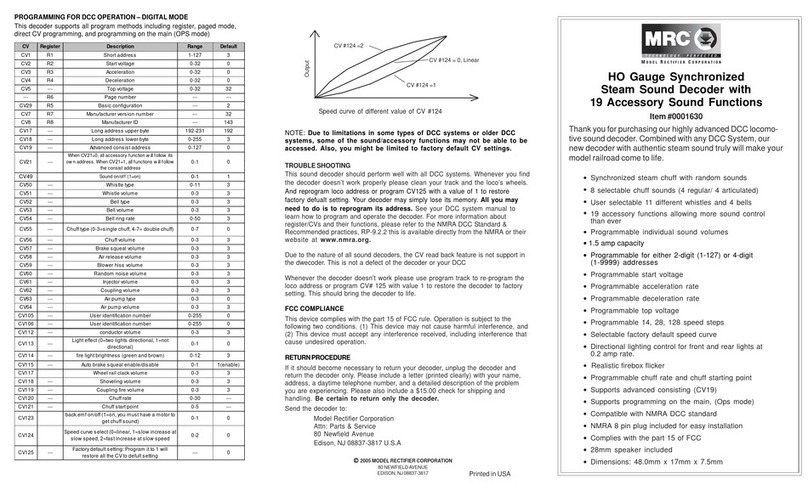
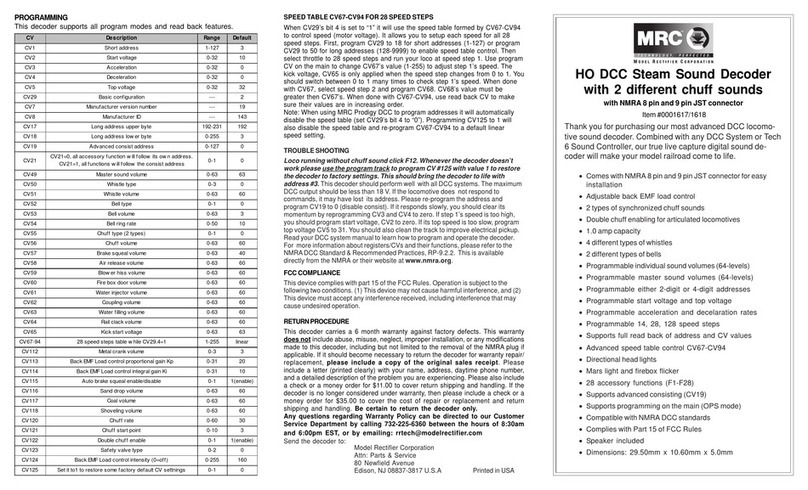
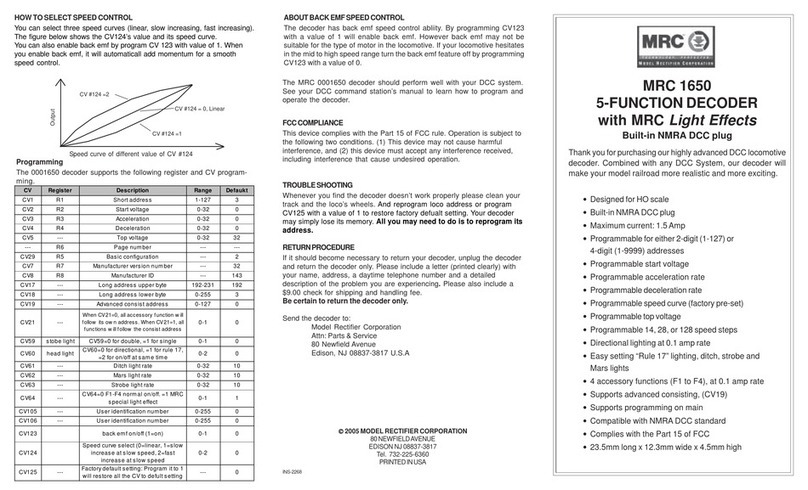
The decoders have been factory programmed with address #3, 28/128
speed steps and maximum top voltage. Select the “Run” mode of your
DCC system and select or acquire address #3. Move up the throttle and
the loco should move.
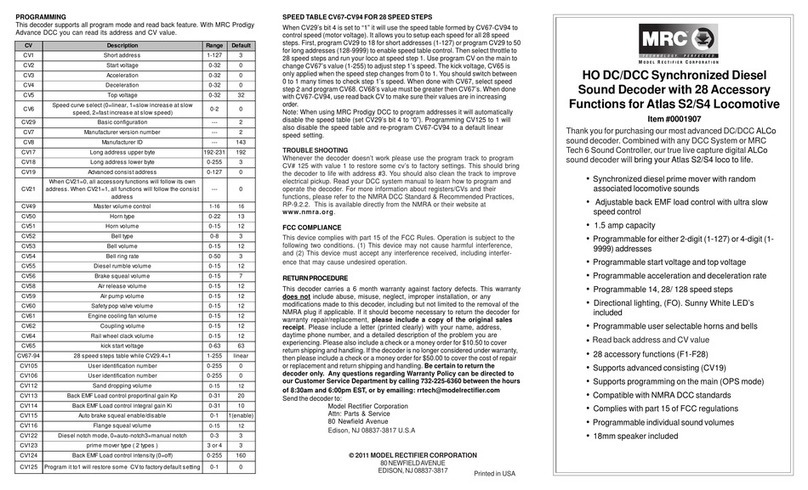
The decoder has 6 types of diesel prime mover sounds. You can use
F12 to change the prime mover sounds. You can also program CV123
to value of 0 to 5 to select the following primer mover for matching your
diesel engine. The CV123 table shows the 6 prime mover sounds and
their associated locomotive types.
The decoder has a start up and shut down feature. If the loco has been
previously shut down, you have to start up the engine by simply press-
ing any numbered function button. To shut down the engine you must
bring the loco to idle and then press F8 three times.
This decoder has 22 different horns. You can use F19 or program CV50
to select these 22 horns. You can also use F18 or program CV52 to
select different 8 bell sounds.
Most of the sounds have their own volume control CV. There is also a
master sound volume control CV49. Also F13 will reduce the master
volume by 1 (you will hear an air release when you reach CV49=1).
Pressing F14 will increase volume by 1 (you will hear an air release
when you reach CV49=16). Programming CV49 to 0 will shut the sound
off.
The decoder is defualt to automatic notching. You can program CV122
to 3 to set manual notching for realistic operation. And then use F9 to
notch up and use F8 to notch down. This simulates the way a real
locomotive operates.
This decoder is equipped with adjustable back EMF closed loop speed
control. Its proportional gain (CV113), integral gain (CV114) and derivative
gain (fixed) are pre-tuned for most locomotives. We recommend that you
do not change these settings. Too much gain may cause the motor to
oscilate (become unstable). Too little gain may cause slow response.
Please get some basic knowledge of PID feedback control before trying to
adjust CV113/114.
There are many more program features available with this decoder.
Please refer to the CV Chart to explore other features of the decoder.
Note: Bell, Dynamic Brake and Rail Wheel Clack cannot play at the same
time. If you activate the Bell sound [F1], while either the Dynamic Brake or
Rail Wheel Clack sounds are activated, the Bell sound will override the
other 2 sounds. Rail Wheel Clack cannot play while the loco is in idle.
When you turn off Dynamic Brake and Rail Wheel Clack sound there will
be one second delay.
DC OPERATION
With DC operation only the last programmed prime mover sound will
play, and you can’t control bells, horns, etc. We recommend you to use
MRC Tech 6 power pack, [item no. 0001200], for your DC operation. It
will enable the full range of sounds on a DC system.