9
Description
US
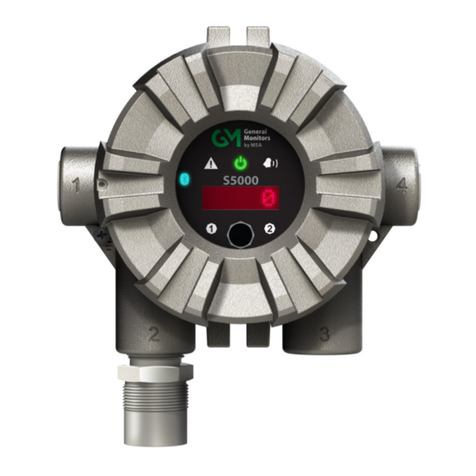
ULTIMA® X5000
2.5 Retrofit Installations
The ULTIMA X5000 has the conduit entries located in the exact same orientation and distance
from the wall and the mounting holes for attaching to a wall are identical to the Ultima X.
2.6 XCell Sensors Optimized for Fixed Gas Applications
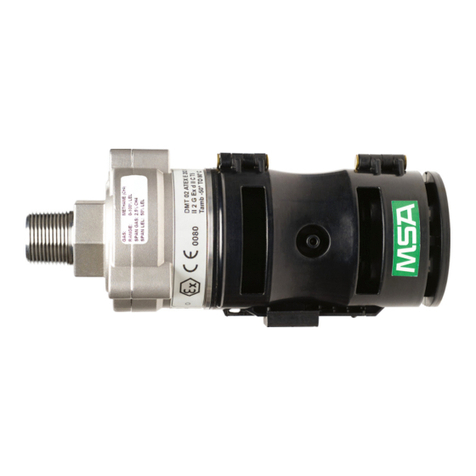
XCell toxic and combustible cat bead sensors are developed andmanufactured by MSA to be the
most shelf-stable and longest lasting sensors available. The XCell non-consuming reaction chem-
istry is tried-and-true, with over 600,000 used in MSA’s portable gas detectors. Now optimized for
fixed gas applications, the XCell sensor platform is available in the ULTIMA X5000 and provides
multiple benefits, including a standard 3-year warranty on all XCell sensors.
One important optimization for fixed gas was incorporating the GM catalytic bead into the XCell
sensor. When it comes to catalytic bead technology, bigger is definitely better. The GM cat bead
is the largest in the industry, providing market leading expected life time and stability.
Lead-based Oxygen sensors are notorious for short life times and poor stability. The XCell sensor
does not use lead, but rather a non-consuming reaction chemistry. The XCell Oxygen sensor is
expected to last well over 3-years and can be safely stored on the shelf for at least 1 year without
sensor performance degradation.
2.7 TruCal Sensing Technology for CO and H2S Electrochemical Sensors
TruCal saves time and money by doing the hard work for you. Using patented pulse check tech-
nology and proprietary Adaptive Environmental Compensation (AEC) algorithms, XCell sensors
with TruCal provide peace of mind for electrochemical sensors like never before.
Automated pulse checks are the muscle behind the TruCal technology. Every six hours, an elec-
trical pulse stimulates the XCell sensor similar to having actual calibration gas applied, providing
a snapshot of the sensor’s sensitivity at the time of the pulse. Using this sensitivity snapshot, the
sensor can diagnose sensor failures like electrode poisoning, electrolyte leaking, or electrical
connectivity issues. The sensitivity snapshots are mapped over time to provide an overall Life &
Health status as either “Good” or “Fair” if the sensor is approaching end of life.
But that’s not all. The brains of the TruCal technology lie within the proprietary Adaptive Environ-
mental Compensation (AEC) algorithms. AEC uses the sensitivity snapshots provided by the
pulse check to adjust sensor output, compensating for environmental impacts on sensor accu-
racy. If the AEC adjustment is greater than expected based on typical environmental impact vari-
ations, the transmitter LED’s will slow flash GREEN, indicating that the sensor should be
calibrated to reset the AEC cycle. The result is a sensor that actively self-monitors for operation
and accuracy, with far fewer manual calibrations.
Actual TruCal sensor performance will depend on the application, background gas exposure, and
environment. To validate XCell sensors with TruCal, it is recommended that users follow their
regular calibration cycle and record the “as found” and “as left” values. This data can be used to
extend the time between calibrations depending on the required specification of the application.
2.8 SafeSwap
The ULTIMA X5000 comes with patented SafeSwap technology, whichallows users to change or
replace XCell sensors without needing to power downtheinstrument. For addedconvenience, the
ULTIMA X5000 comes with Swap Delay enabledby default; a feature that gives users a 2 minute
window to change sensors without triggering a fault condition. For more information on SafeSwap
and Swap Delay, see section 4.2.1.
WARNING!
Aspartof the product certification, itwasverifiedthat optionalcommunication functionsofthis gas
detection instrument while operating at the maximum transaction rate do not adversely affect the
gas detection operation and functions of the instrument. The product certification, however, does
not include or imply approval of the SafeSwap feature, communications protocol or functions
provided by the software of this instrument or of the communications apparatus and software
connected to this instrument.