manuals.online logo
Brands
  1. Home
  2. •
  3. Brands
  4. •
  5. MTHTrains
  6. •
  7. Toy
  8. •
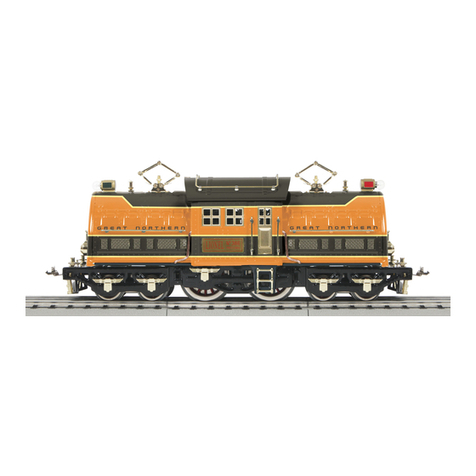
  9. MTHTrains RAILKING M-1a MOUNTAIN STEAM ENGINE User manual

MTHTrains RAILKING M-1a MOUNTAIN STEAM ENGINE User manual

Other MTHTrains Toy manuals
MTHTrains RAILKING MP-15 DIESEL ENGINE User manual
MTHTrains

MTHTrains RAILKING MP-15 DIESEL ENGINE User manual

MTHTrains RailKing 30-2132 User manual

MTHTrains

MTHTrains RailKing 30-2132 User manual

MTHTrains RailKing 30-9006 User manual

MTHTrains

MTHTrains RailKing 30-9006 User manual

MTHTrains Premier GP60 User manual

MTHTrains

MTHTrains Premier GP60 User manual
MTHTrains 30-2519-0 User manual

MTHTrains

MTHTrains 30-2519-0 User manual

MTHTrains 20-20776-1 User manual

MTHTrains

MTHTrains 20-20776-1 User manual

MTHTrains Center Copula Steel Caboose User manual
MTHTrains

MTHTrains Center Copula Steel Caboose User manual

MTHTrains RS-27 User manual

MTHTrains

MTHTrains RS-27 User manual

MTHTrains 30-5114-1 User manual

MTHTrains

MTHTrains 30-5114-1 User manual
MTHTrains RailKing 60ft Streamlined Passenger Cars User manual
MTHTrains

MTHTrains RailKing 60ft Streamlined Passenger Cars User manual

MTHTrains Jordan Spreader User manual

MTHTrains

MTHTrains Jordan Spreader User manual
MTHTrains PREMIER GP-40 DIESEL ENGINE User manual
MTHTrains

MTHTrains PREMIER GP-40 DIESEL ENGINE User manual

MTHTrains RAILKING ES44 User manual

MTHTrains

MTHTrains RAILKING ES44 User manual

MTHTrains BIG BOY User manual

MTHTrains

MTHTrains BIG BOY User manual
MTHTrains RAIL KING FP45 DIESEL ENGINE User manual
MTHTrains

MTHTrains RAIL KING FP45 DIESEL ENGINE User manual

MTHTrains PREMIER GP-7 DIESEL ENGINE User manual
MTHTrains

MTHTrains PREMIER GP-7 DIESEL ENGINE User manual

MTHTrains RAILKING 4-6-2 K-4s User manual
MTHTrains

MTHTrains RAILKING 4-6-2 K-4s User manual

MTHTrains RailKing NYC 4-6-4 User manual
MTHTrains

MTHTrains RailKing NYC 4-6-4 User manual

MTHTrains Premier BL-2 Diesel Engine User manual

MTHTrains

MTHTrains Premier BL-2 Diesel Engine User manual

MTHTrains DL-109 DIESEL ENGINE User manual

MTHTrains

MTHTrains DL-109 DIESEL ENGINE User manual
MTHTrains 60ft Streamlined Full Vista Dome Car User manual

MTHTrains

MTHTrains 60ft Streamlined Full Vista Dome Car User manual

MTHTrains Scale Premier F-3 ABA User manual

MTHTrains

MTHTrains Scale Premier F-3 ABA User manual

MTHTrains Tinplate 381E Electric Locomotive User manual

MTHTrains

MTHTrains Tinplate 381E Electric Locomotive User manual

MTHTrains Premier Gs-2 User manual

MTHTrains

MTHTrains Premier Gs-2 User manual

Popular Toy manuals by other brands
FUTABA GY470 instruction manual

FUTABA

FUTABA GY470 instruction manual

LEGO 41116 manual

LEGO

LEGO 41116 manual

Fisher-Price ColorMe Flowerz Bouquet Maker P9692 instruction sheet
Fisher-Price

Fisher-Price ColorMe Flowerz Bouquet Maker P9692 instruction sheet

Little Tikes LITTLE HANDIWORKER 0920 Assembly instructions

Little Tikes

Little Tikes LITTLE HANDIWORKER 0920 Assembly instructions

Eduard EF-2000 Two-seater exterior Assembly instructions
Eduard

Eduard EF-2000 Two-seater exterior Assembly instructions

USA Trains EXTENDED VISION CABOOSE instructions

USA Trains

USA Trains EXTENDED VISION CABOOSE instructions
Modellbau Laffont Z1601 Assembly instructions

Modellbau Laffont

Modellbau Laffont Z1601 Assembly instructions

NOCH 12905 instruction manual

NOCH

NOCH 12905 instruction manual

Eduard Ki-61-Id quick start guide

Eduard

Eduard Ki-61-Id quick start guide

Viessmann Vollmer 45616 Mounting instruction

Viessmann

Viessmann Vollmer 45616 Mounting instruction

Vollmer 42004 Mounting instruction

Vollmer

Vollmer 42004 Mounting instruction

Phoenix Model CLASSIC-EP instruction manual

Phoenix Model

Phoenix Model CLASSIC-EP instruction manual

H-KING Sopwith Camel British WW1 Fighter instruction manual

H-KING

H-KING Sopwith Camel British WW1 Fighter instruction manual

MODSTER Predator 4x4 Crawler user manual

MODSTER

MODSTER Predator 4x4 Crawler user manual

DHK Hobby 8136 User instruction manual

DHK Hobby

DHK Hobby 8136 User instruction manual

THUNDER TIGER Raptor 50 V2 kit manual

THUNDER TIGER

THUNDER TIGER Raptor 50 V2 kit manual

Timberkits Skateboarder instructions

Timberkits

Timberkits Skateboarder instructions

Hangar 9 Funtana 125 Assembly manual

Hangar 9

Hangar 9 Funtana 125 Assembly manual

manuals.online logo
manuals.online logoBrands
  • About & Mission
  • Contact us
  • Privacy Policy
  • Terms and Conditions

Copyright 2025 Manuals.Online. All Rights Reserved.

RAILKING M-1a MOUNTAIN
STEAM ENGINE
OPERATING INSTRUCTIONS
This RailKing M-1a Mountain Steam Engine is produced in detailed Die-Cast Metal and
operates on O-31 track.This RailKing Steam Engine contains M.T.H.’s Loco-Sound™
sound and train control system. The locomotive is easy to operate with any compatible
standard AC transformer (see the compatibility chart on page 14), and is completely
compatible with most other 3-rail locomotives, rolling stock, and accessories.
M.T.H. takes pride in manufacturing high quality products like your RailKing steam
engine, and we hope that you will enjoy it for a long time. Please read all the
accompanying instructions carefully before setting up and operating your locomotive.
With proper care, this engine should yield years of trouble-free performance.
2
RailKing M-1a Mountain Steam Engine
Table of Contents
Set Up 3
BasicOperation 4
Transformer Controls 4
Speed Control 5
Direction Lock 5
Proto-Cast and Proto-Dispatch 6
Volume Control 7
Maintenance 8
Lubrication and Greasing Instructions 8
Cleaning the Wheels, Tires and Track 9
Locomotive Traction Tire Replacement 9
Smoke Unit Maintenance 10
Locomotive Light Bulb Replacement 11
Troubleshooting 12
Compatibility 13
Transformer Compatibility Chart 14
Safety Precautions 15
Service and Warranty Information 16
3
RailKing M-1a Mountain Steam Engine
Set Up
There are a few simple steps you must take before operating this RailKing
steamer.
1. You should prime the operating smoke unit with smoke fluid before
operating. Add 15-20 drops of smoke fluid through the smokestack, then
gently blow into the stack to eliminate any air bubbles in the fluid. See Fig. 4
on pg. 10.
2. If you choose not to prime the unit with fluid, turn the smoke unit switch
located under the engine to the OFF position (Fig. 5 on pg 10). Running the
engine without a primed smoke unit may cause damage. See the “ProtoSmoke
Unit Operation” section of this book for more information on smoke unit
maintenance.
3. You should lubricate all side rods and linkage components and pickup
rollers to prevent them from squeaking. Use light household oil and follow the
lubrication points marked “L” in Fig. 2 on p. 8. Do not over-oil. Use only a
drop or two on each pivot point.
4. Put your engine on the track and insert the reverse unit plug that extends out
of the tender into the receptacle at the back of the engine. WARNING: DO
NOT CONNECT THIS ENGINE TO A TENDER FROM ANOTHER
ENGINE; IT MAY CAUSE SERIOUS DAMAGE. Look at the bottom of the
engine and tender where each will have a color-coded stamp. If they match
you may connect those two pieces; if not, don’t.
5. Connect the draw bar between the engine and tender. If there are two holes
in the draw bar, the hole located farthest from the tender is for the minimum
track operation, such as O-31 circles of track. The second hole is for O-72 or
larger operation.
At this point, you are ready to begin running your engine.
4
RailKing M-1a Mountain Steam Engine
Basic Operation
Transformer Controls
Use the operation controls on your transformer as described below.
Throttle - Throttle up the power to your track. Then put the engine into
motion by either firmly pressing the Direction button on your transformer or
remote once or dropping and advancing the throttle to put the engine in
forward.
Horn/Whistle - To sound the whistle, firmly press the Horn/Whistle button.
The whistle will sound for as long as you continue to depress the button. It
will stop when you release the button.
Bell - To sound the bell, firmly press and release the Bell button. To turn the
bell off, press and release the Bell button again. The bell will continue to ring
from the time your turn it on until you press and release the button again to
turn it off.
Direction - Your train is programmed to start in neutral. To put the engine
into forward and then to change the direction of the train or to put it into
neutral, firmly press and release the Direction button on your transformer. Just
as you must stop your car between forward and reverse, this engine will not go
directly from forward to reverse; it goes into neutral between directions. If the
train has been moving forward, the first press of the Direction button will put
the train from forward into neutral, the second press into reverse, the third
press back into neutral, and the fourth back into forward.To prevent accidental
high-speed start-ups, this engine is programmed to restart in neutral each time
the track voltage is turned off for 25 seconds or more.
Direction Lock:
You can lock your engine into a directional state (forward, neutral, or reverse)
so that it will not change directions. To do this, put the engine into the
direction you want or into neutral, to lock it into neutral, run it at a very slow
speed (< 10 scale mph), and quickly but firmly press your transformer’s
Whistle button once followed immediately by three presses of the Bell button.
The engine will not change direction (including going into neutral) until you
repeat the 1 whistle, 3 bells code to return the engine to its normal state.
5
RailKing M-1a Mountain Steam Engine
Speed Control:
M.T.H. engines equipped with Loco-Sound have speed control capabilities
that allow the engine to maintain a constant speed up and down grades and
around curves, much like an automobile cruise control. You can add or drop
cars on the run, and the engine will maintain the speed you set.
While the engine is programmed to start with the speed control feature
activated, you can opt to turn it off. This means the engine’s speed will fall as
it labors up a hill and increase as it travels downward. It is also affected by
the addition or releasing of cars while on the run.
To turn speed control on and off,put the engine in neutral, then press the
transformer’s Whistle button firmly but quickly one time then immediately
press the Bell button two times. Repeat the 1 whistle, 2 bells code to return it
to the other state. You will want to do this during the initial neutral upon
start-up if you ever couple this engine to another engine that is not
equipped with speed control to avoid damaging the motors in either
engine. Each time you shut down the engine completely, it will automatically
turn speed control on.
Feature to Be Activated:
Speed Control On/Off
Lock into a Direction/Unlock
Button Code:
1 Whistle, 2 Bells
1 Whistle, 3 Bells
6
RailKing M-1a Mountain Steam Engine
Proto-Cast and Proto-Dispatch:
When used with the RailKing Remote Lock-on (sold separately),
Loco-Sound-equipped engines gain Proto-Cast™and Proto-Dispatch™features.
Proto-Cast: This feature allows you to play audio recordings through your
engine’s speakers. You must supply the audio source (a small portable is
sufficient) and a male-to-male mini cable (1/8” plug, like that used for the
headset with a portable CD/tape player) to connect your audio source to the
remote lock-on. To use Proto-Cast, simply plug the mini-cable into your audio
source (usually into the headphone jack) and into the “Audio” port on the right
side of the remote lock-on and adjust the volume.
Proto-Dispatch: This feature allows you to broadcast your own voice through
your engine’s speakers. You must supply the microphone and a mini cable
(1/8” plug, like that used for the headset with a portable CD/tape player) to
connect your microphone to the remote lock-on. To use Proto-Dispatch,
simply plug the mini-cable into the microphone and into the “Mic” port on the
left side of the remote lock-on and speak into the microphone.
When these features are in use, the locomotive’s own sounds (engine sounds
and bells, whistles, and horns) will be muted so that only the sounds you
broadcast will be heard. Because these two features are voice activated, there
will be a 10-15 second delay after you stop speaking into the microphone or
turn off the audio source before the engine sounds resume. To stop using the
feature and return to normal operation, unplug the cable from the lock-on jack.
If using parallel tracks with multiple Loco-Sound-equipped engines, Proto-Cast
and Proto-Dispatch transmissions from one track may be picked up by the other
nearby engines.
If you experience popping and interference, try cleaning the track with
denatured alcohol as described in the “Cleaning the Wheels, Tires and Track”
section of this booklet.
Note: M.T.H. does not recommend using Proto-Cast and Proto-Dispatch
at the same time.
7
RailKing M-1a Mountain Steam Engine
Volume Control –To adjust the volume of all sounds made by this
engine, turn the master volume control knob located under the tender
clockwise to increase the volume and counter-clockwise to decrease the
volume (see Fig. 1).
Loco-Sound Volume
Adjustment
Figure 1. Loco-Sound Volume Adjustment Knob
8
RailKing M-1a Mountain Steam Engine
Maintenance:
Lubrication and Greasing Instructions
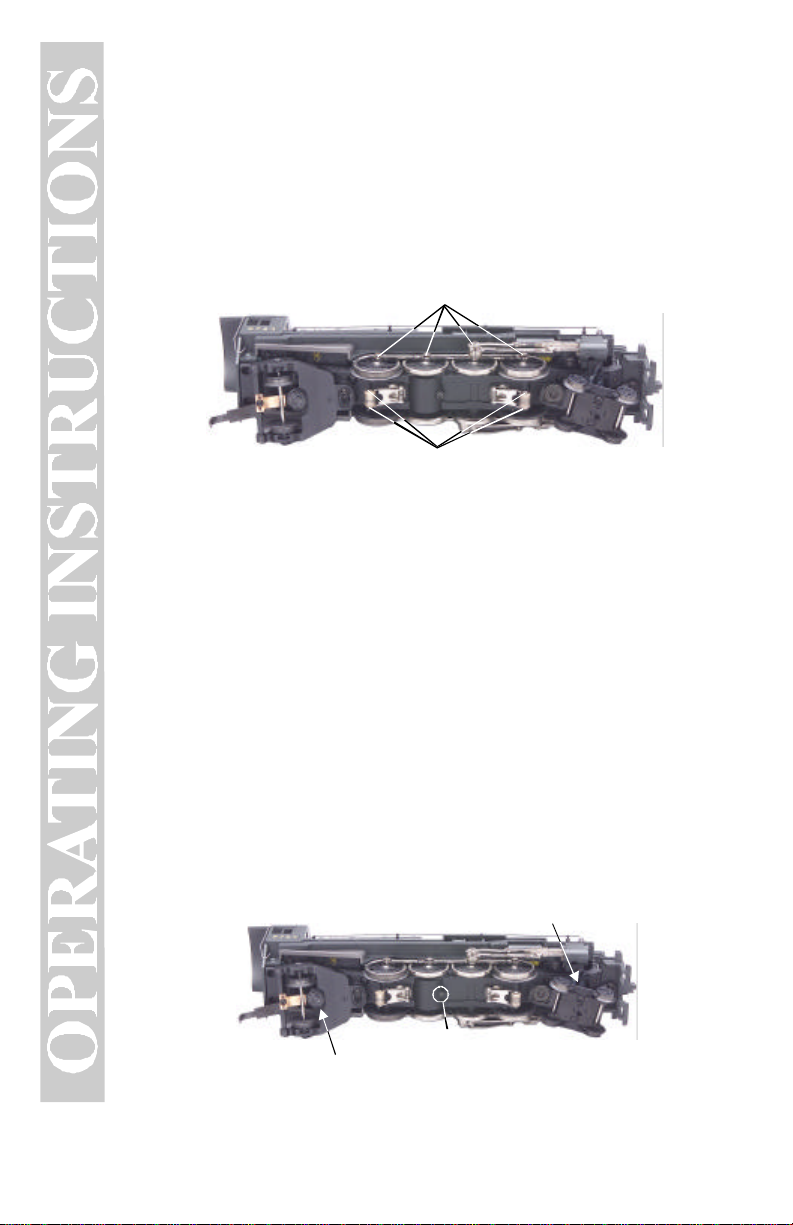
The engine should be oiled and greased in order to run properly.
You should regularly lubricate all side rods and linkage components and
pickup rollers to prevent them from squeaking. Use light household oil and
follow the lubrication points marked “L” in Fig. 2. Do not over oil. Use only
a drop or two on each pivot point.
The locomotive’s internal gearing was greased at the factory and should not
need additional grease until after 50 hours of operation or one year, whichever
comes first. To access the gear box, do the following:
1. Turn the engine upside down.
2. Remove the Phillips screw (marked “GREASE”) located at the third set of
drivers (counting from the front of the engine).
3. Use a grease tube dispenser to put a small amount (approx. 1-2 ml.) of
lithium-based grease into the gearbox.
4. Replace the screw.
You should also grease the leading and trailing locomotive truck tongues to
enhance their ability to slide on the chassis. Follow the grease points shown
on Fig. 3.
Lubricate Pick Up Rollers (L)
Lubricate Side Rods (L)
Figure 2. Lubrication Points on the Engine
Grease Pivot Point (G)
Grease Screw (G)
Figure 3. Greasing Points on the Engine and Body Mounting Screws
9
RailKing M-1a Mountain Steam Engine
Cleaning the Wheels, Tires and Track
Periodically check the locomotive wheels and pickups for dirt and buildup,
which can cause poor electrical contact and traction and prematurely wear out
the neoprene traction tires. Wheels and tires can be cleaned using denatured
alcohol (not rubbing alcohol), which can be found in home improvement
stores, applied with a cotton swab.
Occasional cleaning of the track will also help to ensure good electrical
contact and to prolong the life of your engine’s tires. To clean the track, use a
clean rag and denatured alcohol (not rubbing alcohol). Unplug the
transformer and wipe the rails of the track, turning the rag frequently to ensure
that you are using clean cloth on the rails.
Traction Tire Replacement Instructions
Your locomotive is equipped with two neoprene rubber traction tires on the
rear set of flanged drivers. While these tires are extremely durable, you may
need to replace them at some point.
1. Remove the side rods (the rods that connect each drive wheel to the other)
from the wheels in order to slip the new tire over the grooved drive wheel.
This screw can be loosened with a 5mm nutdriver.
2. Make sure the old tire has been completely removed from the groove in the
drive wheel, using a razor blade or small flathead screwdriver to pry away any
remains.
3. Slip the new tire onto the wheel. You may find it useful to use two small
flathead screwdrivers to stretch the tire over the wheel.
4. If you twist the tire while stretching it over the wheel, you will need to
remove and reinstall the tire. Otherwise your engine will wobble while
operating.
5. Make sure the tire is fully seated inside the groove. Use a razor blade to
trim away any excess tire that doesn’t seat itself inside the groove properly.
One set of replacement tires is included with the model. Additional tires are
available directly from the M.T.H. Parts Department (phone: 410-381-2580;
fax: 410-423-0009; e-mail: [email protected]; mail: 7020 Columbia
Gateway Drive, Columbia MD 21046-1532).
10
RailKing M-1a Mountain Steam Engine
ProtoSmoke®Unit Operation
This steam locomotive contains a smoke unit that outputs smoke through the
smokestack on the boiler of the engine. The smoke unit is essentially a small
heating element and wick that soaks up and then heats a mineral oil-based fluid
that emits a harmless smoke. The smoke is then forced out of the stack by a
small electric fan.
With a few easy maintenance steps, you should enjoy trouble-free smoke unit
operation for years.
• When preparing to run this engine, add 15-20
drops of smoke fluid through the smokestack
(see Fig. 4). We recommend M.T.H.
ProtoSmoke, Seuthe, LGB, or LVTS fluids (a
small pipette of ProtoSmoke fluid is included).
Do not overfill the unit or the fluid may leak out
and coat the interior engine components.
• If you choose not to add the fluid (or have
already added the fluid but choose to run
smoke-free), turn off the smoke unit switch
located under the engine body (see Fig. 5).
Failure either to add fluid to the unit or to turn it
off may damage the smoke unit heating element
and/or wicking material.
• When the smoke output while running the
engine begins to diminish, add another 10-15
drops of smoke fluid or turn the smoke unit off.
• When storing the unit for long periods of time,
you may want to add about 15 drops of fluid to
prevent the wick from drying out.
• After removing the engine from storage, add
another 25 drops of fluid, letting the wick soak up
the fluid for 15 minutes prior to operation.
If you experience poor or no smoke output when
the smoke unit is on and has fluid, check the wick
to see if it has become hard, blackened, and
unabsorbent around the heating element. Remove
AddSmokeFluid
Through Smokestack
Figure 4. Add Smoke Fluid
Proto Smoke
ON/OFF Switch
Figure 5. Smoke Switch
smoke inspection screws
Figure6.Smoke Unit
Inspection Cover