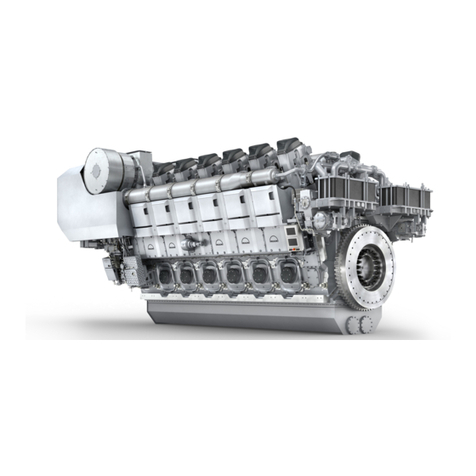
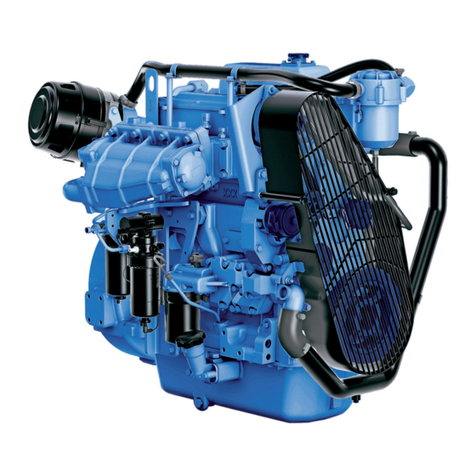
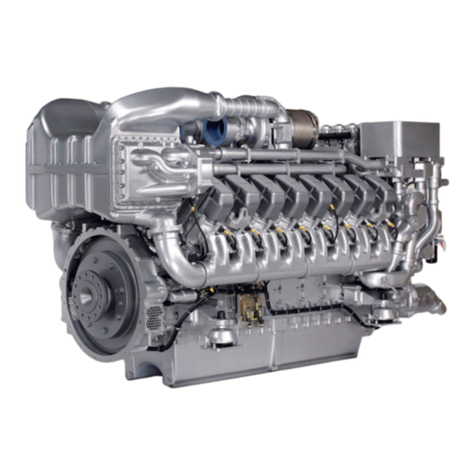
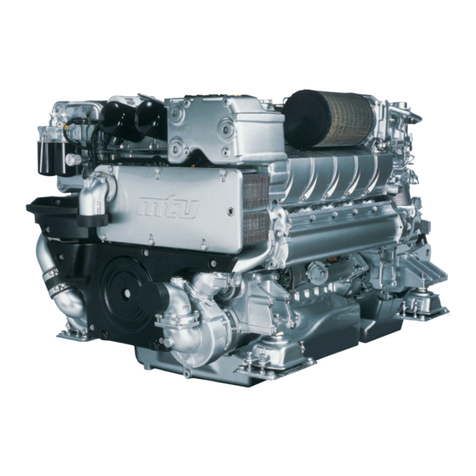
MTU 12 V 2000 M94 User manual

Operating Instructions
Diesel engine
12 V 2000 M94
16 V 2000 M94
MS150061/04E

Printed in Germany
© 2012 Copyright MTU Friedrichshafen GmbH
This Publication is protected by copyright and may not be used in any way whether in whole or in part without the prior
written permission of MTU Friedrichshafen GmbH. This restriction also applies to copyright, distribution, translation, micro‐
filming and storage or processing on electronic systems including data bases and online services.
This handbook is provided for use by maintenance and operating personnel in order to avoid malfunctions or damage
during operation.
Subject to alterations and amendments.

Table of Contents
1 Safety
1.1 General conditions 5
1.2 Personnel and organizational requirements 6
1.3 Transport 7
1.4 Safety regulations for startup and operation 9
1.5 Safety regulations for maintenance and
repair work 10
1.6 Auxiliary materials, fluids and lubricants,
fire prevention and environmental
protection 13
1.7 Conventions for safety instructions in the
text 15
2 General Information
2.1 Tightening specifications for screws, nuts
and bolts 16
2.2 Engine side and cylinder designations 27
2.3 Product description 28
2.4 Engine - Overview 34
2.5 Sensors, actuators and injectors –
Overview 36
3 Technical Data
3.1 12V 2000 M94 engine data 41
3.2 16V 2000 M94 engine data 44
3.3 Firing order 47
3.4 Engine – Main dimensions 48
4 Operation
4.1 Putting the engine into operation after
extended out-of-service periods (>3
months) 49
4.2 Engine – Putting into operation after
scheduled out-of-service-period 50
4.3 Tasks after extended out-of-service periods
(>3 weeks) 51
4.4 Checks prior to start-up 52
4.5 Fuel treatment system – Putting into
operation 53
4.6 Operational checks 55
4.7 Fuel treatment system – Switching on 56
4.8 Starting the engine 57
4.9 Stopping the engine 58
4.10 Emergency stop 59
4.11 After stopping the engine 60
4.12 Fuel treatment system – Shutdown 61
4.13 Plant cleaning 62
5 Maintenance
5.1 Maintenance task reference table [QL1] 63
6 Troubleshooting
6.1 Fuel treatment system – Troubleshooting 64
6.2 Troubleshooting 65
7 Task Description
7.1 SOLAS 68
7.1.1 SOLAS shielding as per MTN 5233 –
Installation 68
7.1.2 SOLAS shielding – Installation 69
7.1.3 Installation locations for SOLAS shielding 70
7.2 Engine 75
7.2.1 Engine – Barring manually 75
7.2.2 Engine – Barring with starting equipment 76
7.3 Cylinder Liner 77
7.3.1 Cylinder liner – Endoscopic examination 77
7.3.2 Cylinder liner – Instructions and comments on
endoscopic and visual examination 79
7.4 Crankcase Breather 81
7.4.1 Crankcase breather – Cleaning oil pre-
separator element 81
7.4.2 Crankcase breather – Oil separator element
replacement, diaphragm check and
replacement 82
7.5 Valve Drive 84
7.5.1 Valve clearance – Check and adjustment 84
7.5.2 Cylinder-head cover – Removal and
installation 87
7.6 Injection Valve / Injector 88
7.6.1 Injector – Replacement 88
7.6.2 Injector – Removal and installation 89
7.7 Fuel System 91
7.7.1 Fuel system – Venting 91
7.8 Fuel Filter 92
MS150061/04E 2012-07 | Table of Contents | 3
DCL-ID: 0000010704 - 004

7.8.1 Fuel filter – Replacement 92
7.8.2 Fuel prefilter – Differential pressure check and
adjustment of gauge 94
7.8.3 Fuel prefilter – Draining 95
7.8.4 Fuel prefilter ‒ Flushing 96
7.8.5 Fuel prefilter – Filter element replacement 98
7.9 Charge-Air Cooling 100
7.9.1 Intercooler – Checking condensate drain line
for coolant discharge and obstruction 100
7.10 Air Filter 101
7.10.1 Air filter – Replacement 101
7.10.2 Air filter – Removal and installation 102
7.11 Air Intake 103
7.11.1 Contamination indicator – Signal ring position
check (optional) 103
7.12 Starting Equipment 104
7.12.1 Starter – Condition check 104
7.13 Lube Oil System, Lube Oil Circuit 105
7.13.1 Engine oil – Level check 105
7.13.2 Engine oil – Change 106
7.14 Oil Filtration / Cooling 107
7.14.1 Engine oil filter – Replacement 107
7.14.2 Centrifugal oil filter – Cleaning and filter-
sleeve replacement 109
7.15 Coolant Circuit, General, High-
Temperature Circuit 112
7.15.1 Drain and venting points 112
7.15.2 Engine coolant – Level check 117
7.15.3 Engine coolant – Change 118
7.15.4 Engine coolant – Draining 119
7.15.5 Engine coolant – Filling 120
7.15.6 HT coolant pump — Relief bore check 121
7.15.7 Engine coolant – Sample extraction and
analysis 122
7.15.8 Coolant filter – Replacement 123
7.16 Raw Water Pump with Connections 124
7.16.1 Raw water pump – Relief bore check 124
7.17 Belt Drive 125
7.17.1 Drive belt – Condition check 125
7.18 Battery-Charging Generator 126
7.18.1 Battery-charging generator drive – Drive belt
replacement 126
7.19 Fuel Supply System 127
7.19.1 Water drain valve – Check 127
7.19.2 Differential pressure gauge – Check 128
7.19.3 Water level probe (3-in-1 rod electrode) –
Check 129
7.19.4 Pump capacity – Check 130
7.19.5 Coalescer filter element – Replacement 131
7.20 Wiring (General) for Engine/Gearbox/Unit 133
7.20.1 Engine wiring – Check 133
7.21 Accessories for (Electronic) Engine
Governor / Control System 134
7.21.1 Engine governor and connectors – Cleaning 134
7.21.2 Engine governor – Checking plug-in
connections 135
7.21.3 EMU – Checking plug-in connections 136
7.21.4 Engine governor – Carry out self-test 137
7.21.5 EMU and connectors – Cleaning 138
7.21.6 ECU 7 engine governor – Removal and
installation 139
7.21.7 Engine monitoring unit – Removal and
installation 140
8 Appendix A
8.1 Abbreviations 141
8.2 MTU contact persons/service partners 144
9 Appendix B
9.1 Special Tools 145
9.2 Consumables 152
9.3 Spare Parts 154
9.4 Index 156
4 | Table of Contents | MS150061/04E 2012-07
DCL-ID: 0000010704 - 004

1 Safety
1.1 General conditions
General
In addition to the instructions in this publication, the applicable country-specific legislation and other com‐
pulsory regulations regarding accident prevention and environmental protection must be observed. This
state-of-the-art engine has been designed to meet all applicable laws and regulations. The engine may
nevertheless present a risk of injury or damage in the following cases:
• Incorrect use
• Operation, maintenance and repair by unqualified personnel
• Modifications or conversions
• Noncompliance with the Safety Instructions
Correct use
The engine is intended solely for use in accordance with contractual agreements and the purpose envis‐
aged for it on delivery. Any other use is considered improper use. The engine manufacturer accepts no
liability whatsoever for resultant damage or injury in such case. The responsibility is borne by the user
alone.
Correct use also includes observation of and compliance with the maintenance specifications.
Modifications or conversions
Unauthorized modifications to the engine represent a safety risk.
MTU will accept no liability or warranty claims for any damage caused by unauthorized modifications or
conversions.
Spare parts
Only genuine MTU spare parts must be used to replace components or assemblies. MTU accepts no
liability whatsoever for damage or injury resulting from the use of other spare parts and the warranty shall
be voided in such case.
Reworking components
Repair or engine overhaul must be carried out in workshops authorized by MTU.
MS150061/04E 2012-07 | Safety | 5
TIM-ID: 0000000860 - 017

1.2 Personnel and organizational requirements
Personnel requirements
All work on the engine shall be carried out by trained and qualified personnel only.
The specified legal minimum age must be observed.
The operator must specify the responsibilities of the operating, maintenance and repair personnel.
Organizational measures
This publication must be issued to all personnel involved in operation, maintenance, repair or transporta‐
tion.
Keep it at hand at the operating site of the engine so that it is available to operating, maintenance, repair
and transport personnel at all times.
Use the manual as a basis for instructing personnel on engine operation and repair with an emphasis on
explaining safety-relevant instructions.
This is particularly important in the case of personnel who only occasionally perform work on or around
the engine. This personnel must be instructed repeatedly.
For the identification and layout of the spare parts during maintenance or repair work, take photos or use
the spare parts catalog.
Working clothes and protective equipment
Wear proper protective clothing for all work.
Use the necessary protective equipment for the given work to be done.
6 | Safety | MS150061/04E 2012-07
TIM-ID: 0000000874 - 018

1.3 Transport
Transport without flange-mounted gearbox
A max. permissible diago‐
nal pull 70°
B max. permissible diago‐
nal pull 35°
Illustration is valid for 12/16V 2000 M engines
MS150061/04E 2012-07 | Safety | 7
TIM-ID: 0000038133 - 001

Transport with flange-mounted gearbox
Illustration is valid for 12/16V 2000 M engines
Lift the engine only with the lifting eyes provided.
The eyebolts mounted at the driving end and on the gearbox must not be used for transporting plants
with flange-mounted gearboxes.
Only use transport and lifting devices approved by MTU.
Take the engine's center of gravity into account.
The engine must only be transported in installation position, max. permissible diagonal pull with flange-
mounted gearbox is 10°.
If the engine is supplied with special aluminum foil packing, lift the engine at the lifting eyes of the bear‐
ing pedestal or use a means of transportation which is appropriate for the given weight (forklift truck).
Install the crankshaft locking device and the locking screws for the engine mounts prior to engine trans‐
portation.
Secure the engine against tilting during transport. In particular when going down inclines or ramps, the
engine must be secured against moving and tilting.
Setting the engine down after transport
Only set down engine on a firm, level surface.
Make sure that the consistency and load-bearing capacity of the ground or support surface is adequate.
Never set an engine down on the oil pan unless expressively authorized to do so by MTU on a case-to-
case basis.
8 | Safety | MS150061/04E 2012-07
TIM-ID: 0000038133 - 001

1.4 Safety regulations for startup and operation
Safety precautions when putting the equipment into operation
Prior to initial operation of the assembly or plant, install the assembly or unit according to the specifica‐
tions and check the installation according to the MTU specifications.
Before putting the device or plant into operation, always ensure:
• that all maintenance and repair work is completed,
• that all loose parts have been removed from rotating machine components,
• that all persons are clear of the danger zone of moving machine components.
Immediately after putting the device or plant into operation, make sure that all control and display instru‐
ments as well as the monitoring, signaling and alarm systems are working properly.
Safety regulations for equipment operation
Emergency procedures must be practiced regularly.
The operator must be familiar with the controls and displays.
The operator must be familiar with the consequences of all operations to be performed.
During operation, the display instruments and monitoring units must be permanently observed with re‐
gard to present operating status, violation of limit values and warning or alarm messages.
The following steps must be taken if a malfunction of the system is recognized or reported by the system:
• inform supervisor(s) in charge,
• analyze the message,
• if required, carry out emergency operations e.g. emergency engine stop.
Engine operation
The following conditions must be fulfilled before starting the engine:
• Wear ear protectors.
• Ensure that the engine room is well ventilated.
• Do not inhale engine exhaust gases.
• Ensure that the exhaust system is free of leaks and that the gases are discharged to atmosphere.
• Mop up any leaked or spilled fluids and lubricants immediately or soak up with a suitable binding
agent.
• Protect battery terminals, battery-charger terminals and cables against accidental contact.
• When the engine is running, never release coolant, oil, fuel, compressed-air or hydraulic lines.
Operation of electrical equipment
When operating electrical equipment, certain components of this equipment are live.
Observe the safety instructions for these devices.
MS150061/04E 2012-07 | Safety | 9
TIM-ID: 0000023743 - 010

1.5 Safety regulations for maintenance and repair work
Safety regulations for maintenance and repair work
Have maintenance and repair work carried out by qualified and authorized personnel only.
Allow the engine to cool down before starting maintenance work (risk of explosion of oil vapors).
Before starting work, relieve pressure in systems and compressed-air lines which are to be opened.
Take special care when removing ventilation or plug screws from the engine. Cover the screw or plug
with a rag to prevent fluids escaping under pressure.
Take special care when draining hot fluids ⇒ Risk of injury.
When changing the engine oil or working on the fuel system, ensure that the engine room is adequately
ventilated.
Allow the engine / system to cool down before starting to work.
Observe the maintenance and repair instructions.
Never carry out maintenance and repair work with the engine running unless expressly instructed to do
so.
Secure the engine against accidental starting.
Disconnect the battery when electrical starters are fitted.
Close the main valve on the compressed-air system and vent the compressed-air line when pneumatic
starters are fitted.
Disconnect the control equipment from the assembly or system.
Use only proper, calibrated tools. Observe the specified tightening torques during assembly/disassembly.
Carry out work only on assembles and/or units which are properly secured.
Never use lines for climbing.
Keep fuel injection lines and connections clean.
Always seal connections with caps or covers if a line is removed or opened.
Take care not to damage lines, in particular fuel lines, during maintenance and repair work.
Ensure that all retainers and dampers are installed correctly.
Ensure that all fuel injection and pressurized oil lines are installed with enough clearance to prevent con‐
tact with other components. Do not place fuel or oil lines near hot components.
Do not touch elastomeric seals if they have carbonized or resinous appearance unless hands are proper‐
ly protected.
Note cooling time for components which are heated for installation or removal ⇒ Risk of burning.
When working high on the engine, always use suitable ladders and work platforms. Make sure compo‐
nents are placed on stable surfaces.
Observe special cleanness when conducting maintenance and repair work on the assembly or system.
After completion of maintenance and repair work, make sure that no loose objects are in/on the assem‐
bly or system.
Before barring the engine, make sure that nobody is standing in the danger zone. Check that all guards
have been reinstalled and that all tools and loose parts have been removed after working on the engine.
The following additional instructions apply to starters with beryllium copper pinion:
• Breathing protection of filter class P2 must be applied during maintenance work to avoid health haz‐
ards caused by the beryllium-containing pinion. Do not blow out the interior of the flywheel housing or
the starter with compressed air. Clean the flywheel housing inside with a class H dust extraction de‐
vice as an additional measure.
10 | Safety | MS150061/04E 2012-07
TIM-ID: 0000000879 - 023
This manual suits for next models
1
Table of contents
Other MTU Engine manuals
MTU
MTU 12 V 2000 M92 User manual

MTU
MTU 16V4000R43 User manual
MTU
MTU 12V4000L32FB User manual

MTU
MTU 12 V 4000 T94 User manual
MTU
MTU 12V2000Gx6x User manual
MTU
MTU 8V2000M40A User manual

MTU
MTU 8 V 2000 M40A User manual

MTU
MTU 20V4000L32FB User manual
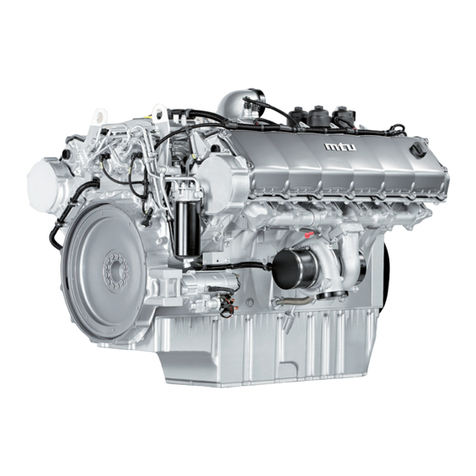
MTU
MTU 8V1600 G10F User manual
MTU
MTU 12 V 2000 M86 User manual
MTU
MTU 12V4000C*5 series User manual
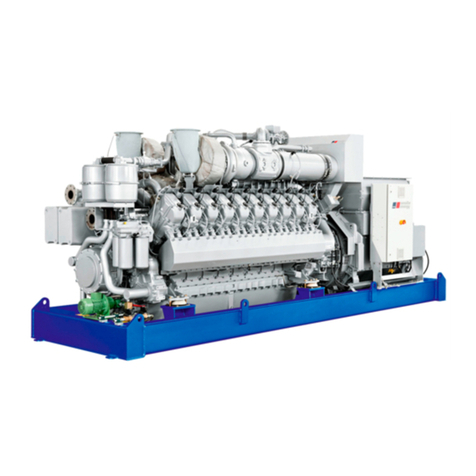
MTU
MTU 12V4000L32F User manual
MTU
MTU MS150112/01E User manual
MTU
MTU 8 V 4000 Lx2 xx User manual
MTU
MTU 16V4000M*3 series User manual
MTU
MTU 8 V 2000 M50A User manual

MTU
MTU 20 V 4000 G83 User manual
MTU
MTU 12V2000M93 User manual
MTU
MTU 8 V 2000 M9x User manual

MTU
MTU 12 V 4000 Lx4 User manual