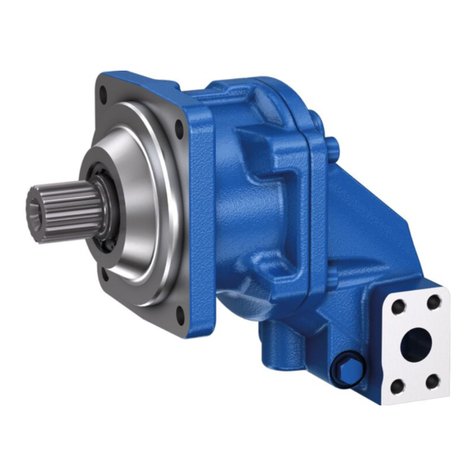
MTU 12V2000M91 User manual

Operating Instructions
Diesel Engine
12V2000M91
16V2000M91
MW15409/04E

Engine model kW/cyl. Application group
12V2000M91 93.3 1DS, continuous operation, variable, low utilization
16V2000M91 93.3 1DS, continuous operation, variable, low utilization
Table 1: Applicability
© 2015 Copyright MTU Friedrichshafen GmbH
This publication is protected by copyright and may not be used in any way, whether in whole or in part, without the prior writ-
ten consent of MTU Friedrichshafen GmbH. This particularly applies to its reproduction, distribution, editing, translation, micro-
filming and storage or processing in electronic systems including databases and online services.
All information in this publication was the latest information available at the time of going to print. MTU Friedrichshafen GmbH
reserves the right to change, delete or supplement the information provided as and when required.

Table of Contents
1 Safety
1.1 Important provisions for all products 5
1.2 Personnel and organizational requirements 7
1.3 Safety regulations for startup and operation 8
1.4 Safety precautions when working on the
engine 9
1.5 Fire prevention and environmental
protection, fluids and lubricants, auxiliary
materials 12
1.6 Standards for safety notices in the text 14
2 Transport
2.1 Transportation 15
2.2 Lifting requirements 16
3 General Information
3.1 Engine side and cylinder designations 20
3.2 Product description 21
3.3 Engine layout – 2000 M91 engines 29
4 Technical Data
4.1 12/16V 2000 M91 engine data 30
4.2 Firing order 33
4.3 Main engine dimensions 34
5 Operation
5.1 LOP controls (without Blue Line automation
system) 35
5.2 Putting the engine into operation after
extended out-of-service periods (>3 months) 37
5.3 Putting the engine into operation after
scheduled out-of-service period 38
5.4 Engine start at LOP (without BlueLine
automation system) 39
5.5 Starting the engine at the BlueLine
automation system (control stand) 40
5.6 Engine emergency stop at BlueLine
automation system (control stand) 41
5.7 Operational checks 42
5.8 Coupling – Engaging from LOP 43
5.9 Coupling – Disengaging from LOP 44
5.10 Waterjet – Flushing from LOP (optional) 45
5.11 Engine shutdown at LOP (without BlueLine
automation system) 46
5.12 Stopping the engine at the BlueLine
automation system (control stand) 47
5.13 Emergency engine shutdown at LOP
(without BlueLine automation system) 48
5.14 After stopping the engine 49
5.15 Plant – Cleaning 50
6 Maintenance
6.1 Maintenance task reference table [QL1] 51
7 Troubleshooting
7.1 Troubleshooting 52
7.2 LOP fault messages 55
8 Task Description
8.1 Engine 64
8.1.1 Engine – Barring manually 64
8.1.2 Engine – Barring with starting system 65
8.2 Cylinder Liner 66
8.2.1 Cylinder liner – Endoscopic examination 66
8.2.2 Instructions and comments on endoscopic and
visual examination of cylinder liners 68
8.3 Crankcase Breather 70
8.3.1 Crankcase breather – Cleaning oil pre-
separator element 70
8.3.2 Crankcase breather – Oil separator
replacement, diaphragm check and
replacement 71
8.4 Valve Drive 73
8.4.1 Valve clearance – Check and adjustment 73
8.4.2 Cylinder head cover – Removal and
installation 76
8.5 Injection Pump / HP Pump 77
8.5.1 Injection pump – Replacement 77
8.5.2 Injection pump – Removal and installation 78
8.6 Injection Valve / Injector 81
8.6.1 Injector – Replacement 81
8.6.2 Injector – Removal and installation 82
8.7 Fuel System 85
8.7.1 HP fuel line – Pressure pipe neck replacement 85
8.7.2 Fuel – Draining 87
8.7.3 Fuel system – Venting 88
8.8 Fuel Filter 90
8.8.1 Fuel filter – Replacement 90
8.8.2 Fuel prefilter – Differential pressure check
and adjustment of gauge 92
8.8.3 Fuel prefilter – Draining 93
8.8.4 Fuel prefilter – Flushing 95
8.8.5 Fuel prefilter – Filter element replacement 97
MW15409/04E 2015-08 | Table of Contents | 3
DCL-ID: 0000039398 - 002

8.9 Sensors, Actuators and Injectors on the
Engine 99
8.9.1 Sensors and actuators – Overview 99
8.10 Charge-Air Cooling 109
8.10.1 Intercooler ‒ Checking condensate drain line
for coolant discharge and obstruction 109
8.11 Air Filter 110
8.11.1 Air filter – Replacement 110
8.11.2 Air filter – Removal and installation 111
8.12 Air Intake 112
8.12.1 Service indicator – Signal ring position check 112
8.12.2 Air flap – Check ease of movement 113
8.13 Exhaust Flap with Actuator 114
8.13.1 Exhaust flap – Check ease of movement 114
8.14 Starting Equipment 115
8.14.1 Starter – Condition check 115
8.15 Lube Oil System, Lube Oil Circuit 116
8.15.1 Engine oil – Level check 116
8.15.2 Engine oil – Change 117
8.16 Oil Filtration / Cooling 118
8.16.1 Oil dipstick — Marking 118
8.16.2 Engine oil filter – Replacement 119
8.16.3 Centrifugal oil filter and filter sleeve –
Cleaning and replacement 121
8.17 Coolant Circuit, General, High-Temperature
Circuit 124
8.17.1 Drain and venting points 124
8.17.2 Engine coolant – Level check 129
8.17.3 Engine coolant – Change 130
8.17.4 Engine coolant – Draining 131
8.17.5 Engine coolant ‒ Filling 132
8.17.6 HT coolant pump ‒ Relief bore check 133
8.17.7 Engine coolant – Sample extraction and
analysis 134
8.18 Raw Water Pump with Connections 135
8.18.1 Raw water pump – Priming 135
8.18.2 Raw water pump – Relief bore check 136
8.19 Belt Drive 137
8.19.1 Drive belt – Condition check 137
8.20 Battery-Charging Generator 138
8.20.1 Battery-charging generator drive – Drive belt
check and adjustment 138
8.20.2 Battery-charging generator drive – Drive belt
replacement 140
8.21 Engine Mounting / Support 141
8.21.1 Engine mounting – Checking condition of
resilient mounts 141
8.22 Universal Shaft 142
8.22.1 Universal shaft – Greasing 142
8.23 Wiring (General) for Engine/Gearbox/Unit 143
8.23.1 Engine cabling – Check 143
8.24 Accessories for (Electronic) Engine
Governor / Control System 144
8.24.1 Engine governor and connectors – Cleaning 144
8.24.2 Engine monitoring unit and connectors –
Cleaning 145
8.24.3 Start interlock limit switch – Check 146
8.24.4 Engine Control Unit – Plug connection check 147
8.24.5 Engine Monitoring Unit – Plug connection
check 148
8.24.6 Engine control system – Removal and
installation 149
8.25 Emergency Instrumentation (Local
Operating Panel) 150
8.25.1 LOP and connectors – Cleaning 150
8.25.2 LOP – Visual inspection 151
8.25.3 LOP – Test procedures 153
9 Appendix A
9.1 Abbreviations 155
9.2 MTU contact persons/service partners 158
10 Appendix B
10.1 Special Tools 159
10.2 Index 167
4 | Table of Contents | MW15409/04E 2015-08
DCL-ID: 0000039398 - 002

1 Safety
1.1 Important provisions for all products
Nameplate
The product is identified by nameplate, model designation or serial number and must match with the infor-
mation on the title page of this manual.
Nameplate, model designation or serial number can be found on the product.
All EU-certified engines delivered by MTU come with a second nameplate. When operating the machine in the
EU: The second nameplate must be affixed in a prominent position as described in the accompanying specifi-
cations.
General information
This product may pose a risk of injury or damage in the following cases:
• Incorrect use
• Operation, maintenance and repair by unqualified personnel
• Modifications or conversions
• Noncompliance with the safety instructions and warning notices
Correct use
The product is intended for use in accordance with its contractually-defined purpose as described in the rele-
vant technical documents only.
Intended use entails operation:
• Within the permissible operating parameters in accordance with the (→ Technical data)
• With fluids and lubricants approved by the manufacturer in accordance with the (→ Fluids and Lubricants
Specifications of the manufacturer)
• With spare parts approved by the manufacturer in accordance with the (→ Spare Parts Catalog/MTU con-
tact/Service partner)
• In the original as-delivered configuration or in a configuration approved by the manufacturer in writing (in-
cluding engine control/parameters)
• In compliance with all safety regulations and in adherence with all warning notices in this manual
• With maintenance work performed in accordance with the (→ Maintenance Schedule) throughout the use-
ful life of the product
• In compliance with the maintenance and repair instructions contained in this manual, in particular with
regard to the specified tightening torques
• With the exclusive use of technical personnel trained in commissioning, operation, maintenance and re-
pair
• By contracting only workshops authorized by the manufacturer to carry out repair and overhaul
The product may only be operated in explosive atmospheres if it was certified for such operating conditions.
Any other use, in particular malpractice, shall be considered non-intended. Such improper use increases the
risk of injury and damage when working with the product. The manufacturer shall not be held liable for any
damage resulting from improper, non-intended use.
Modifications or conversions
Unauthorized changes to the product represent a contravention of its intended use and compromise safety.
Changes or modifications shall only be considered to comply with the intended use when expressly author-
ized by the manufacturer. The manufacturer shall not be held liable for any damage resulting from unauthor-
ized changes or modifications.
MW15409/04E 2015-08 | Safety | 5
TIM-ID: 0000040530 - 007

Emission regulations and emission labels
Responsibility for compliance with emission regulations
Modification or removal of any mechanical/electronic components or the installation of additional compo-
nents including the execution of calibration processes that might affect the emission characteristics of the
product are prohibited by emission regulations. Emission control units/systems may only be maintained, ex-
changed or repaired if the components used for this purpose are approved by the manufacturer.
Noncompliance with these regulations will invalidate the design type approval issued by the emissions regu-
lation authorities. The manufacturer does not accept any liability for violations of the emission regulations.
The maintenance schedules of the manufacturer must be observed over the entire life cycle of the product.
Replacing components with emission labels
Emission labels are attached to all MTU engines. These must remain on the engine throughout its operational
life.
Engines used exclusively in land-based, military applications other than by US government agencies are ex-
cepted from this proviso.
Please note the following when replacing components with emission labels:
• Appropriate emission labels must be affixed on spare parts.
• Emission labels may not be transferred from old components to new ones.
• Emission labels on old components must be removed and destroyed.
6 | Safety | MW15409/04E 2015-08
TIM-ID: 0000040530 - 007

1.2 Personnel and organizational requirements
Organizational measures of the user/manufacturer
This manual must be issued to all personnel involved in operation, maintenance, repair, or transportation.
Keep this manual handy in the vicinity of the product such that it is accessible to operating, maintenance,
repair, and transport personnel at all times.
Personnel must receive instruction on product handling and maintenance based on this manual with a spe-
cial emphasis on safety requirements and warnings.
This is important in the case of personnel who only occasionally perform work on or around the product.
These personnel must be instructed repeatedly.
Personnel requirements
All work on the product shall be carried out by trained and qualified personnel only:
• Training at the Training Center of the manufacturer
• Technical personnel from the areas mechanical engineering, plant construction, and electrical engineering
The operator must define the responsibilities of the personnel involved in operation, maintenance, repair, and
transport.
Personnel must not be under the influence of alcohol, drugs, or strong medication.
Working clothes and personal protective equipment
When working, always wear the necessary personal protective equipment (for example safety shoes, ear pro-
tectors, protective gloves, goggles, breathing protection). Observe the information on personal protective
equipment in the respective activity description.
MW15409/04E 2015-08 | Safety | 7
TIM-ID: 0000040531 - 007

1.3 Safety regulations for startup and operation
Safety regulations for startup
Install the product correctly and carry out acceptance in accordance with the manufacturer's specifications
before putting the product into service. All necessary approvals must be granted by the relevant authorities
and all requirements for initial startup must be fulfilled.
When putting the product into operation, always ensure that:
• All personnel is clear of the danger zone surrounding moving parts of the machine.
Electrically-actuated linkages may be set in motion when the Engine Control Unit (governor) is switched
on.
• All maintenance and repair work has been completed.
• All loose parts have been removed from rotating machine components.
• All safety equipment is in place.
• No persons wearing pacemakers or any other technical body aids are present.
• The service room is adequately ventilated.
• Hazardous gases may occur as a result of the combustion of paints or oils in the first operating hours of
the product. Enter the service room only with a suitable breathing protection.
• The exhaust system is leak-tight and that the gases are vented to atmosphere.
• Protect battery terminals, generator terminals or cables against accidental contact.
• Check that all connections have been correctly allocated (e.g. +/- polarity, direction).
Immediately after putting the product into operation, make sure that all control and display instruments as
well as the monitoring, signaling and alarm systems are working properly.
Smoking is prohibited in the area of the product.
Safety regulations during operation
The operator must be familiar with the control and display elements.
The operator must be familiar with the consequences of any operations performed.
During operation, the display instruments and monitoring units must be permanently observed with regard to
present operating status, violation of limit values and warning or alarm messages.
Malfunctions and emergency stop
Practice the procedures for emergencies, in particular, emergency stop, on a regular basis.
The following steps must be taken if a malfunction of the system is detected or reported by the system:
• Inform supervisor(s) in charge.
• Analyze the message.
• Respond to the emergency appropriately, e.g. execute an emergency stop.
Operation
Do not remain in the operating room when the product is running for any longer than absolutely necessary.
Keep a safe distance away from the product if possible. Do not touch the product unless expressly instructed
to do so following a written procedure.
Do not inhale the exhaust gases of the product.
The following requirements must be fulfilled before the product is started:
• Wear ear protection.
• Mop up any leaked or spilled fluids and lubricants immediately or soak up with a suitable binder agent.
Operation of electrical equipment
During operation of electrical devices, certain elements of these devices are live/under high voltage.
Observe the warning information applicable to the devices.
8 | Safety | MW15409/04E 2015-08
TIM-ID: 0000040533 - 011

1.4 Safety precautions when working on the engine
Safety regulations prior to maintenance and repair work
Have maintenance or repair work carried out by qualified and authorized personnel only.
Allow the product to cool down to less than 50 °C (risk of explosion for oil vapors, fluids and lubricants, risk
of burning).
Relieve pressure in fluid and lubricant systems and compressed-air lines which are to be opened. Use suita-
ble collecting vessels of adequate capacity to catch fluids and lubricants.
When changing the oil or working on the fuel system, ensure that the service room is adequately ventilated.
Never carry out maintenance and repair work with the product in operation, unless:
• It is expressly permitted to do so following a written procedure.
• The product is running in the low load range and only for as long as absolutely necessary.
Lock-out the product to preclude undesired starting, e.g.
• Start interlock
• Key switch
• With hydraulic starting system: shut off supply line.
Attach “Do not operate” sign in the operating area or to control equipment.
Disconnect the battery. Lock out circuit breakers.
Close the main valve on the compressed-air system and vent the compressed-air line when pneumatic start-
ers are fitted.
Disconnect the control equipment from the product.
If special tools are specified, these special tools or other suitable tools must be used.
Elastomer components (e.g. engine mounts, damping elements, couplings and V-belts) must not be painted.
They may only be installed after painting the engine or must be covered before painting work is carried out.
The following applies to starters with copper-beryllium alloy pinions:
• Wear a respirator mask (filter class P3). Do not blow out the interior of the flywheel housing or the starter
with compressed air. Clean the flywheel housing inside with a class H dust extraction device.
• Observe the safety data sheet.
Safety regulations during maintenance and repair work
Take special care when removing ventilation or plug screws from the product. Cover the screw or plug with a
rag to prevent fluids escaping under pressure.
Take care when draining hot fluids and lubricants (risk of burning).
Use only proper and calibrated tools. Observe the specified tightening torques during assembly or disassem-
bly.
Carry out work only on assemblies or plants which are properly secured.
Make sure components or assemblies are placed on stable surfaces. Adopt suitable measures to avoid that
components/tools fall down . Use the specified lifting equipment for all components.
Never use the product as a climbing aid.
When working high on the equipment, always use suitable ladders and work platforms. Never work on en-
gines or components that are held in place by lifting equipment.
Keep fuel injection lines and connections clean.
Carry out appropriate cleaning procedures to clean and inspect components requiring special cleanness (e.g.
components carrying oil, fuel, or air).
Always seal connections with caps or covers if a line is removed or opened.
Fit new seals when re-installing lines.
MW15409/04E 2015-08 | Safety | 9
TIM-ID: 0000040535 - 011

Never bend lines and avoid damaging lines, particularly the fuel lines.
Ensure that all retainers and dampers are installed correctly.
Ensure that O-rings are not installed in a slanted/twisted condition.
Ensure that all fuel injection and pressurized oil lines are installed with enough clearance to prevent contact
with other components. Do not place fuel or oil lines near hot components.
Do not touch elastomeric seals (e.g. Viton sealing rings) with your bare hands if they have a carbonized or
resinous appearance.
Note cooling time for components which are heated for installation or removal (risk of burning).
Pay particular attention to cleanliness at all times.
Remove any condensate from components which were chilled before assembly. If necessary, coat the com-
ponents with a suitable corrosion inhibitor.
Safety regulations following maintenance and repair work
Before barring, make sure that nobody is standing in the danger zone of the product.
Check that all access ports/apertures which have been opened to facilitate working are closed again.
Check that all safety equipment has been installed and that all tools and loose parts have been removed
(especially the barring gear).
Ensure that no unattached parts have been left in/on the product (e.g. including rags and cable straps).
Make sure the grounding device is properly connected.
Welding work
Welding operations on the product or mounted units are not permitted. Cover the product when welding in
its vicinity.
Before starting welding work:
• Switch off the power supply master switch.
• Disconnect the battery.
• Separate the electrical ground of electronic equipment from the ground of the unit.
No other maintenance or repair work must be carried out in the vicinity of the product while welding is going
on. Risk of explosion or fire due to oil vapors and highly flammable process materials.
Do not use product as ground terminal.
Never position the welding power supply cable adjacent to, or crossing wiring harnesses of the product. The
welding current may otherwise induce an interference voltage in the wiring harnesses which could conceiva-
bly damage the electrical system.
Remove components (e.g. exhaust pipe) from the product before performing necessary welding work .
Hydraulic installation and removal
Check satisfactory function and safe operating condition of tools, jigs and fixtures to be used. Use only the
specified jigs and fixtures for hydraulic removal/installation procedures.
Observe the max. permissible force-on pressure specified for the jig/fixture.
Do not attempt to bend or exert force on H.P. lines.
Before starting work, pay attention to the following:
• Vent the installation/removal device, the pumps and the pipework at the relevant designated points.
• During the installation procedure, screw on device with pushed-in plunger.
• During the removal procedure, screw on device with retracted plunger.
For a hydraulic installation/removal device with central expansion pressure supply, screw spindle into shaft
end until correct sealing is established.
10 | Safety | MW15409/04E 2015-08
TIM-ID: 0000040535 - 011
This manual suits for next models
1
Table of contents
Other MTU Engine manuals
MTU
MTU 8V4000Mx4 User manual

MTU
MTU 12 V 4000 T95 x User manual
MTU
MTU 12V4000L32F User manual

MTU
MTU 16 V 4000 M63L User manual
MTU
MTU 20 V 4000 M93 User manual
MTU
MTU 8V4000M*3 series User manual
MTU
MTU 12 V 2000 G25 User manual
MTU
MTU 12V2000Gx5 User manual
MTU
MTU 12V4000C*5 series User manual
MTU
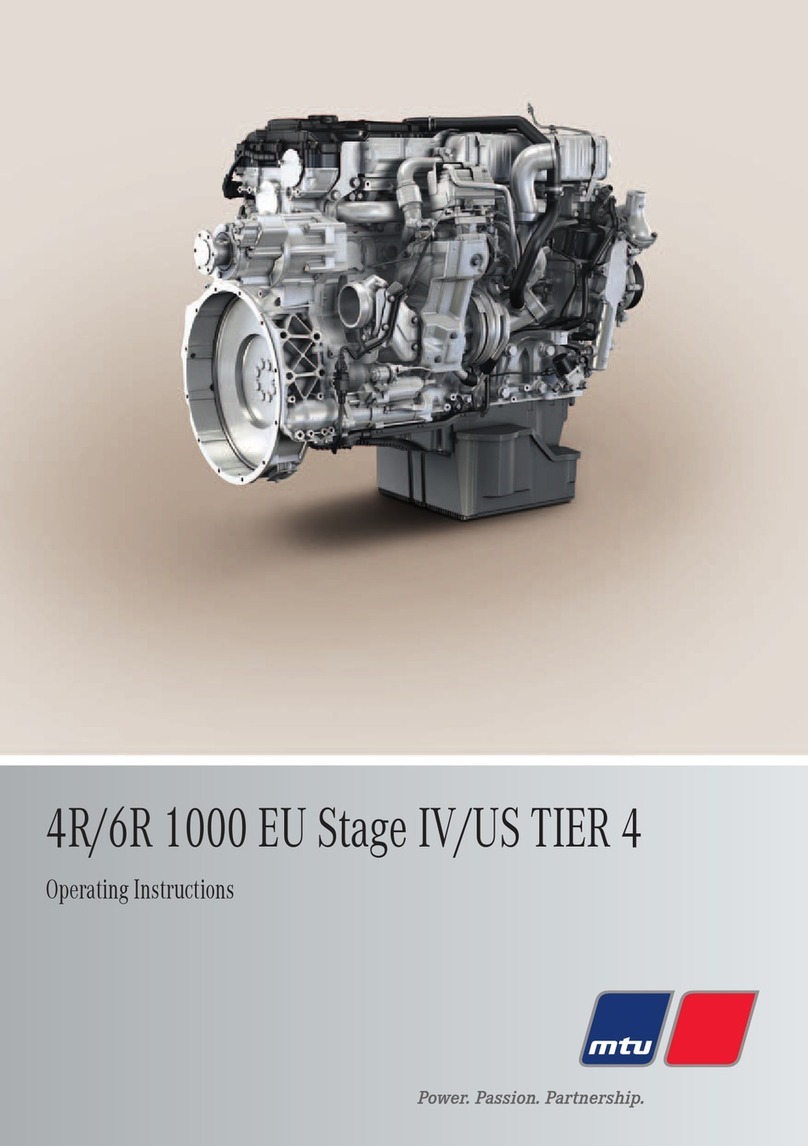
MTU 4R 1000 SERIES User manual
MTU
MTU 8 V 2000 M70 User manual
MTU
MTU 12 V 2000 Gx6F User manual
MTU
MTU 6R 1600 G10F User manual
MTU
MTU 12V2000Gx6 series User manual
MTU
MTU 20V4000Bx4 User manual
MTU
MTU 12V 2000 C66 User manual
MTU
MTU 12 V 2000 M92 User manual
MTU
MTU 4R 1000 SERIES User manual

MTU
MTU V 4000 M70 User manual
MTU
MTU 20V4000L33F User manual