manuals.online logo
Brands
  1. Home
  2. •
  3. Brands
  4. •
  5. Mutable Instruments
  6. •
  7. Music Equipment
  8. •
  9. Mutable Instruments Peaks User manual

Mutable Instruments Peaks User manual

Other Mutable Instruments Music Equipment manuals

Mutable Instruments Plaits User manual

Mutable Instruments

Mutable Instruments Plaits User manual

Mutable Instruments Ripples User manual

Mutable Instruments

Mutable Instruments Ripples User manual

Mutable Instruments Branches User manual

Mutable Instruments

Mutable Instruments Branches User manual

Mutable Instruments Tides User manual

Mutable Instruments

Mutable Instruments Tides User manual

Mutable Instruments Braids User manual

Mutable Instruments

Mutable Instruments Braids User manual

Mutable Instruments Braids User manual

Mutable Instruments

Mutable Instruments Braids User manual

Mutable Instruments Warps User manual

Mutable Instruments

Mutable Instruments Warps User manual

Mutable Instruments Braids User manual

Mutable Instruments

Mutable Instruments Braids User manual

Popular Music Equipment manuals by other brands

Aguilar CHORUSAURUS user guide

Aguilar

Aguilar CHORUSAURUS user guide

Fishman NEO-D user guide

Fishman

Fishman NEO-D user guide

HEXDEVICES Tama 12 user manual

HEXDEVICES

HEXDEVICES Tama 12 user manual

Mesa/Boogie Flux-drive owner's manual

Mesa/Boogie

Mesa/Boogie Flux-drive owner's manual

DOLFINOS The CARBON Edition user manual

DOLFINOS

DOLFINOS The CARBON Edition user manual

DAPAudio IPS-PT user guide

DAPAudio

DAPAudio IPS-PT user guide

Dynacord DPM 8016 owner's manual

Dynacord

Dynacord DPM 8016 owner's manual

Moen GEC8 Live owner's manual

Moen

Moen GEC8 Live owner's manual

Fender 1 brochure

Fender

Fender 1 brochure

Yamaha MLC-16 operating manual

Yamaha

Yamaha MLC-16 operating manual

Sonuscore TIME TEXTURES manual

Sonuscore

Sonuscore TIME TEXTURES manual

flight of harmony V'Amp user guide

flight of harmony

flight of harmony V'Amp user guide

NANO PERFORMANCE MIXER quick guide

NANO

NANO PERFORMANCE MIXER quick guide

BHI NEIM 1031 MKII user guide

BHI

BHI NEIM 1031 MKII user guide

Befaco KICKALL user manual

Befaco

Befaco KICKALL user manual

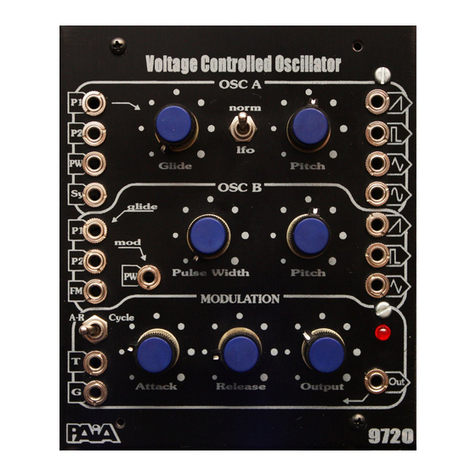
Paia 9720 Assembly and using manual

Paia

Paia 9720 Assembly and using manual

limex ALPIN MASTER 128 user manual

limex

limex ALPIN MASTER 128 user manual

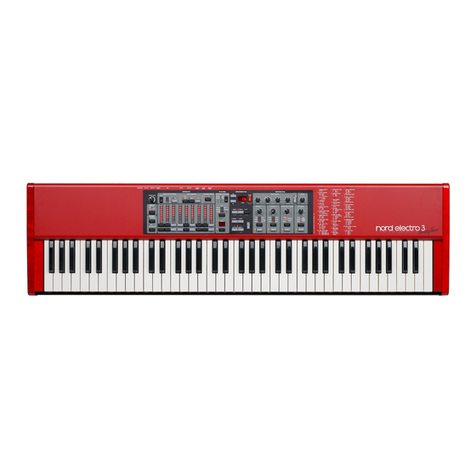
nord Electro 3 user manual

nord

nord Electro 3 user manual

manuals.online logo
manuals.online logoBrands
  • About & Mission
  • Contact us
  • Privacy Policy
  • Terms and Conditions

Copyright 2025 Manuals.Online. All Rights Reserved.

LFO: Low frequency oscillator
5 waveforms are provided, each of them continously
variable:
• Sine with wavefolding
• Triangle with controllable ascending/descending ratio
• Square with duty cycle control
• Stepped triangle with variable number of steps
• Clocked noise with interpolation control
Knob TWIN & EXPERT mode SPLIT mode
1 Frequency Ch. 1 Frequency
2 Waveform Ch. 1 Waveform
3 Waveshape variation Ch. 2 Frequency
4 Initial phase Ch. 2 Waveform
The trigger resets the LFO to the phase set by the
“initial phase” control.
Peaks
Dual trigger converter
TAP: Tempo synchronized LFO
This function is similar to the LFO except that the fre-
quency is synchronized to the rate of the input trigger
signals, or to the “taps” on the buttons (G) and (H).
Knob TWIN & EXPERT mode SPLIT mode
1 Amplitude Ch. 1 Waveform
2 Waveform Ch. 1 Shape
3 Waveshape variation Ch. 2 Waveform
4 Initial phase Ch. 2 Shape
DRUM: Analog modeling drums
Channel 1 is a modeled analog bass drum, and channel
2 a modeled snare drum.
Knob TWIN & EXPERT mode SPLIT mode
1 Frequency BD attack
2 Frequency modulation/
tone
BD decay
3 Attack/noisiness SD tone
4 Decay SD noisiness
Note: With extreme noisiness and tone settings, the
snare drum turns into a hi-hat.
Tips
Hold the function selection switch (F) for 1 second to
unlock 4 new secret functions. Repeat this operation to
go back to the 4 standard functions.
About Peaks
Peaks is a 2-channel multi-function signal generator:
envelopes, synchronized low-frequency oscillations, or
drum signals can be generated in response to triggers.
Installation
Peaks requires a -12V / +12V power supply (2x5 pins
connector). The red stripe of the ribbon cable (-12V side)
must be oriented on the same side as the “Red stripe”
marking on the board.
The power consumption is as follows:
-12V: 2mA ; +12V: 60mA.
Online manual and help
The manual can be found online at
mutable-instruments.net/modules/peaks/manual
For help and discussions, head to
mutable-instruments.net/forum
A
B
C
D
E
F
G
H
1
2
3 4
Front panel
A. B. C. D. Parameters. Refer to the tables in the next
sections.
E. Control mode selection switch and LED.
F. Function selection switch and LEDs.
G. H. Manual trigger buttons for channels 1 & 2.
1. 2. Channel 1 & 2 trigger inputs.
3. 4. Channel 1 & 2 signal outputs.
Control modes
Peaks can operate in 3 different modes:
TWIN: Both channels share the same parameters but
can be triggered independently. The 4 knobs control the
4 parameters. Perfect for duophony!
SPLIT: Knobs 1&2 control two main parameters of chan-
nel 1; and knobs 3&4 two main parameters of channel 2.
Press the button (E) to switch back and forth between
TWIN and SPLIT mode. The LED is lit in SPLIT mode.
EXPERT: Channel 1 and 2 are completely independent.
Hold the button (E) for 1 second to enter the EXPERT
mode. Press (E) to change the channel. The LED blinks
once when channel 1 is active, twice when channel 2 is
active. Hold (E) for 1 second to leave the EXPERT mode.
ENV: Envelope generator
Knob TWIN & EXPERT mode SPLIT mode
1 Attack Ch. 1 Attack
2 Decay Ch. 1 Decay
3 Sustain Ch. 2 Attack
4 Release Ch. 2 Decay
In Twin & Expert modes, the envelope is an ADSR and
requires a Gate signal.
In Split mode, the envelope is a simpler AD, and only
requires a Trigger signal.
Attack time Decay time
Sustain
level
Release time