manuals.online logo
Brands
  1. Home
  2. •
  3. Brands
  4. •
  5. NAD
  6. •
  7. Receiver
  8. •
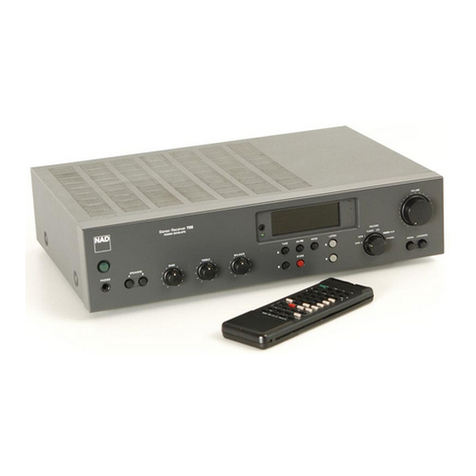
  9. NAD 7220PE User manual

NAD 7220PE User manual

Other manuals for 7220PE

2

This manual suits for next models

1

Other NAD Receiver manuals

NAD T741 User manual

NAD

NAD T741 User manual

NAD T760 User manual

NAD

NAD T760 User manual

NAD 120 Manual

NAD

NAD 120 Manual

NAD T762 User manual

NAD

NAD T762 User manual

NAD T743 User manual

NAD

NAD T743 User manual

NAD T785 HD User manual

NAD

NAD T785 HD User manual

NAD T742 User manual

NAD

NAD T742 User manual

NAD T 757 User manual

NAD

NAD T 757 User manual

NAD T744 User manual

NAD

NAD T744 User manual

NAD VISO TWO User manual

NAD

NAD VISO TWO User manual

NAD T765 HD User manual

NAD

NAD T765 HD User manual

NAD T765 User manual

NAD

NAD T765 User manual

NAD C717 User manual

NAD

NAD C717 User manual

NAD T761 User manual

NAD

NAD T761 User manual

NAD L 54 User manual

NAD

NAD L 54 User manual

NAD T761 User manual

NAD

NAD T761 User manual

NAD T 773 User manual

NAD

NAD T 773 User manual

NAD T775 User manual

NAD

NAD T775 User manual

NAD T 747 User manual

NAD

NAD T 747 User manual

NAD T 758 User manual

NAD

NAD T 758 User manual

NAD T737 User manual

NAD

NAD T737 User manual

NAD T 743 User manual

NAD

NAD T 743 User manual

NAD T 751 User manual

NAD

NAD T 751 User manual

NAD T761 User manual

NAD

NAD T761 User manual

Popular Receiver manuals by other brands

Televes ZAS HD SAT user manual
Televes

Televes ZAS HD SAT user manual

Realistic DX-75 Operating and service instructions

Realistic

Realistic DX-75 Operating and service instructions

Saris 4620 Assembly instructions

Saris

Saris 4620 Assembly instructions

Mini DTR 206C PVR user manual
Mini

Mini DTR 206C PVR user manual
RF Elements TwistPort manual
RF Elements

RF Elements TwistPort manual
Denon DN-200WS user guide

Denon

Denon DN-200WS user guide

Yamaha RX-V467 owner's manual
Yamaha

Yamaha RX-V467 owner's manual
Russound SaphIR 858 instruction manual
Russound

Russound SaphIR 858 instruction manual
Quasonix RDMS Firmware update procedure

Quasonix

Quasonix RDMS Firmware update procedure

Pioneer XV-HTD1 Service manual

Pioneer

Pioneer XV-HTD1 Service manual

ATZ HDMI-V2-44HE150 manual

ATZ

ATZ HDMI-V2-44HE150 manual

Sony XNV-770BT MyTomTom Specifications

Sony

Sony XNV-770BT MyTomTom Specifications

Grundig STR 7122 TWIN Service manual

Grundig

Grundig STR 7122 TWIN Service manual

Creative Blaster Modem user guide

Creative

Creative Blaster Modem user guide

Panduit ATLONA AT-OME-RX11 installation guide

Panduit

Panduit ATLONA AT-OME-RX11 installation guide

VOLTCRAFT UTPS-40 operating instructions

VOLTCRAFT

VOLTCRAFT UTPS-40 operating instructions

JVC KW-ADV794 instructions

JVC

JVC KW-ADV794 instructions

Litelink VT-1001 operating instructions

Litelink

Litelink VT-1001 operating instructions

manuals.online logo
manuals.online logoBrands
  • About & Mission
  • Contact us
  • Privacy Policy
  • Terms and Conditions

Copyright 2025 Manuals.Online. All Rights Reserved.

SERVICE
—
MANUAL
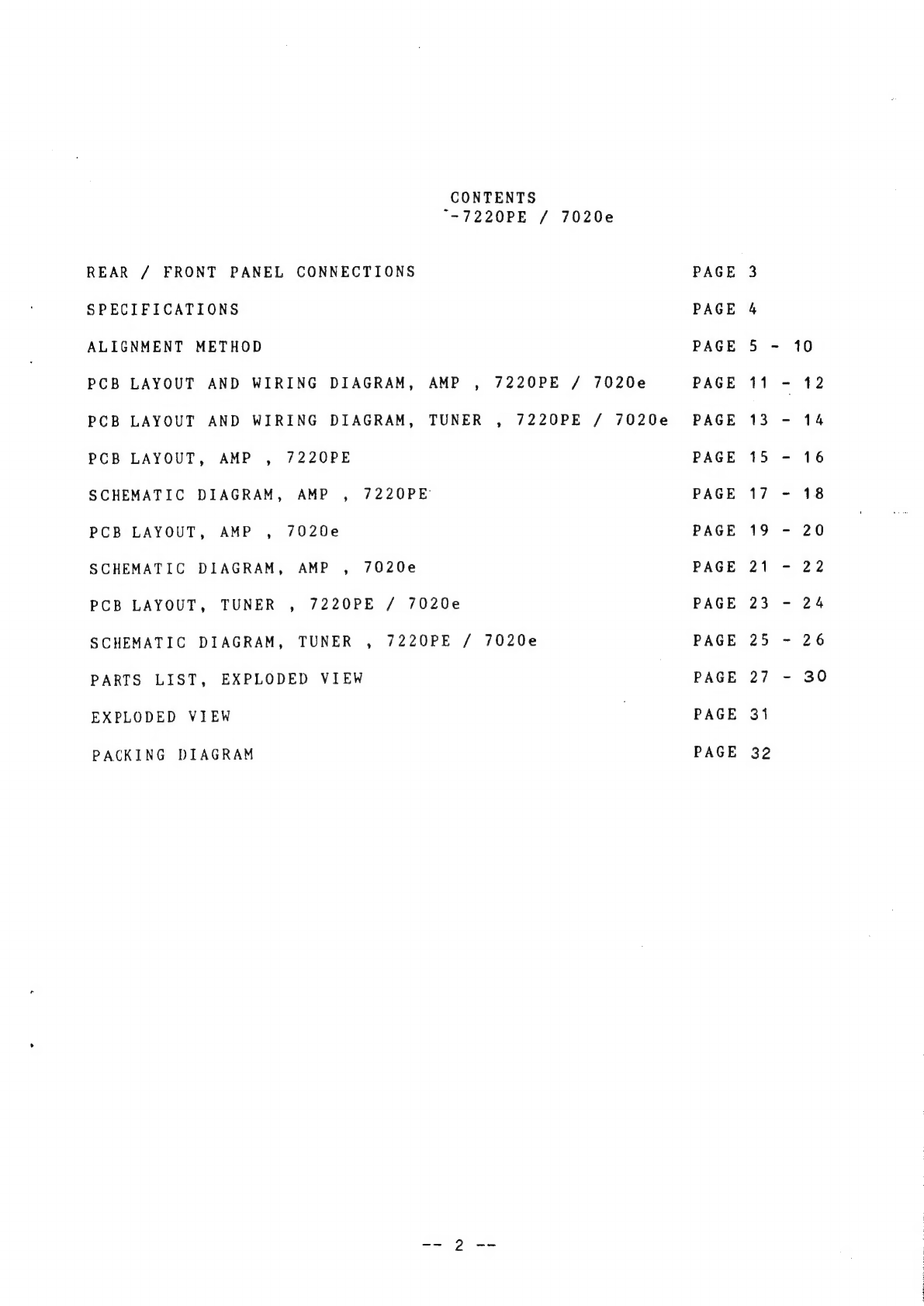
CONTENTS
-7220PE
/
7020e
REAR
/
FRONT
PANEL
CONNECTIONS
SPECIFICATIONS
ALIGNMENT
METHOD
PCB
LAYOUT
AND
WIRING
DIAGRAM,
AMP
,
7220PE
/
7020e
PCB
LAYOUT
AND
WIRING
DIAGRAM,
TUNER
,
7220PE
/
7020e
PCB
LAYOUT,
AMP
,
7220PE
SCHEMATIC
DIAGRAM,
AMP
,
7220PE
PCB
LAYOUT,
AMP
,
7020e
SCHEMATIC
DIAGRAM,
AMP
,
7020e
PCB
LAYOUT,
TUNER
,
7220PE
/
7020e
SCHEMATIC
DIAGRAM,
TUNER
,
7220PE
/
7020e
PARTS
LIST,
EXPLODED
VIEW
EXPLODED
VIEW
PACKING
DIAGRAM
--
2--
PAGE
PAGE
PAGE
PAGE
PAGE
PAGE
PAGE
PAGE
PAGE
PAGE
PAGE
PAGE
PAGE
PAGE
11
13
15
17
19
21
23
25
27
31
32
20
22
24
26
30
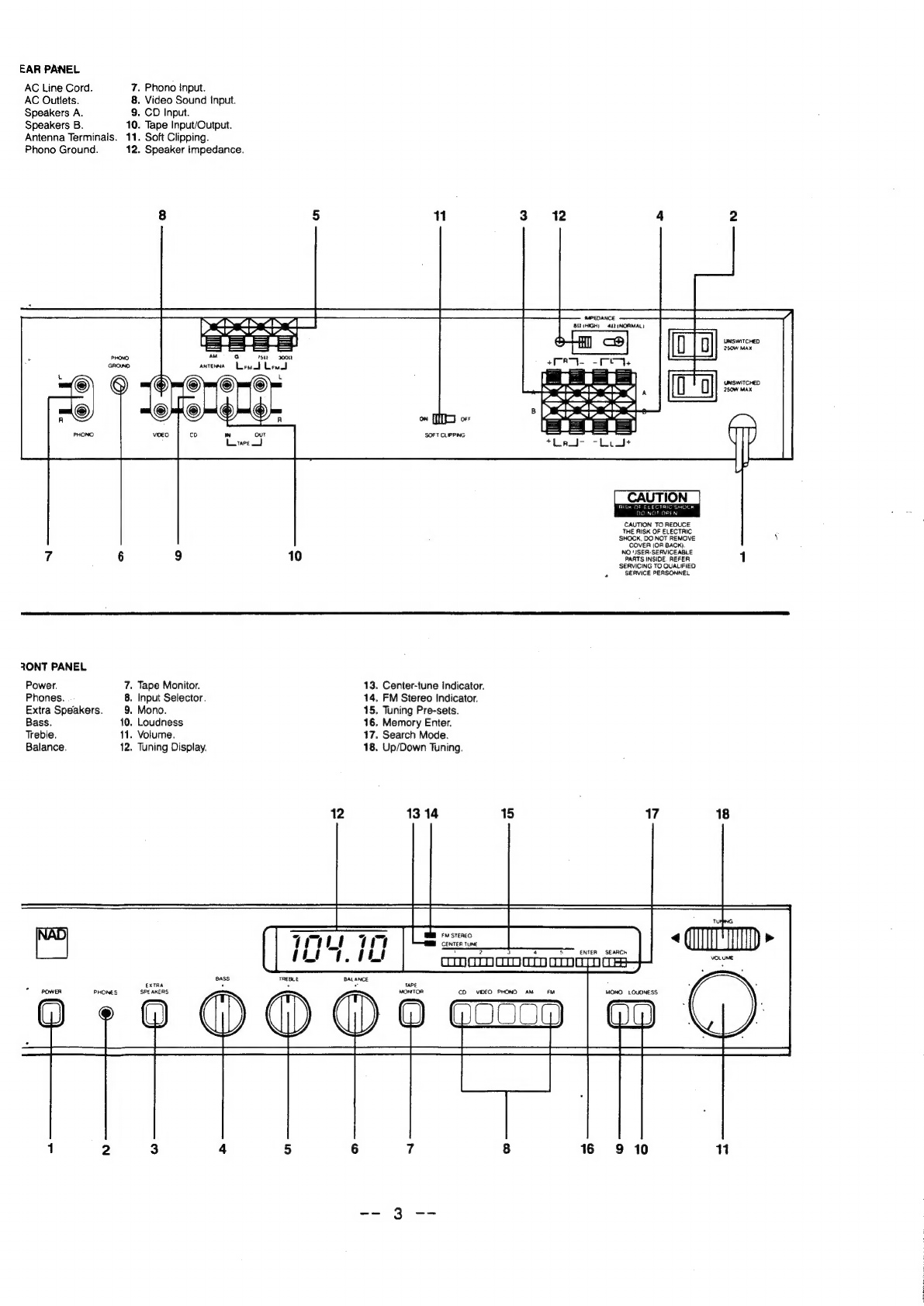
EAR
PANEL
AC
Line
Cord.
7.
Phono
Input.
AC
Outlets.
8.
Video
Sound
Input.
Speakers
A.
9.
CD
Input.
Speakers
B.
10.
Tape
Input/Output.
Antenna
Terminals.
11.
Soft
Clipping.
Phono
Ground.
12.
Speaker
tmpedance.
8 5
11
3
«12
4
2
BALIHIGH)
412
(NORMAL)
UNSWITCHED
250W
MAX
antewa
Liew
Lewd
UNSWITCHED
250W
MAX
“CAUTION
DO
NOT
OPEN
CAUTION
TO
REDUCE
THE
RISK
OF
ELECTRIC
SHOCK,
DO
NOT
REMOVE
COVER
(OR
BACK},
7
6
9
10
NO
SER-SERVICEABLE
1
PAATS
INSIDE,
REFER
SERVICING
TO
QUALIFIED
SERVICE
PERSONNEL
ONT
PANEL
Power.
7.
Tape
Monitor.
13.
Center-tune
indicator.
Phones.
8.
Input
Selector.
14,
FM
Stereo
Indicator.
Extra
Speakers.
9.
Mono.
15.
Tuning
Pre-sets.
Bass.
10.
Loudness
16.
Memory
Enter.
Treble.
11.
Volume.
17.
Search
Mode.
Balance.
12.
Tuning
Display.
18.
Up/Down
Tuning.
12
13
14
15
17
18
FM
STEREO.
CENTER
TUNE
<P)
>
VOLUME
(cara
TREBLE
BALANCE
EXTRA
s
SPEAKERS
O0e0
@MqQ
WO
(oom
[SS
LA
arma
cS,
Ae
Le
TAPE
MONO
LOUONESS.
WW
a
Specifications
NAD
7220PE
Stereo
Receiver
Note:
Specifications
are
measured
in
accordance
with
EIA
Standard
RS-
490
(IHF
A-202)
for
amplifiers
and
ANSI-IEEE
Standard
185
(1975),
i.e.
IHF
T-200,
for
tuners.
Amplifier
measurements
referred
to
8
ohms
are
taken
with
the
Speaker
Impedance
selector
set
to
8Q
(High).
Measurements
for
4
and
2
ohms
are
taken’with
Impedance
selector
at
4Q
(Normal).
Power
Amplifier
Section
CONTINUOUS
AVERAGE
POWER
OUTPUT
AT
8
OHMS
(minimum
RMS
power
per
channel,
both
channels
driven,
with
no
more
than
the
rated
distortion)
:
Rated
distortion
(THD),
20
Hz
-
20
kHz
Clipping
power,
1
kHz
(maximum
continuous
power
per
channel)
Dynamic
Headroom
at
8
ohms
Dynamic
power
(maximum
8
ohms
short-term
power
per
channel)
4ohms
2
ohms
Slew
factor
Slew
rate
Damping
factor
(ref.
8
ohms,
at
50
Hz)
T.H.D
and
SMPTE
I.M.
distortion
from
250
mW
to
rated
output
IHF
|.M.
(CCIF
IM)
and
T.I.M.
distortion
at
rated
output
Preamplifier
Section.
Phono
Input
Input
Impedance
Input
Sensitivity
(1
kHz)
Signal-to-Noise
Ratio
with
cartridge
connected,
A-weighted
Input
Overload
at
20
H2z/1kHz/20kHz
RIAA
Accuracy
High-Level
Inputs
(CD,
Video,
Tape)
Input
impedance
Input
Sensitivity
Signal-to-Noise
ratio,
A-weighted
Input
Overload
Frequency
Response
infrasonic
Fitter
Controls
Treble
Bass
FM
Tuner
Section
Input
sensitivity
Mono,
-30
dB
THD+N
Mono,
50
dB
S/N
Stereo,
50
dB
S/N
Stereo
60
dB
S/N
20
W
(13
dBW)
0.04%
25
W
+4.4dB
55W
75W
85
W
>
50
15V/usec
>
30
<
0.04%
<
0.04%
R=47KQ
,
C=
100
pF
0.55
mV
for
1
W
out
2.4
mV
for
20
W
out
75
dB
re
5
mV
20/200/1700
mV
+0.5
dB
R=40kQ
,C
=
100
pF
33
mV
for
1W
out
150
mV
for
20W
out
84
dB
re
1
Wout
97
dB
re
20W
out
>10V
20Hz
-
20kHz
+0.5,
-1.0
dB
-3
dB
at
15
Hz
24
dB/octave
+7
dB
at
10kHz
+10
dB
at
50
Hz
10.8
dBf
(1.9
nV/3002
,
or
0.95
pV
into
75Q
)
14.4
dBf
(2.9
pn
V/3002
)
37
Bf
(40
pV)
47
dBf
(120
pV)
Capture
ratio
(at
45
and
65
dBf)
AM
rejection
(at
65
and
85
dBf)
Selectivity
Image
rejection
R.F.
intermodulation
LF.
rejection
SCA
rejection
Subcarrier
suppression
(19
&
38
kHz)
THD
at
100%
modulation
Mono,
1kHz
|
100Hz-6kHz
Stereo,
1
kHz
100Hz-6kHz,
Signal-to-noise
ratio
Mono
‘
IHF
weighted,
65
dBf
Stereo
Frequency
response,
30Hz-15
kHz
Stereo
separation
AM
Tuner
Section
Usable
sensitivity
THD
Selectivity
Image
rejection
LF.
rejection
SIN
ratio
(30%
mod.,
50
mV
input)
Physical
Specifications
Width
x
Depth
x
Height
Net
Weight
ShippingWeight
Power
Consumption
<
1.5
dB
>
60
dB
58
dB
70
dB
60
dB
90
dB
60
dB
60
dB
0.1%
0.2%
0.1%
0.3%
>
80
dB
>
74dB
+0.5
dB
45
dB
5yVv
0.5%
30
dB
45
dB
35
dB
45
dB
42
x
27.3
x
8cm.
6.5
x
103/4
x
334
in.
5.5kg
(12.1
lbs)
6.8
kg
(15
Ibs)
50/60
Hz
at
110,
120,
220,
or
240
VAC
150
W
Specifications
are
those
in
effect
at
the
time
of
printing.
NAD
reserves
the
right
to
change
Specifications
or
designs
at
any
time
without
notice.
Industrial
Design:
REINHOLD
WEISS
DESIGN/CHICAGO
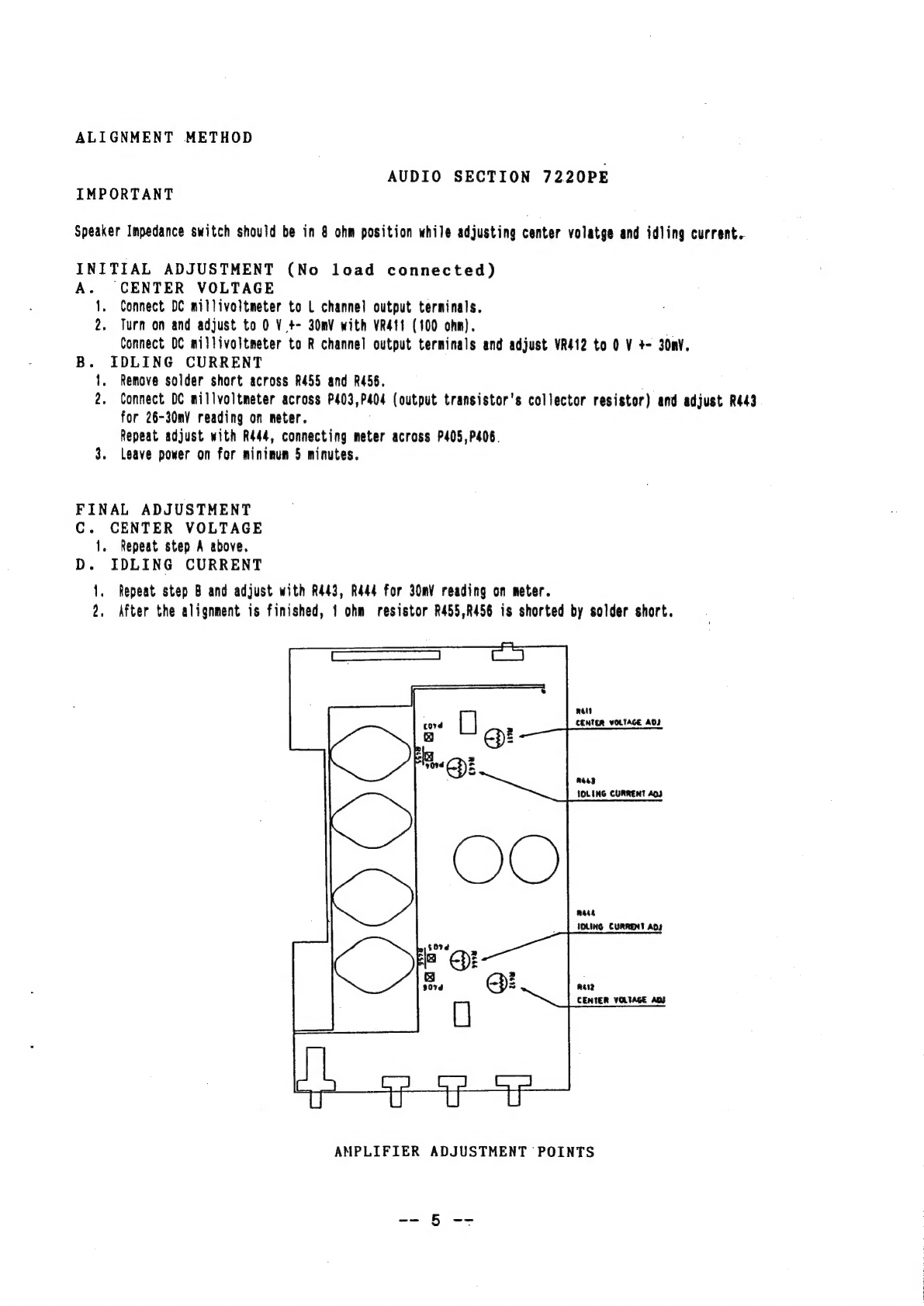
ALIGNMENT
METHOD
AUDIO
SECTION
7220PE
IMPORTANT
Speaker
Impedance
switch
should
be
in
8
ohm
position
while
adjusting
center
volatge
and
idling
current.
INITIAL
ADJUSTMENT
(No
load
connected)
A.
CENTER
VOLTAGE
1,
Connect
DC
millivoltmeter
to
L
channe)
output
terminals.
2.
Turn
on
and
adjust
to
0
¥
+-
30mV
with
VR411
(100
ohm).
7
Connect
DC
millivoltmeter
to
R
channel
output
terminals
and
adjust
VR412
to
0
V
+-
30mv.
B.
IDLING
CURRENT
1.
Remove
solder
short
across
R455
and
R456.
2.
Connect
DC
millvoltmeter
across
P403,P404
(output
transistor's
collector
resistor)
and
adjust
R443
for
26-30mY
reading
on
meter.
Repeat
adjust
with
R444,
connecting
meter
across
P405,P406.
3.
Leave
power
on
for
minimum
5
minutes.
FINAL
ADJUSTMENT
C.
CENTER
VOLTAGE
1.
Repeat
step
A
above.
D.
IDLING
CURRENT
1.
Repeat
step
B
and
adjust
with
R443,
Rd
for
30mV
reading
on
meter.
2.
After
the
alignment
is
finished,
1
ohm
resistor
R455,R456
is
shorted
by
solder
short.
mo
CENTER
VOLTAGE
ADJ
RAa3
fOLING
CURRENT
Ao)
Mace
IDLING
CURRENT
ADJ
REZ
CENTER
VOLTAGE
AD}
AMPLIFIER
ADJUSTMENT
POINTS
--
5
--
FM
ALIGNMENTS
NECESSARY
INSTRUMENTATION
FM
GENERATOR
(less
than
0.05%
THD)
STEREO
GENERATOR
(less
than
0.058%
THD,
more
than
50
dB
separation
at
1
KHz.
AUDIO
GENERATOR
(not
necessary
if
FM
generator
has
built
in
sweep;
i.e.
SOUND
TECHNOLOGY
ST
1000A
and
ST
1020A)
2
AC
VIVM's
(or
one
with
left/right
channel
switch)
THD
ANALYZER
(resolution
better
than
0.1%)
OSCILLOSCOPE
(5m
or
better
sensitivity,
X
input
capability)
FREQUENCY
COUNTER
YOM
or
DMM
(high
impedance,
must
read
in
mV)
DIODE
DETECTOR
PROBE
COPPER/FERRITE
INDUCTOR
IMPORTANT
While
all
FM
generator
output
levels
hereafter
are
referred
to
the
300
ohm
input,
75
ohm
input
can
be
used,
but
be
aware
of
possible
equipment
groundloops
and
divide
the
RF
output
level
by
2.
Before
alignments
commence
set
input
selector
to
tuner
and
release
tape,
mono
and
FM
NR.
defeat
switches
(out)
ALIGNMENT
OF
FRONTEND
should
only
be
necessary
after
repair
to
frontend
or
crystal
oscillator
circuits
(pin
2
and
3
on
Q911)
A.
TUNING
VOLTAGE
(OSCILLATOR)
It
is
essential
to
check
tuning
voltage
before
aligning
the
rest
of
th
frontend,
1.
Connect
DMM
between
shield
and
pin
5
on
frontend,
2.
Tune
to
108
MHz
and
adjust
L
101
if
voltage
is
incorrect.
SPECIFICATION
20.5V
+-
0.5V
-3,.
Tune
to
87.5
MHz
and
read
voltage,
repeat
step
2
and
3
if
incorrect.
SPECIFICATION
3V
+-
0.5¥
B.
RF
ADJUSTMENT
(TRACKING)
1,
Connect
RF
generator
to
antenna
input
and
detectorprobe
to
pin
1,Q104
(IF
DETECTOR)
with
ground
to
detectorshield.
Adjust
sensitivity
of
oscilloscope
to
maximum
(SmV
or
better)
and
modulate
FM
generator
sweep
+-
300
KHz
or
more
WITH
modulating
(sweep)
signal
connected
to
X-imput
of
oscilloscope.
2.
Set
tuner
to 90
MHz,
enter
into
preset
1,
and
tune
generator
so
that
curve
appars
on
oscilloscope.
Turn
down
RF
input
level
so
that
curve
covers
approximately
1/2
of
oscilloscope
display.
J.
Check
alignments
of
L2-L
4-5
by
inserting
copper/ferrite
inductor
close
to
them
while
watching
curve
on
oscilloscope.
Curve
should
decrease
in
height
with
either
ferrite
(same
as
increasing
inductance,
i.e.
more
core)
or
with
copper
(same
as
decreasing
inductance,
i.e.
extend
size
of
coil),
If
curve
increases
in
size
more
than
10%
adjust
only
the
coil
which
reacts
incorrectly.
Adjust
coils
by
gently
extend
or
contract
the
aircoil
with
a
non-metallic
and
non-static
tool
(i.e.
plastic
knit-pin
or
a
wooden stick),
Be
careful
not
to
deform
coil,
4.
Set
tuner
to
105MHz,
enter
into
preset
2,
and
tune
generator
so
that
curve
appears
on
oscilloscope.
9.
Check
lL
2-14-45
again
with
the
ferrite/copper
inductor.
Curve
should
not
increase
more
than
10%
on
any
of
the
coils.
6.
Repeat
step
2+3+4+5
if
curve
height
is
outside
of
telerances,
if
necessary
distribute
the
error
between
90
and
105
KHz,
Check
tuning
voltage
again
if
tolerances
not
possible
to
achieve.
C.
IF
ADJUSTMENT
1.
Set
tuner
to
approximately
98
MHz
(the
tuner
must
be
tuned
to
an
unoccupied
frequency)
enter
into
preset
3,
and
tune
FM
generator
to
display
a
curve
on
the
oscilloscope.
2.
Adjust
11
(IFT
tuner
frontend)
to
maximum
and
symmetrical
curve
on
th
display,
using
as
little
input
signal
as
Possible,
D.
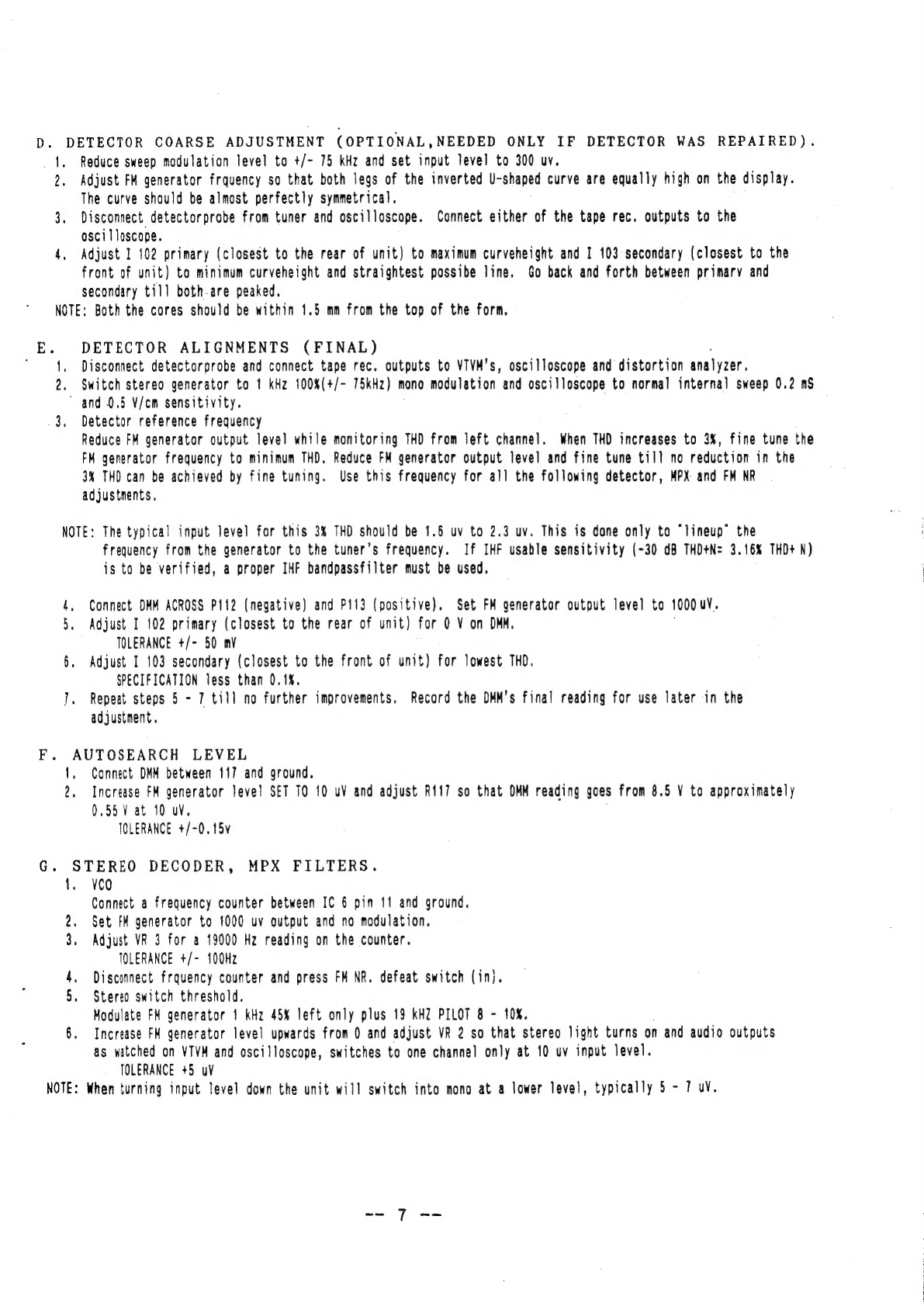
DETECTOR
COARSE
ADJUSTMENT
(OPTIONAL,NEEDED
ONLY
IF
DETECTOR
WAS
REPAIRED).
Reduce
sweep
modulation
level
to
+/-
75
kHz
and
set
input
level
to
300
uv.
Adjust
FA
generator
frquency
so
that
both
legs
of
the
inverted
U-shaped
curve
are
equally
high
on
the
display.
The
curve
should
be
almost
perfectly
symmetrical.
Disconnect
detectorprobe
from
tuner
and
oscilloscope.
Connect
either
of
the
tape
rec.
outputs
to
the
oscilloscope.
Adjust
I
102
primary
(closest
to
the
rear
of
unit)
to
maximum
curveheight
and
I
103
secondary
(closest
to
the
front
of
unit)
to
minimum
curveheight
and
straightest
possibe
line.
Go
back
and
forth
between
primary
and
secondary
till
both-are
peaked.
NOTE:
Both
the
cores
should
be
within
1.5
mm
from
the
top
of
the
form,
DETECTOR
ALIGNMENTS
(FINAL)
Disconnect
detectorprobe
and
connect
tape
rec.
outputs
to
VTVM's,
oscilloscope
and
distortion
analyzer.
Switch
stereo
generator
to
1
kHz
100X(+/-
75kHz)
mono
modulation
and
oscilloscope
to
normal
internal
sweep
0.2
mS
“and
0.5
V/cm
sensitivity.
Detector
reference
frequency
Reduce
FM
generator
output
level
while
monitoring
THD
from
left
channel.
When
THD
increases
to
3%,
fine
tune
the
FM
generator
frequency
to
minimum
THD,
Reduce
FM
generator
output
level
and
fine
tune
till
no
reduction
in
the
3%
THD
can
be
achieved
by
fine
tuning.
Use
this
frequency
for
all
the
following
detector,
MPX
and
FM
NR
adjustments.
NOTE:
The
typical
input
level
for
this
3%
THD
should
be
1.6
uv
to
2.3
uv.
This
is
done
only
to
“lineup”
the
NOTE:
1,
2.
frequency
from
the
generator
to
the
tuner’s
frequency.
If
IHF
usable
sensitivity
(-30
dB
THD+N=
3.16%
THD+N)
is
to
be
verified,
a
proper
IHF
bandpassfilter
must
be
used.
Connect
DMM
ACROSS
P112
(negative)
and
P113
(positive).
Set
FM
generator
output
level
to
1000
wv.
Adjust
I
102
primary
(closest
to
the
rear
of
unit)
for
0
V
on
DMM.
TOLERANCE
+/-
50
mV
Adjust
I
103
secondary
(closest
to
the
front
of
unit)
for
lowest
THD.
SPECIFICATION
less
than
0.1%.
Repeat
steps
5
-
7
till
no
further
improvements.
Record
the
DMM’s
final
reading
for
use
later
in
the
adjustment.
AUTOSEARCH
LEVEL
Connect
DMM
between
117
and
ground.
Increase
FM
generator
level
SET
TO
10
uY
and
adjust
R117
so
that
DMM
reading
goes
from
8.5
V
to
approximately
0.554
at
10
uv.
TOLERANCE
+/-0.15v
STEREO
DECODER,
MPX
FILTERS.
{.
VCO
Connect
a
frequency
counter
between
IC
6
pin
11
and
ground.
Set
FM
generator
to
1000
uv
output
and
no
modulation,
Adjust
VR
3
for
a
19000
Hz
reading
on
the
counter.
TOLERANCE
+/-
100H2
Disconnect
frquency
counter
and
press
FM
NR.
defeat
switch
(inj.
Stereo
switch
threshold.
Modulate
FM
generator
1
kHz
45%
left
only plus
19
KHZ
PILOT
8
-
tOX.
Increase
FM
generator
level
upwards
from
0
and
adjust
VR
2
so
that
stereo
light
turns
on
and
audio
outputs
as
watched
on
VTVM
and
oscilloscope,
switches
to
one
channel
only
at
10
uv
input
level.
TOLERANCE
+5
uv
When
turning
input
level
down
the
unit
will
switch
into
mono
at
a
lower
level,
typically
5
-
7
u¥.
--
7
--
:
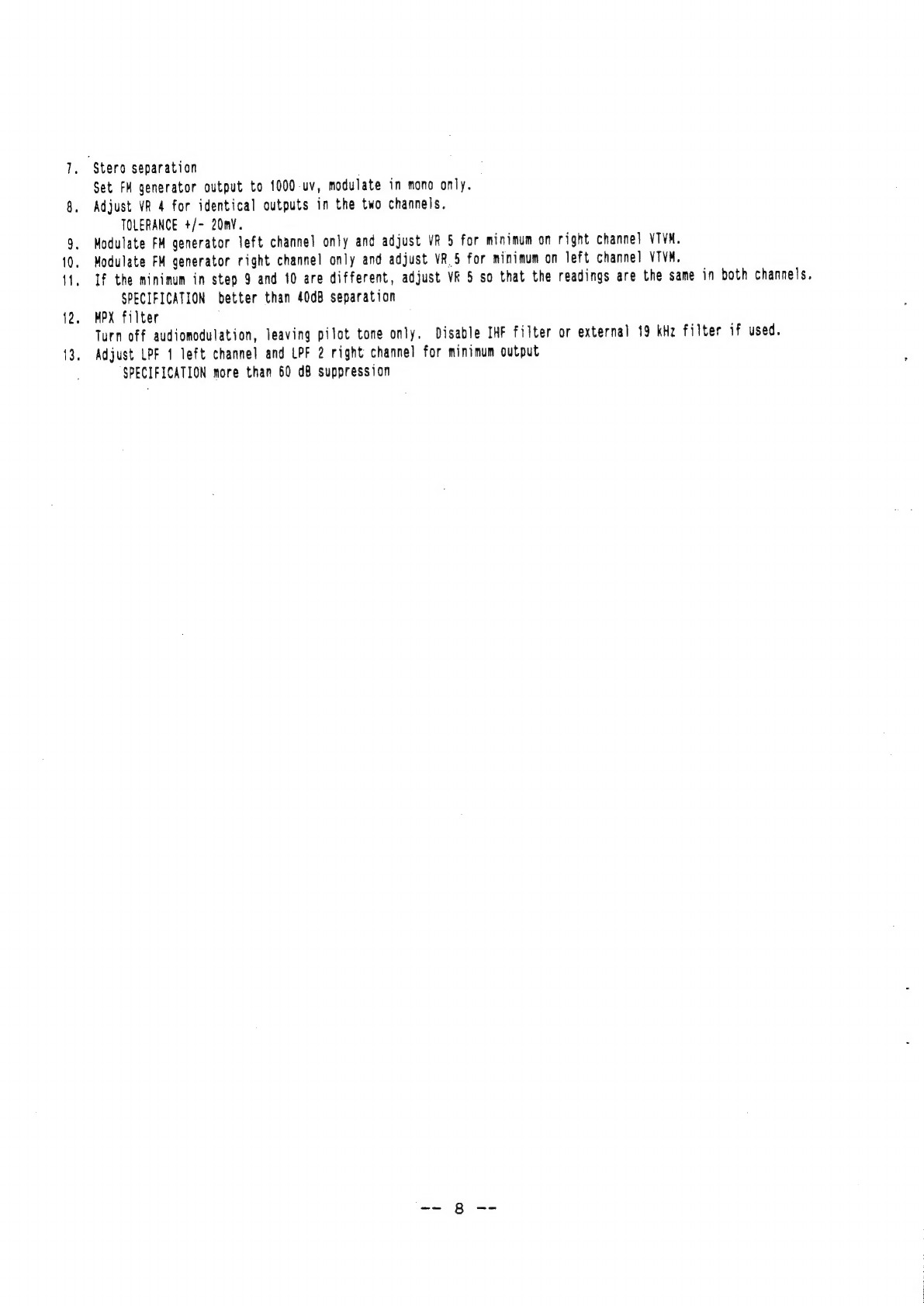
“Stero
separation
Set
FA
generator
output
to
1000
uv,
modulate
in
mono
only.
Adjust
VR
4
for
identical
outputs
in
the
two
channels,
TOLERANCE
+/-
20mV.
Modulate
FM
generator
left
channel
only
and
adjust
VR
§
for
minimum
on
right
channel
VTVM.
Modulate
FM
generator
right
channel
only
and
adjust
VR.5
for
minimum
on
left
channel
VTVM.
If
the
minimum
in
step
9
and
tO
are
different,
adjust
VR
5
so
that
the
readings
are
the
same
in
both
channels.
SPECIFICATION
better
than
40dB
separation
MPX
filter
Turn
off
audiomodulation,
leaving
pilot
tone
only.
Disable
IHF
filter
or
external
19
kHz
filter
if
used.
Adjust
LPF
1
left
channel
and
LPF
2
right
channel
for
minimum
output
SPECIFICATION
more
than
60
dB
suppression
--
8
--
AM
ALIGNMENTS
Unless
repairs
khave
been done
to
Oscillator
Section,
do
not
adjust
AM
OSC
coil
or
Trimming
Capacitor.
If
OSC
Adjustment
is
needed,
connect
hight
impedance
voltmeter
(preferably
DMM)
between
P123
and
ground.
A.
OSC
ADJUSTMENT
1.
Tune
unit
to
show
600KHz
on
display
and
adjust
L102
to
read
1.75V+-0.05V
on
DMM.
B.
IF
ADJUSTMENT
.
For
IF
adjustment
and
Tracaking
adjustment
connect
VTVM
to
loudspeaker
output
(or
tape
output),
only
one
channel
connection
needed,
and
connect
signal
generator
to
antenna
terminals.
Adjust
generator
for
30%
modulation
and
approx.
!v0
uv
input.
Tune
both
generator
and
receiver
to
approx.
{1000KHz,
and
adjust
generator
frequency
for
maximum
reading
on
VTVM.
Then
adjust
IFT2,
and
IFT3
for
maximum
reading
on
meter.
—
C.
TRACKING
ADJUSTMENT
{.
Tune
unit
and
generator
to
show
approx.
600KHz
and
adjust
L101
to
maximum
reading
on
VTVM.
2.
Tune
unit
and
generator
to
show
approx.
{400KHz
and
adjust
C138
(Trimming
Capacitor)
for
maximum
reading
on
VTVM.
3,
Repeat
step
1
and
2
unit
no
fkurhter
imprivement.
--
9
--
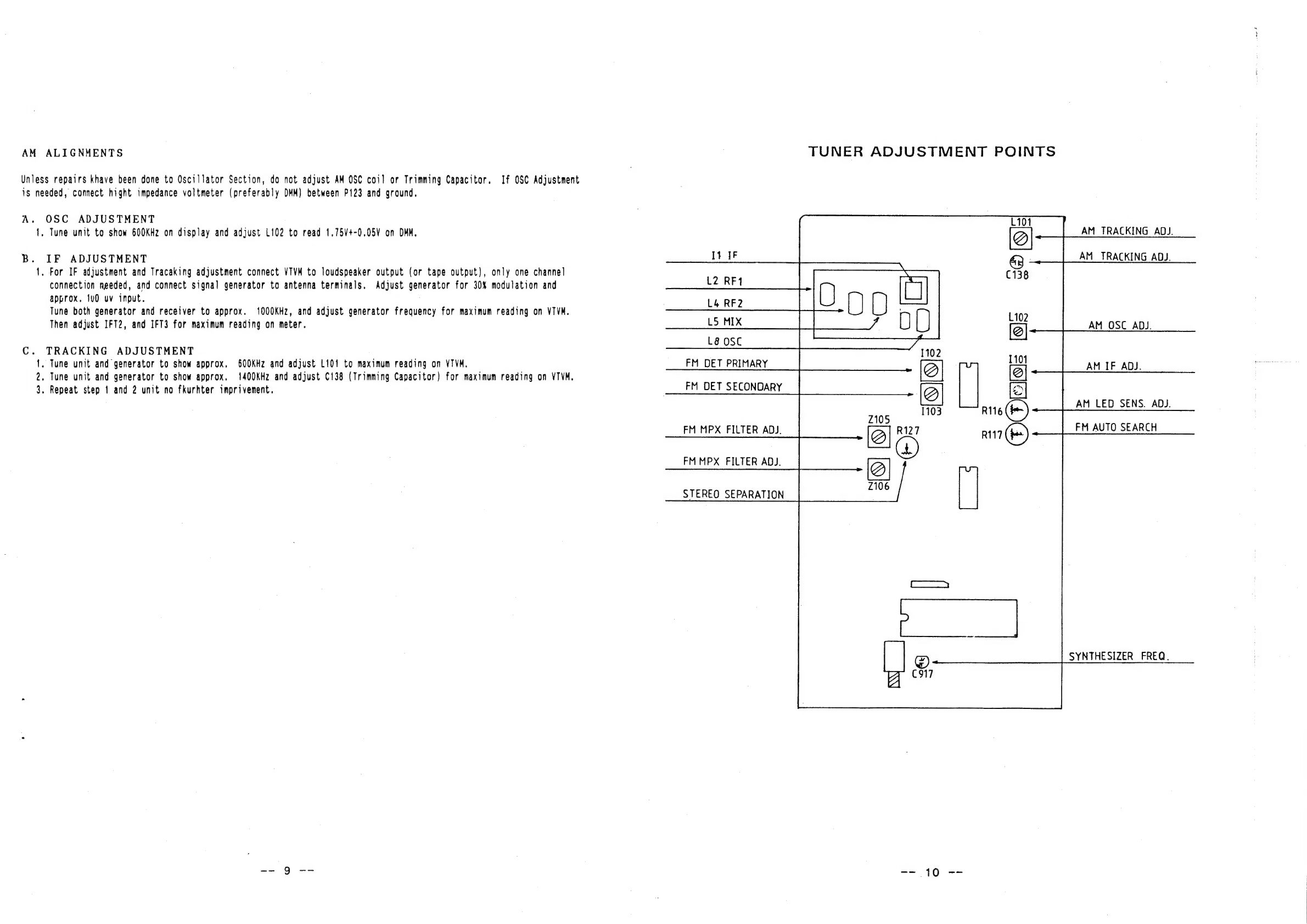
TUNER
ADJUSTMENT
POINTS
AM
TRACKING
ADJ.
It
IF
AM_
TRACKING
ADJ.
L2
RF1
L4
RF2
LS
MIX
AM_OSC_ADJ.
L8
OSC
FM
DET
PRIMARY
AM
_IF
ADJ.
FM
DET
SECONDARY
AM
LED
SENS.
ADJ.
FM
MPX
FILTER
ADJ.
FM
AUTO
SEARCH
FM
MPX
FILTER
ADJ.
STEREO
SEPARATION
SYNTHESIZER
FREQ.
For
versions
A,
Al. F
ions
B,
Bl,
C,-Cl.
AMPLIFIER
PCB
LAYOUT
AND
WIRING
DIAGRAM
an
oe
a
ee
meee
YEL
UNSWITCHED
S
oo
'
VIO
BROWN
P122
TO
TUNER
PCB
P12)
P120
ttt
|
P.T
ie
(120v)
RED
=
N
sJo
3a
sf
N
(120V)
RED
PHONES
7
POWER
SW
P126
weoncewee
te
ORG
:
SPEAKERS
PHONES
POWER
SW
OWER
TO
TUNER
PCB
A,
16
Siig
RED
a,