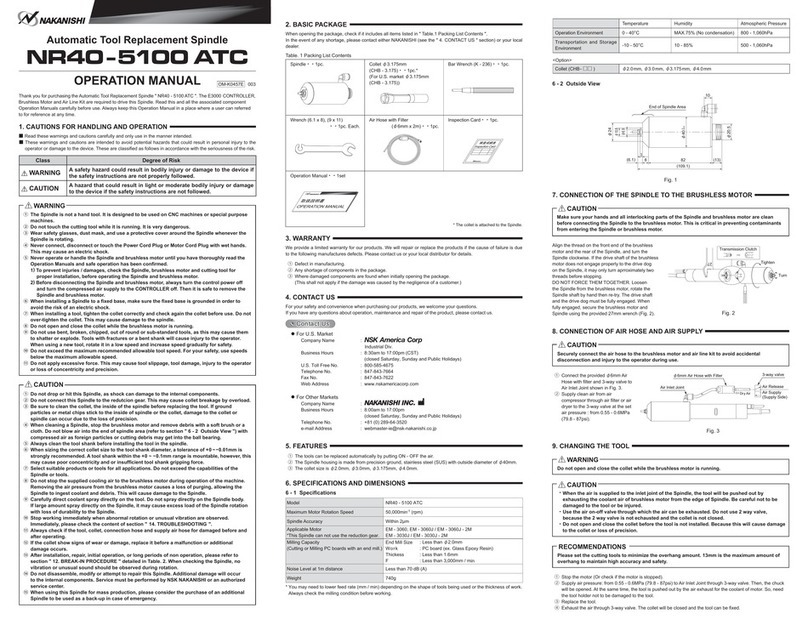
5.1
8
7
5
Tighten
Loosen
Wrench 5mm
Collet
Tool
Wrench 7mm
8. CHANGING THE TOOL
①Set the provided 7mm wrench on the Spindle.
②Place the provided 5mm wrench on the chuck
and turn it counterclockwise to loosen the collet
and remove the tool.
③Clean the collet, then insert the new tool and
tighten the collet by turning clockwise. Do not
over-tighten.
CAUTION
Do not tighten the collet without inserting a tool or dummy bur as this will result in damage to the
collet.
Fig. 3
Fig. 4
7
5.1
Spindle Shaft
Collet
Loosen
Wrench 7mm
9. REPLACING THE COLLET
①Remove the tool according to the section
" 8. CHANGING THE TOOL " procedure above.
(Fig. 4).
②Place the provided 7mm wrench on the spindle
shaft, and turn the top of the collet counter-
clockwise to remove the collet.
③Install the new collet into the Spindle by turning it
clockwise.
Please set the cutting tools to minimize the
overhang amount. 13mm is the maximum amount
of overhang to maintain high accuracy and safety.
RECOMMENDATION
10. INSTALLATION OF THE SPINDLE
WARNING
When installing a Spindle to a xed base, make sure the xed base is grounded in order to avoid
the risk of an electric shock.
CAUTION
・When installing a Spindle, do not hit, drop or cause shock to the Spindle. This may cause
damage to internal components and result in malfunctions.
・
When mounting the Spindle, be sure to secure within Clamping Area etched on the motor
spindle O.D. If theSpindle is installed incorrectly, damage to the internal components is possible.
・Cautions when tightening the securing bolts on to a Split Type Holder
Do not over-tighten the bolt. This will cause damage to Spindle's precision.
Tighten the bolt until the Spindle body can not be rotated by hand within the xture.
Extreme tightening is not necessary or recommended.
Apply working force and check that the Spindle is tight before using.
①When mounting a Spindle, refer to the Clamping Area
etched on the Spindle (Fig. 5).
(
Clamping Area
)
CLAMPING AREA
(27)
Fig. 5
Slit
Fastening Bolt
Slit of Bushing
Fastening Bolt Fastening Bolt
Spacer
Bushing with Slit
Split Type Holder
Fig. 6
②When installing a Spindle to the holder, recommended installation method is shown Fig 6. Refer to " ③How to
fabricate the Split Type Holder ". If this is not possible, install as shown in Fig. 7.
Fig. 7 Fig. 8
CAUTION
Do not allow set screws to come directly in
contact with the Spindle body as shown in
Fig. 8, as this will result in damage to the
Spindle housing and internal components.
When installing, never clamp directly over
the bearings, as this will result in bearing
damage (Refer to Fig. 9).
Fastenig Bolt
Deformation
Damage of internal
Components
Bearing
Fig. 9
Fastening Bolt
Front View
Fastening Bolt
Spacer
Slit
Side View
Fastening Bolt
Screw for Removal
Spacer
Spacer
Screw for Removal
③How to fabricate the Split Type Holder
(1) Rough bore the inside diameter of the Split
Type Holder.
(2) Cut a slit. (Ex. Slit 2mm) wide.
(3) Tighten the Screw for Removal and Force
Open the Slit Area.
(4) Insert a spacer (Ex. thickness = 2mm) into
the Slit Area.
(5) Loosen the Screw for Removal, and tighten
the fastening bolt with its specied torque.
(6) Finish the Split Type Holder so that the
inside diameter of the Split Type Holder
is ȭ
22.8 with its tolerance range from
-
0.01mm to
-
0.015mm, and its roundness
and cylindricity of less than 5μm.
(7) When inserting the Spindle loosen the
Fastening Bolt, and tighten the Screw for
Removal, widening the Slit Area. Fig. 10
CAUTION
・How to conrm the correct tightening or clamping of the Spindles in the holder : In case of use
a brushless motor.
Measure the current value of the Control Unit's power cord by the clamp meter.
Fasten the holder so that the increase in the no-load current value (during rotation at the
maximum rotation speed) with the Spindle fastened is 10mA (for type 200V / 230V) or less,
compared to the no-load current value (during rotation at the maximum rotation speed)
without fastening the Spindle. Do not over-tighten the Fastening Bolt. It may damage Spindle's
precision and shorten the life of the bearings.
・
The nal responsibility for ensuring holder
'
s safety for use in a given application is left to the
designer of the equipment in which NAKANISHI's Spindle is installed.
NAKANISHI offers Spindles with a wide variety of capabilities and specications.
Please carefully check the Spindle's specications against the requirements of your
equipment and verify suitability and safety of the Holder prior to initial use.
11. BREAK-IN PROCEDURE
During transportation, storage or installation, the grease inside the bearings will settle. If the Spindle is suddenly run at
high-speed, the grease will be ejected from the bearings, causing excessive heat that will cause bearing damage. After
installation, repair, initial operation, or long periods of non operation, please follow the break-in procedure detailed in Table. 2.
Steps
12 3 4
Air Pressure (MPa) For Air Motor
0.1 0.2 0.3 0.4
Rotation Speed
(min-1) (rpm)
For Brushless Motor
5,000 10,000 15,000 20,000
Rotation Time (min)
15 10 10 15
Items to Check
No Abnormal
Noises.
The Spindle housing temperature during
the break-in process should not exceed 20
degrees C (36 degrees F) above ambient
temperature. Should the Spindle exceed this
limit, rest the Spindle for at least 20 minutes
and re-start the break in procedure from the
beginning. If the housing temperature rises
again and exceeds 20 degrees C (36 degrees
F) above ambient temperature, check the
Spindle and motor for proper installation.
The Spindle
housing
temperature
during the
break-in
process should
not exceed
20 degrees C
(36 degrees F)
above ambient
temperature.
Table. 2
Table. 3Overhang and Speed
Overhang (mm) Max. Speed (min-1) (rpm)
20 N x 0.5
25 N x 0.3
50 N x 0.1
* N = Max. Operating Speed with 13mm overhang.
Table. 3Overhang and Speed
Overhang (mm) Max. Speed (min-1) (rpm)
20 N x 0.5
25 N x 0.3
50 N x 0.1
* N = Max. Operating Speed with 13mm overhang. Fig. 11
3.14 x Diameter (mm) x rotation speed (min-1) (rpm)
1,000 x 60
Surface Speed (m/s)
=
12. CAUTIONS IN USING GRINDSTONES AND TOOLS
①The proper surface speed for general grindstones is 10 -30 m /s.
②Do not exceed 13mm of overhang for mounted grindstones as shown in Fig. 11. If the overhang must
exceed 13mm, reduce the motor speed in accordance with Table. 3.
③Dress the grindstone prior to use.
④Do not use cutting tools with bent or broken shanks, cracks or excessive run-out.
⑤For grinding, the maximum depth of cut should not exceed 0.01mm radially or axially. Reciprocate the
tool several times after each pass to eliminate tool pressure.
⑥Always operate cutting tools within the allowable recommended speed of the cutting tools. Use of a
cutting tool outside of the allowable speed of the cutting tools could cause damage to the spindle and
injury to the operator.
⑦Keep the cutting tool shank and collet clean. If contaminants are left in the collet, excessive run-out will
cause damage to the cutting tool and or spindle.
⑧Do not strike or disassemble the Spindle.
⑨Please set the cutting tools to minimize the overhang amount. 13mm is the maximum amount of overhang
to maintain high accuracy and safety.
13
CAUTION
The maximum surface speed or rpm is always specied for a grindstone. Do not exceed the
maximum speed with reference to the calculating chart below. Always follow the grindstone
manufacturer's recommendations.
13. TROUBLESHOOTING
If a problem or concern occurs, please check the following prior to consulting your dealer.
14. DISPOSAL OF THE SPINDLE
When disposal of a Spindle is necessary, follow the instructions from your local government agency for proper
disposal of industrial components.
In case of using a brushless motor, refer to brushless motor and E2530 Control Unit Operation Manuals.
In case of using an air motor, refer to the air motor and the Air Line Kit Operation Manuals.
Contents are subject to change without notice.
Trouble Cause Inspection / Corrective Action
Spindle does not rotate or
rotate smoothly.
The Spindle ball bearings have been
damaged.
Replace the ball bearings.
(Return to NAKANISHI dealer service.)
The motor has been damaged. Replace the motor.
(Return to NAKANISHI dealer service.)
Overheating during
rotation.
Cutting debris has contaminated the
ball bearing, and the ball bearings are
damaged.
Replace the ball bearings.
(Return to NAKANISHI dealer service.)
Abnormal vibration or
noise during rotation.
The tool shank is bent. Replace the tool.
Cutting debris has contaminated the ball
bearings.
Replace the ball bearings.
(Return to NAKANISHI dealer service.)
The spindle ball bearings have been
damaged.
Tool slippage. Collet chuck is not correctly installed. Check and clean the collet. Reinstall the collet.
The collet is worn. Replace the collet.
High run-out. The tool is bent. Change the tool.
Collet chuck is not correctly installed.
Secure the collet correctly.
The collet is worn. Replace the collet.
Inside of the Spindle is worn. Replace the Spindle shaft.
(Return to NAKANISHI dealer service.)
Contaminants inside the collet or the
Spindle.
Clean the collet and the inside of the taper and
Spindle.
The Sindle ball bearings have been
damaged.
Replace the ball bearings.
(Return to NAKANISHI dealer service.)
2015.07.20 002