- All data without guarantee, except technical modification -
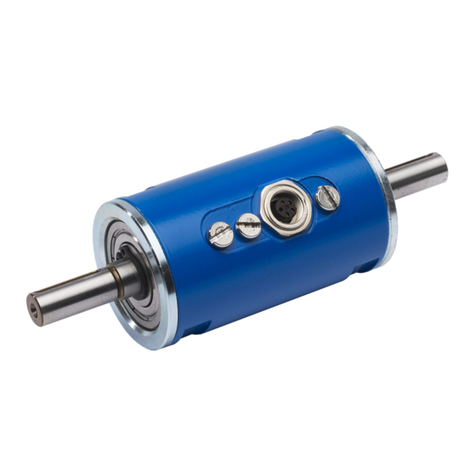
NCTE torque sensors
Series 5000
Intended Use
Use the product only as described in the instruction manual. Any other use is considered as improper and
may result in property damage or even personal injury. The manufacturer assumes no liability for damage
caused by improper or incorrect use.
Installation and removal
Make sure to install the sensor shafts exactly with the proper aligned connecting shafts. The key stone
adapter/square endings of the connecting shafts are to be attached forceless to the corresponding ones of
the sensor. No external axial force should be on the housing of the sensor from distortion. A maximum cable
length of 5 m must not to be exceeded. Using a cable or connector other than supplied by NCTE, or a similar
cable that is of a different length may affect the overall performance of the sensor.
Do not remove the shaft with torque applied to the sensor.
Interface description
Mechanical connection:
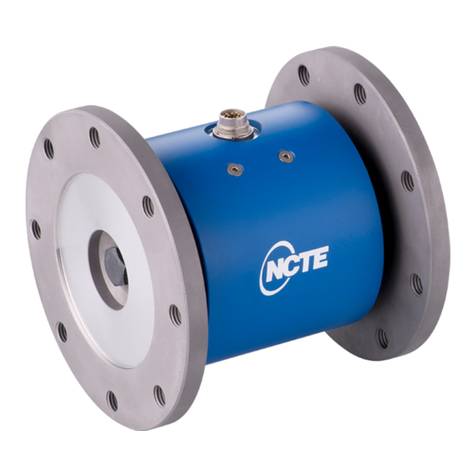
On the basis of the attached flanges, the sensor can be flanged for mechanical power transmission.
Electrical connector:
On the sensor housing there is an 8-pin socket for the power supply and the signal output (see chapter
connection plan).
Operation (in regular case or in optimal case)
Optimal measurement parameters can be achieved if the sensor is applied in accordance to the specification.
By compliance with the specification the sensor works generally trouble-free and maintenance-free.
Irregular operation, measures against disturbance
The mechanical overload on the sensor (e. g. exceeding of maximum allowed torque) may cause damage to
the sensor and in consequence the incorrect signal output. In such cases please do not open the sensor.
Contact NCTE directly for assistance.
Commissioning
After sensor installation pay attention to the following:
The sensor may only be operated with a shielding.
Switch on the power supply unit and check the supply voltage. Peak voltage must be avoided! Be
sure to verify the power supply voltage before connecting the sensor!
Connect the sensor to the power supply unit by using the delivered cable.
Connect the sensor output to a high-resistance device such as an A/D converter, oscilloscope, PC
measurement board. The sensor should be in mechanical unloaded state while connecting it.
Handling and transportation
By handling, storage and transportation keep the sensor away from magnetic or electromagnetic fields.