manuals.online logo
Brands
  1. Home
  2. •
  3. Brands
  4. •
  5. NETGEAR
  6. •
  7. Switch
  8. •
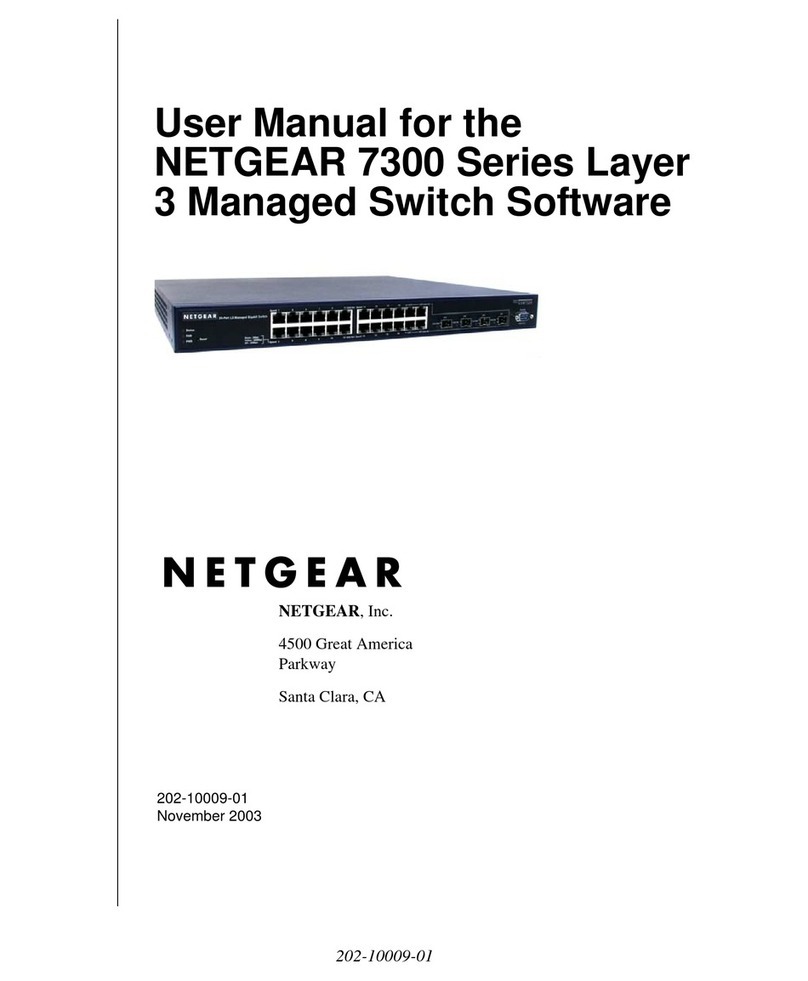
  9. NETGEAR 7000 Series User manual

NETGEAR 7000 Series User manual

Other manuals for 7000 Series

1

This manual suits for next models

3

Other NETGEAR Switch manuals

NETGEAR GC728X Manual

NETGEAR

NETGEAR GC728X Manual

NETGEAR ProSafe GS108P User manual

NETGEAR

NETGEAR ProSafe GS108P User manual

NETGEAR ProSafe GS116 User manual

NETGEAR

NETGEAR ProSafe GS116 User manual

NETGEAR GS724Tv1 - ProSafe Gigabit Smart Switch User manual

NETGEAR

NETGEAR GS724Tv1 - ProSafe Gigabit Smart Switch User manual

NETGEAR GS108X User manual

NETGEAR

NETGEAR GS108X User manual

NETGEAR DS104 User manual

NETGEAR

NETGEAR DS104 User manual

NETGEAR 7200 Series User manual

NETGEAR

NETGEAR 7200 Series User manual

NETGEAR FS 750 User manual

NETGEAR

NETGEAR FS 750 User manual

NETGEAR ProSAFE GS724Tv4 User manual

NETGEAR

NETGEAR ProSAFE GS724Tv4 User manual

NETGEAR FSM7328S - ProSafe Switch User manual

NETGEAR

NETGEAR FSM7328S - ProSafe Switch User manual

NETGEAR ProSafe GSM7324 User manual

NETGEAR

NETGEAR ProSafe GSM7324 User manual

NETGEAR GS605 - Gigabit Desktop Switch User manual

NETGEAR

NETGEAR GS605 - Gigabit Desktop Switch User manual

NETGEAR FS728TPv1 - ProSafe 24 Port 10/100 Smart... Parts list manual

NETGEAR

NETGEAR FS728TPv1 - ProSafe 24 Port 10/100 Smart... Parts list manual

NETGEAR EN516 - Hub - EN User manual

NETGEAR

NETGEAR EN516 - Hub - EN User manual

NETGEAR FS116P - ProSafe 16 Port 10/100 Desktop... User manual

NETGEAR

NETGEAR FS116P - ProSafe 16 Port 10/100 Desktop... User manual

NETGEAR GSS108E User manual

NETGEAR

NETGEAR GSS108E User manual

NETGEAR GSM7352SNA - Prosafe 48 Port Gigabit L3 Managed Stackable... User manual

NETGEAR

NETGEAR GSM7352SNA - Prosafe 48 Port Gigabit L3 Managed Stackable... User manual

NETGEAR GS108Tv2 - ProSafe Gigabit Smart Switch Coming... User manual

NETGEAR

NETGEAR GS108Tv2 - ProSafe Gigabit Smart Switch Coming... User manual

NETGEAR M4200 Series Manual

NETGEAR

NETGEAR M4200 Series Manual

NETGEAR GS108T - ProSafe - Gigabit Smart Switch Manual

NETGEAR

NETGEAR GS108T - ProSafe - Gigabit Smart Switch Manual

NETGEAR ProSafe GSM5212P Manual

NETGEAR

NETGEAR ProSafe GSM5212P Manual

NETGEAR ProSAFE S3300 User manual

NETGEAR

NETGEAR ProSAFE S3300 User manual

NETGEAR GS108LP User manual

NETGEAR

NETGEAR GS108LP User manual

NETGEAR FSM726v2 - 10/100 Mbps Managed Switch User guide

NETGEAR

NETGEAR FSM726v2 - 10/100 Mbps Managed Switch User guide

Popular Switch manuals by other brands

TRENDnet TK-401R null

TRENDnet

TRENDnet TK-401R null

TRENDnet TK-200K null

TRENDnet

TRENDnet TK-200K null

TRENDnet TE100-S8 null

TRENDnet

TRENDnet TE100-S8 null

URC Total Control MFS-8 installation manual

URC

URC Total Control MFS-8 installation manual

Azbil HPQ-D11 user manual

Azbil

Azbil HPQ-D11 user manual

Sony DFS-900M operating instructions

Sony

Sony DFS-900M operating instructions

SICK i17S operating instructions

SICK

SICK i17S operating instructions

F&F SZR-277 quick start guide

F&F

F&F SZR-277 quick start guide

Shure UAMS/BK user guide

Shure

Shure UAMS/BK user guide

Dräger X-zone Switch Off Instructions for use

Dräger

Dräger X-zone Switch Off Instructions for use

Asco Joucomatic 349 Series manual

Asco

Asco Joucomatic 349 Series manual

BT Mini Hub user guide

BT

BT Mini Hub user guide

D-Link DES-1226G manual

D-Link

D-Link DES-1226G manual

Johnson Controls FS80-C installation instructions

Johnson Controls

Johnson Controls FS80-C installation instructions

MicroNet SP1200A user manual

MicroNet

MicroNet SP1200A user manual

Ruijie RG-PF2920 Series Hardware  installation and reference guide

Ruijie

Ruijie RG-PF2920 Series Hardware installation and reference guide

Altinex DA1914SX user guide

Altinex

Altinex DA1914SX user guide

RJM MASTERMIND PBC/6X user manual

RJM

RJM MASTERMIND PBC/6X user manual

manuals.online logo
manuals.online logoBrands
  • About & Mission
  • Contact us
  • Privacy Policy
  • Terms and Conditions

Copyright 2025 Manuals.Online. All Rights Reserved.

)NSTALLATION'UIDE
7000 Series Managed Switch (7200RS, 7200R, 7300S, 726E)
Start Here
Before you begin installation of your switch, check the Package Contents listed in the
Hardware Installation Guide that supports your switch on your Resource CD. If any item
is missing or damaged, contact your place of purchase.
Other documentation available on your Resource CD for your switch are the 7000 Series
Software Administration Guide, and a Command Line Interface Reference Manual for
each switch series.
Follow these quick steps to install your switch. You can also consult the full Hardware
Installation Guide for your switch on the Resource CD.
Set Up the Switch
Prepare the site so that the mounting, access, power source, and environmental
requirements are met. If you have any questions about these requirements, see the
Hardware Installation Guide for your switch on your Resource CD.
1. Install the switch using one of the following methods:
a. On a flat surface: Put one of the rubber footpads that came with the switch on
each of the four concave spaces on the bottom of the switch.
b. In a Rack: Use the rack-mount kit supplied with your switch, following the
installation instructions included with the kit,.
2. Apply AC power.
When you apply power, the power LED can display the following behavior:
• The power LED will blink yellow as it conducts a Power-On Self Test (POST).
After the switch passes the POST, the LED turns green. The switch is now
functional. If the POST fails, the Power LED will remain yellow (see
“Troubleshooting” in the Hardware Installation Manual for assistance).
• If the power LED does not light, check that the power cable is plugged in
correctly and that the power source is good. If this does not resolve the problem,
see “Troubleshooting” in the Hardware Installation Guide on the Resource CD.
3. Connect devices to the switch.
• Use Category 5 (Cat5) cable to connect between network ports at speeds of
100Mbps or less.
• Use Category 5e (Cat5e) for 1000Mbps networking speed.
Fiber SFP modules are shipped separately. If you need instructions on installing an
SFP module, please refer to the Hardware Installation Guide on the Resource CD.
Note: In the room housing the switch, ensure that the ambient temperature does not
exceed the specified operating temperature and that the environment is free of water
condensation.
Perform the Initial Configuration
This switch can be managed through its Web interface, or by using the Command Line
Interface (CLI) through the serial console port. This guide describes the Web method. The
CLI method is also described to determine a DHCP-assigned IP address or to use ezconfig
to assign a static IP address. For Web management, follow one of the following three
procedures, depending upon how your PC is set up.
• PC in DHCP client mode without DHCP server
• PC with static IP address
• PC in DHCP client mode with DHCP server
To perform extensive CLI management, see both the CLI Reference Manual for your
switch and the 7000 Series Administration Guide.
PC in DHCP Client Mode without DHCP Server
If no DHCP server is present, the switch assumes a default IP address of 169.254.100.100
and a subnet mask of 255.255.0.0. The switch is in the same subnet used by a PC NIC port
when in DHCP-client mode without a DHCP server present. Use this IP value to log into
the switch (see “Web Login to the Switch”).
PC with Static IP Address
When the PC is in this mode, the switch must also be assigned a static IP address. To
assign a static IP Address, access the switch from the serial console port as follows:
1. Connect a console to the switch.
Using the null-modem cable supplied with the switch, connect a VT100/ANSI
terminal or a workstation to the switch port labeled Console.
2. Start a terminal emulation program (TEP).
a. Start a TEP using the appropriate method for your operating system:
• Windows users can use HyperTerminal.
• Windows Vista users should download a TEP from the Internet.
• Macintosh users can use ZTerm.
• UNIX users can use a terminal emulator such as TIP.
b. Configure the TEP to use the following settings (they are written below the
connector on the switch front panel):
• Baud rate: 9,600 bps
• Data bits: 8
• Parity: none
• Stop bit: 1
• Flow control: none
c. At the command prompt User:,login to the switch using the user name
admin, then press Enter. At the password prompt, press Enter again (no
password is needed for initial configuration).
d. At the next command prompt, type ezconfig and press Enter.
The ezconfig utility is now running in the switch. Use it to set up your static IP
address and subnet mask as shown in the following example. Make sure that the
selected switch IP address is in the same subnet as that of the PCs.

October 2008
This symbol was placed in accordance with the European Union Directive 2002/96 on the Waste
Electrical and Electronic Equipment (the WEEE Directive). If disposed of within the European
Union, this product should be treated and recycled in accordance with the laws of your jurisdiction
implementing the WEEE Directive.
© 2008 by NETGEAR, Inc. All rights reserved. NETGEAR and the NETGEAR logo are registered trademarks
of NETGEAR, Inc. in the United States and/or other countries. Other brand and product names are trademarks or
registered trademarks of their respective holders. Information is subject to change without notice.
3. Use this IP value to log in to the switch (see “Web Login
to the Switch”).
PC in DHCP Client Mode with DHCP Server
By default, the switch is configured as a DHCP client to obtain its IP address from a
DHCP server in the connected network. You must access the switch from the serial
console port.
1. Make sure that the switch is connected to a DHCP server.
User:admin
Password:
(FSM7328S) >ezconfig
NETGEAR EZ Configuration Utility
--------------------------------
Hello and Welcome!
This utility will walk you thru assigning the IP address for the switch
management CPU. It will allow you to save the changes at the end. After
the session, simply use the newly assigned IP address to access the Web
GUI using any public domain Web browser.
Admin password not defined. Do you want to change the password? (Y/N/Q) n
The 'enable' password required for switch configuration via the command
line interface is currently not configured. Do you wish to change it (Y/N/Q)? n
Assigning an IP address to your switch management
Current IP Address Configuration
--------------------------------
IP Address Assignment Mode: DHCP
IP Address: 0.0.0.0
Subnet mask: 0.0.0.0
Would you like to assign an IP address now? (Y/D/N/Q/?)? y
IP Address: 10.10.10.1
Network mask: 255.255.255.0
Do you want to assign switch name and location information (Y/N/Q)? n
There are changes detected, do you wish to save the changes permanently (Y/N)? y
The configuration changes have been saved successfully.
Please enter 'show running-config' to see the final configuration.
Thanks for using EzConfig!
2. Find the switch IP address assigned by the DHCP server.
After locating the switch IP address:
a. Perform steps 1 through 3 of the procedure “PC with Static IP Address”.
b. Type the show network command and press Enter. A screen will display
that shows the active switch IP address.
c. Use this IP address to login to the switch through its Web Management interface
(see “Web Login to the Switch”).
Web Login to the Switch
Use the appropriate IP address for your configuration to manage your switch through its
Web interface.
1. Type http://<ipaddress> into the URL window of your browser. A screen similar to
the following, will display.
2. Type admin for the username and leave the password field blank.
3. Click Login. The Management screen will display.
You can now navigate from this point to configure your switch.
Customer Support
After completing setup and configuration, locate the serial number on the bottom label of
the 7000 Series Managed Switch and use it to register your product at
http://www.netgear.com/register.
Registration on the web site or over the phone is required before you can use our
telephone support service. The phone numbers for worldwide regional customer support
centers are on the Warranty and Support Information card that came with your product.
Go to http://www.netgear.com/support for product updates and web support.