manuals.online logo
Brands
  1. Home
  2. •
  3. Brands
  4. •
  5. Nokia
  6. •
  7. Cell Phone
  8. •
  9. Nokia 111 Owner's manual

Nokia 111 Owner's manual

Other manuals for 111

1

This manual suits for next models

2

Other Nokia Cell Phone manuals

Nokia RH-128 User manual

Nokia

Nokia RH-128 User manual

Nokia 6620 - Smartphone 12 MB User manual

Nokia

Nokia 6620 - Smartphone 12 MB User manual

Nokia 5235 Comes with Music User manual

Nokia

Nokia 5235 Comes with Music User manual

Nokia 3330 User manual

Nokia

Nokia 3330 User manual

Nokia 3105 User manual

Nokia

Nokia 3105 User manual

Nokia 3100 - Cell Phone 484 KB Service manual

Nokia

Nokia 3100 - Cell Phone 484 KB Service manual

Nokia N97 User manual

Nokia

Nokia N97 User manual

Nokia 7310 Supernova User manual

Nokia

Nokia 7310 Supernova User manual

Nokia 1112 - Cell Phone - GSM User manual

Nokia

Nokia 1112 - Cell Phone - GSM User manual

Nokia 6710 Navigator User manual

Nokia

Nokia 6710 Navigator User manual

Nokia Lumia 720 User manual

Nokia

Nokia Lumia 720 User manual

Nokia 9211380 User manual

Nokia

Nokia 9211380 User manual

Nokia 6020 - Cell Phone 3.5 MB User manual

Nokia

Nokia 6020 - Cell Phone 3.5 MB User manual

Nokia 8 Sirocco User manual

Nokia

Nokia 8 Sirocco User manual

Nokia Lumia 520 User manual

Nokia

Nokia Lumia 520 User manual

Nokia 5310 XpressMusic User manual

Nokia

Nokia 5310 XpressMusic User manual

Nokia TA-1253 User manual

Nokia

Nokia TA-1253 User manual

Nokia NAVIGATOR 6210 User manual

Nokia

Nokia NAVIGATOR 6210 User manual

Nokia 3230 - Smartphone 6 MB User manual

Nokia

Nokia 3230 - Smartphone 6 MB User manual

Nokia 203 User manual

Nokia

Nokia 203 User manual

Nokia PM 3205 User manual

Nokia

Nokia PM 3205 User manual

Nokia 6190 - Cell Phone - GSM User manual

Nokia

Nokia 6190 - Cell Phone - GSM User manual

Nokia 6670 - Smartphone 8 MB User manual

Nokia

Nokia 6670 - Smartphone 8 MB User manual

Nokia 3155 Installation instructions

Nokia

Nokia 3155 Installation instructions

Popular Cell Phone manuals by other brands

LG L34C user guide

LG

LG L34C user guide

Ericsson T60d manual

Ericsson

Ericsson T60d manual

Zte Score M user manual

Zte

Zte Score M user manual

Sony Xperia Z1 Compact Startup guide

Sony

Sony Xperia Z1 Compact Startup guide

AT AT-Q5 user manual

AT

AT AT-Q5 user manual

Vingtor ACM-M-A-V2 Installation/configuration

Vingtor

Vingtor ACM-M-A-V2 Installation/configuration

Olitech EasyFlip 2 Quick setup guide

Olitech

Olitech EasyFlip 2 Quick setup guide

Zte Atrium Z793C user manual

Zte

Zte Atrium Z793C user manual

Alcatel IDEAL manual

Alcatel

Alcatel IDEAL manual

Zte BLADE A520 quick start guide

Zte

Zte BLADE A520 quick start guide

switel M222 user manual

switel

switel M222 user manual

LG LG-P503 user guide

LG

LG LG-P503 user guide

LG F2410 user guide

LG

LG F2410 user guide

Argom E500 manual

Argom

Argom E500 manual

Hisense U30 user manual

Hisense

Hisense U30 user manual

Argom Tech E401 user manual

Argom Tech

Argom Tech E401 user manual

honor 8X user guide

honor

honor 8X user guide

ZTE-G S516 user manual

ZTE-G

ZTE-G S516 user manual

manuals.online logo
manuals.online logoBrands
  • About & Mission
  • Contact us
  • Privacy Policy
  • Terms and Conditions

Copyright 2025 Manuals.Online. All Rights Reserved.

27.03.2011
Sales package content and product features might vary depending on region and product variant.
Copyright © 2011. All rights reserved. Nokia is a registered trademark of Nokia Corporation.
Nokia Asha 202
Eco profile
Product:
Nokia Asha 202
Product type:
Mobile device
Weight:
90 grams (including battery)
Dimensions:
Length: 114.8 mm x Width: 49.8 mm x Height: 13.9 mm
Volume:
68 cc (cm3)
Package:
Weight:
29.5 grams
Dimensions:
Length: 137 mm x Width: 90 mm x Height: 55 mm
Volume:
678 cc (cm3)
Material:
Corrugated board
Environmental features
MATERIALS AND SUBSTANCES:
PACKAGING:
RECYCLING:
Free of PVC, free of nickel on the product
surface, free of brominated & chlorinated
compounds and free of antimony trioxide
as defined in Nokia Substance List
Made of renewable material, Contains up
to 60% recycled material, Packaging is 100
% recyclable, Minimized package
All materials of the device can be
recovered as materials and energy
USER GUIDE:
ENERGY EFFICIENCY:
ECO CONTENT AND SERVICES:
Small printed user guide and full user
guide on nokia.com, black & white printing,
Green tips page
Unplug charger reminder, Energy efficient
charger
Available at Nokia Store
Materials used
Through careful material selection we aim to reduce the environmental impact of our products. The chart below shows the estimated
proportions of the materials used to create this mobile device.
Metals:
E.g. stainless steel, copper, zinc, aluminium.
Nokia’s products contain ~0.1-0.2% precious metals.
Ceramic materials:
Glass, other ceramics.
Plastics:
E.g. ABS/PC, PET, PA, epoxy.
Battery:
E.g. lithium cobalt compound, graphite, aluminium,
copper.
Other:
Non-metals such as silicon. Other materials such as
glues.
Find out more about the materials used to create Nokia products at www.nokia.com/materials
Metals
26%
Ceramic
materials
7%
Plastics
44%
Battery
22%
Other
1%
27.03.2011
Sales package content and product features might vary depending on region and product variant.
Copyright © 2011. All rights reserved. Nokia is a registered trademark of Nokia Corporation.
Restricted substances
Nokia is an industry leader in substance management. We proactively manage and keep track of all the substances in our products,
not just those that raise concerns. We have strict requirements for substances that are not allowed in Nokia products.
These are defined in the Nokia Substance list, which is available at www.nokia.com/substances
This product fully complies with all relevant global regulations, for example:
The EU RoHS Directive 2002/95/EC
“Management Methods on the Prevention and Control of Pollution caused by Electronic Information Products” commonly known as “China RoHS”
European REACH Regulation 1907/2006/EC
The Montreal Protocol on Substances That Deplete the Ozone Layer
Additionally, Nokia has voluntarily restricted the use of many other harmful substances, and calls attention to substances such as skin
sensitizers and substances that might cause harm to the environment or to the user during the lifecycle of the phone.
Some details of such substances for this product are listed below:
The surface of this device does not contain nickel in the platings.
This product does not contain Brominated or Chlorinated compounds or Antimony trioxide as specified in Nokia Substance List requirement and
definition.
Polyvinylchloride (PVC) is not used in this product or its packaging
Energy consumption
1
Call (GSM):
590
mW
Idle mode:
10
mW
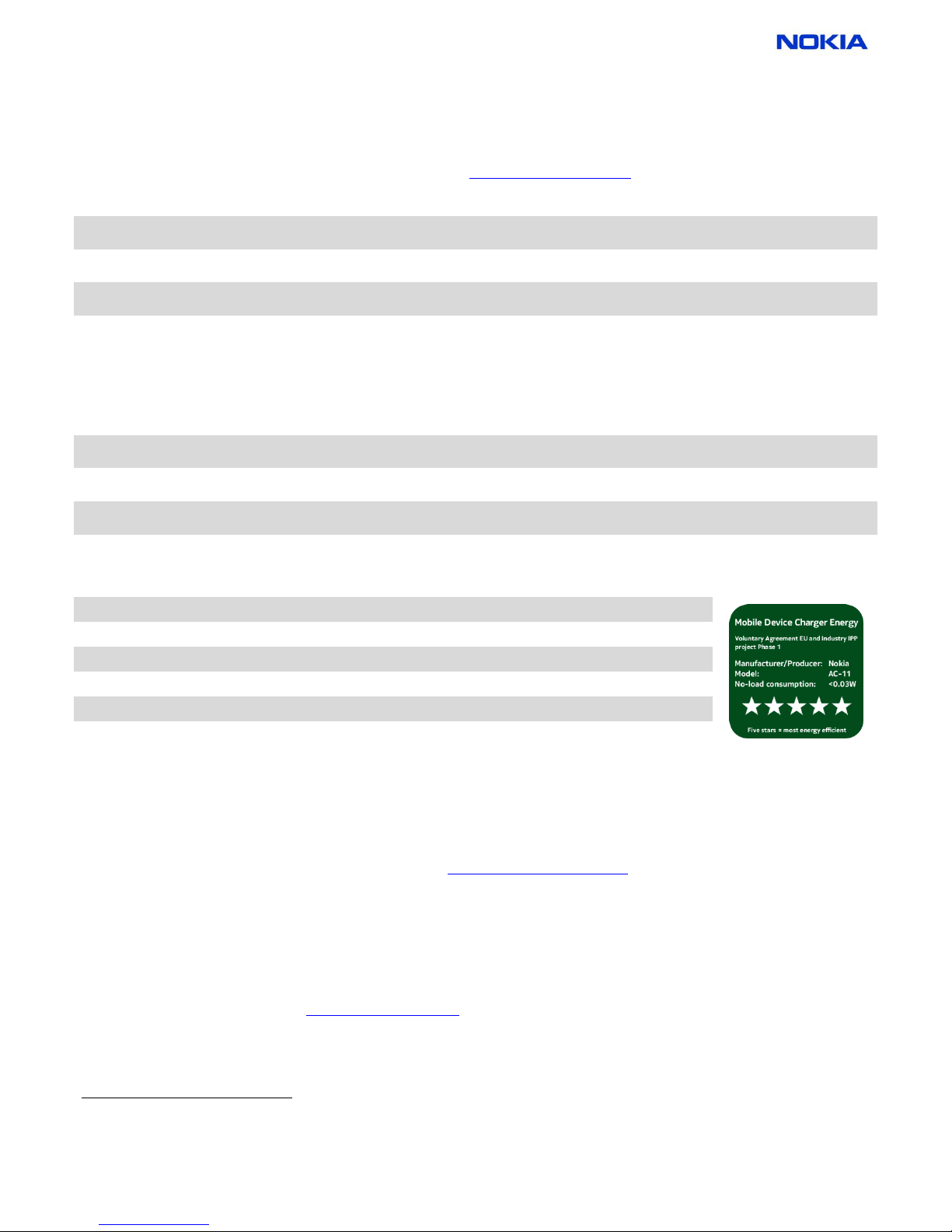
Charger no-load power consumption:
AC-11
<0.03
W
Charger weight:
48
grams
Battery capacity:
BL-5C
1020
mAh
Battery weight:
23
grams
The supplied battery complies with the EU Battery Directive 2006/66/EC and does not contain cadmium, lead, or mercury in
concentrations higher than those defined in the directive.
The supplied charger meets EU ErP directive and regulation 278/2009 and EU Code of Conduct on Energy Efficiency of external power
supplies.
More information on chargers and the Charger Energy label at www.nokia.com/chargerenergy
Packaging
We work to minimize the environmental impact of our packaging by selecting sustainable materials, reducing the packaging size,
reducing the volume of material we use, and considering what happens to the package when it is no longer needed.
Nokia’s packaging contains no hazardous or restricted substances, and is fully compliant with the EU directive 94/62/EC.
Find out more about our packaging at www.nokia.com/packaging
1
The measured values are dependent on several factors, e.g. measurement environment, frequency and operator network settings. The
measurements are made @ 1800 MHz according to reference document: GSM Association Official Document: DG.09, ‘Battery Life Measurement
Technique’ www.gsmworld.com/documents

27.03.2011
Sales package content and product features might vary depending on region and product variant.
Copyright © 2011. All rights reserved. Nokia is a registered trademark of Nokia Corporation.
Recycling
Always return your used electronic products, batteries, and packaging materials to a dedicated recycling collection point. This way you
help prevent uncontrolled waste disposal and promote the recycling of materials.
All mechanical parts as well as packaging materials have been marked where practically possible.2Plastic parts are marked in accordance with ISO
11469 and ISO 1043-1 to -4 standards.
This product and its battery have been marked with the crossed-over wastebasket symbol (WEEE Directive) to signify that they cannot be disposed of
with regular household waste and need to be taken instead to an appropriate collection point.
Check how to recycle your Nokia products at www.nokia.com/recycle
Environmental impact
Energy use: 154 MJ
3
Greenhouse gas emissions: 8 kg CO2-eq.3
These figures represent the estimated environmental impact of this device over a product life cycle including 3 years of usage. This
impact is equal to driving 53km in a typical family car. The mobile phones with basic functionalities have typically smaller
environmental impact than the devices with wide range of features. However, the latter ones provide the user with more
opportunities to reduce the personal environmental footprint by reducing the need to buy, use and charge multiple devices.
Energy use
Greenhouse gas emissions
The above energy use and greenhouse gas emissions figures are based on a Life Cycle Assessment in accordance with the ISO 14040
and ISO 14044. These calculations take into account the raw materials acquisition, component manufacturing, Nokia’s own factory
processes, inbound & outbound logistics, usage (3 years) and recycling of the mobile devices. The source data is measured at our own
factories and operations and collected from suppliers. In addition we use internationally available LCI databases.
The life cycle assessment method has been externally audited. The environmental impacts of different accessories, packaging, user
guides, and Nokia corporate overhead including travel are not included.
Find out more about the environmental impact of our products at www.nokia.com/LCA
2
Dependent on size, location and materials of the part.
3
The results of a life cycle assessment (LCA) always depend on the calculation method, scoping and assumptions used; and they reflect our
understanding at the time when published. The results are therefore not directly comparable with those conducted by other parties.
Raw materials
& component
manufacture
37%
Nokia factory
4%
Transportation
14%
Product usage
44%
Recycling
1%
Raw materials
& component
manufacture
38%
Nokia factory
5%
Transportation
17%
Product usage
39%
Recycling
1%