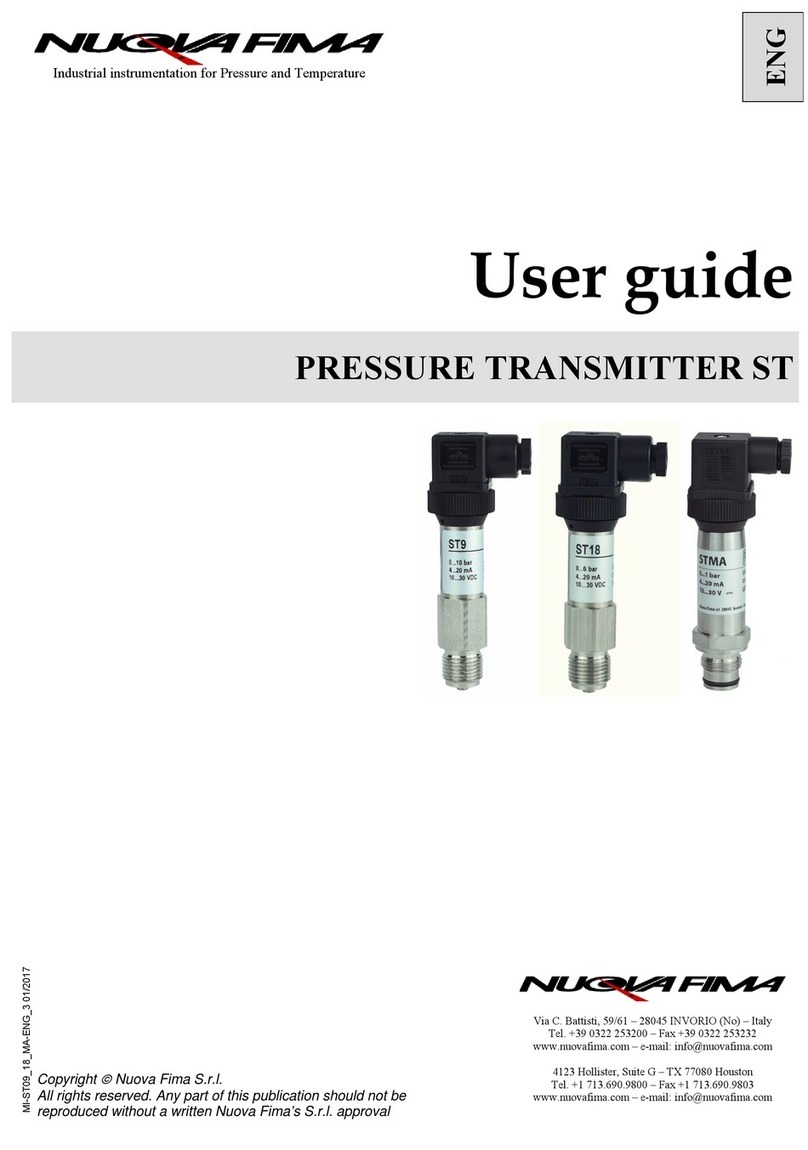
User guide
PRESSURE TRANSMITTER ST
NUOVA FIMA - Industrial instrumentation for Pressure and Temperature 3
The pressure transmitter turns the input pressure into an output electrical signal. The electrical signal changes
according to the input pressure level.
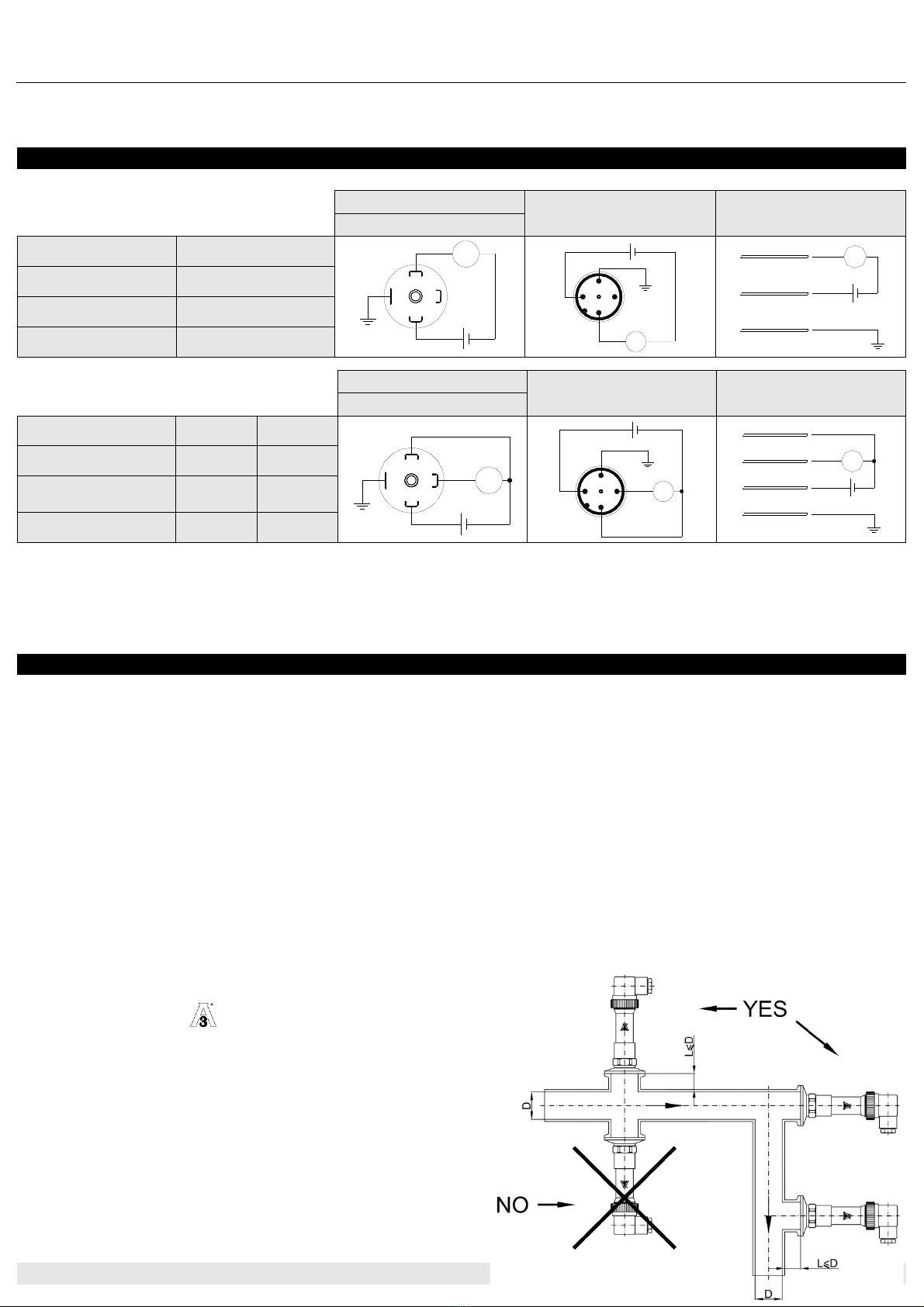
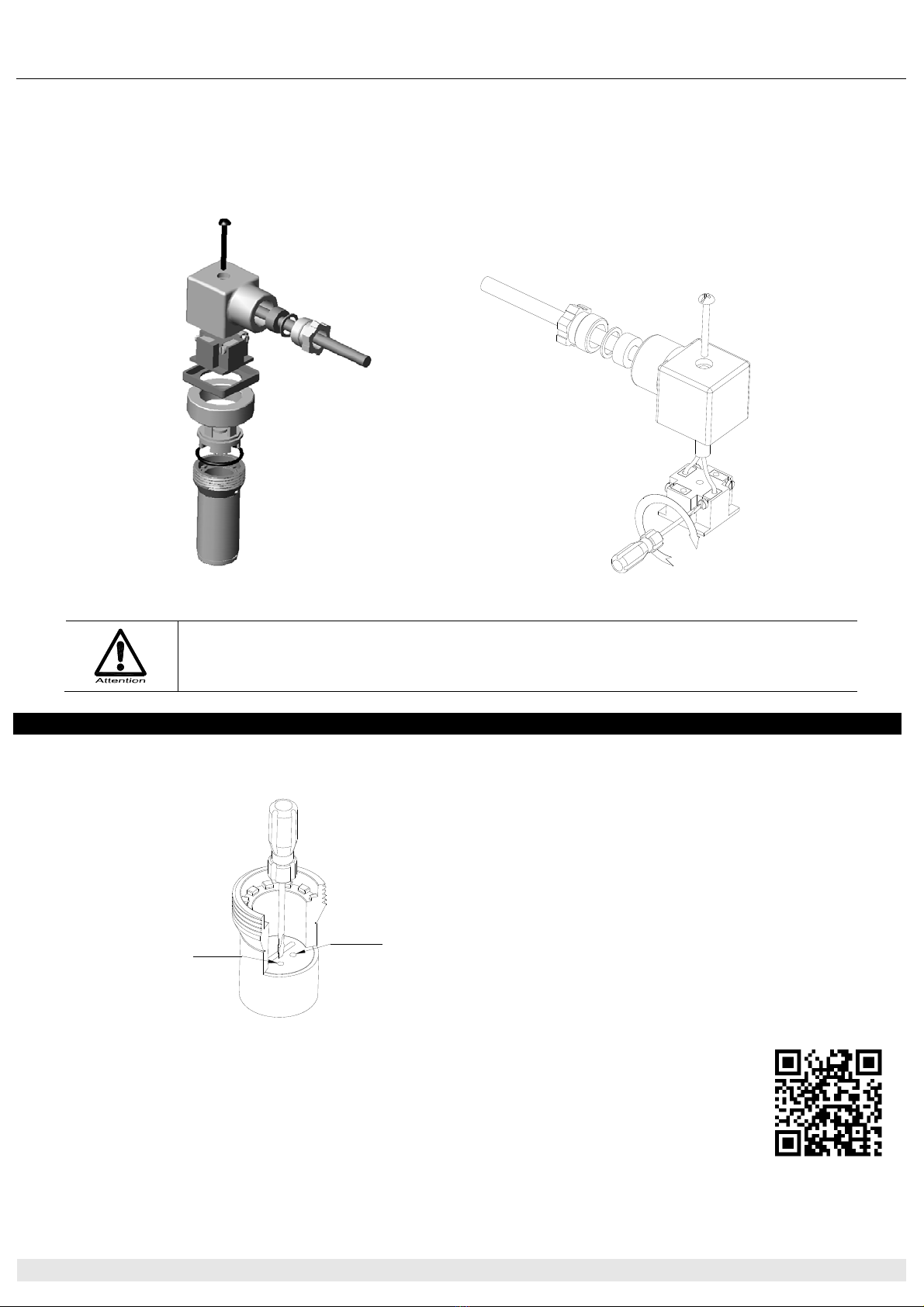
4. Electrical connections
EN 175301-803 Form A M12x1 Cable output
EN 175301-803 Form C
Output signal: 4...20 mA A
2
1
3
A out
+V in
123
4
A out A
+V in
Screen
A out
+V in
Brown
White A
N° of wires: 2
Charge (Ohm): RL – (Vin-10)/0,02
Input +Vin: 10…30
EN 175301-803 Form A M12x1 Cable output
EN 175301-803 Form C
Output signal: 0…5 Vdc 0…10 Vdc
+V in
1
-V in
2
3V
V out
+V in
2
4
13V
-V in
V out
+V in
Brown
Screen
White
Green
V out V
-V in
N° of wires: 3 3
Charge (Ohm): min.
5Koh
min.
10Koh
Input +Vin: 8…30 14…30
The transmitter metal case should always be connected to ground through the process connection thread in order to
protect it from disturbances due to electromagnetic fields or electrostatic charges.
If this procedure cannot be performed, the transmitter should be connected to the ground through the connector and
the cable screen.
5. Installation
- Before installing an electric safety equipment into a plant or a system, the user should verify that the instrument is
suitable to the plant characteristics and that it is installed correctly. After installation procedure is finalized, the user
should verify that the instrument is not exposed to any source of heat that may exceed the established ambient limits.
Secure the instrument thread through a special key/wrench on the process connection hexagon without grasping the
case by the hands.
- Secure the instrument thread through a special key/wrench on the process connection hexagon (20…30Nm). The
correct torque depends on the type of process connection and the type of seal used (form and material). If the
connection thread is conical the instrument is tightened through a simple screwing on the plug. In order to improve the
thread tightness, the male thread should be wrapped with a PTFE layer.
- If the instrument is equipped with a fluid diaphragm seal the connection should be clamped on the diaphragm
otherwise the calibration could be compromised.
- The monitoring devices such as rings, clamps, nuts, flanges, seals and O-rings are not generally included in the
supply and are not included in this manual. Seals and O-rings must be chosen from the food industry approved
models.
Instruments showing symbol.
Instruments with a DIN11851 connection should be installed
using special seals such as those produced by Siersema
Komponenten System (S.K.S.) B. V. or seals type ASEPTO-
STAR k-flex produced by Kieselmann GmbH.
Instruments provided with a process connection complying
with the ISO 2853 (IDS/ISS) standards should be installed
using a “T-seal” seal type produced by Combifit
International B.V. In the opposite picture you can see how to
install it correctly in order to ensure a proper instrument
operation and cleanliness. Improper installation may produce