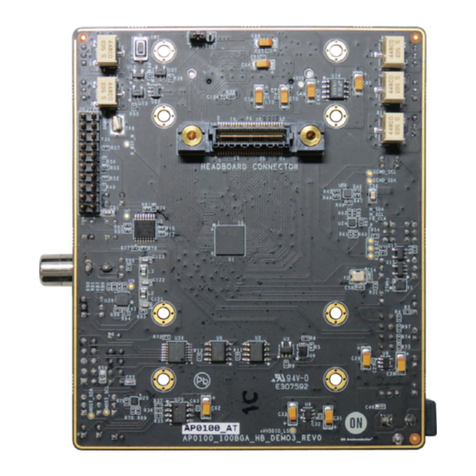
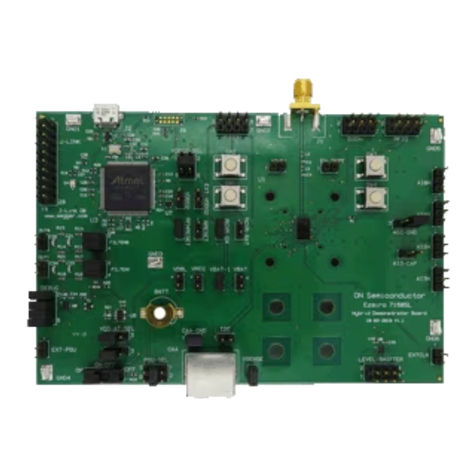
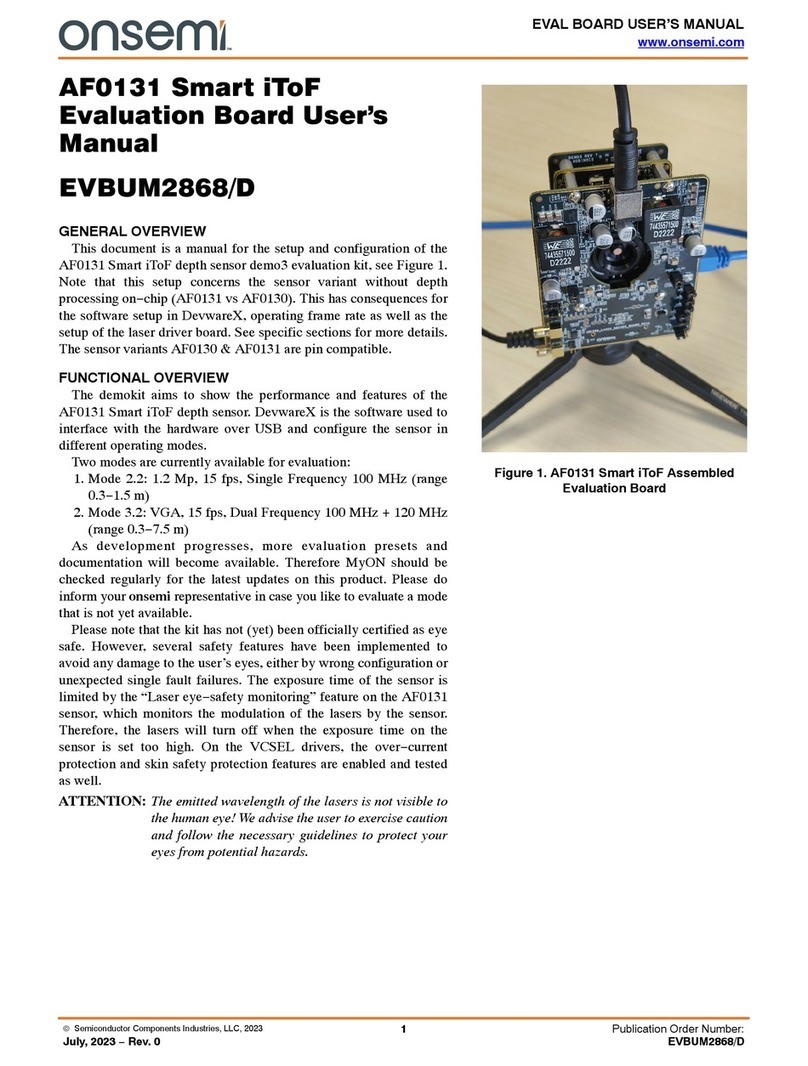
NCP1083REF12VC4GEVB
www.onsemi.com
2
Assigned Power
The NCP1083REF12VC4GEVB will request Class 4
during Physical Layer classification. PDs need to consider
that they can be underpowered and eventually be assigned
to Class 3.
The state of the nCLASS_AT output provides information
about the power level that the PSE has assigned to the
NCP1083REF12VC4GEVB during classification. See
Table 1 to determine the assigned power based on the status
of the orange NCL led.
Table 1. CLASSIFICATION RESULT
NCL Led Assigned Class Assigned Power
off 3 13 W
on 4 25.5 W
Figure 2 shows that the load on the 12 V output should be
limited to 1.82 A to meet the maximum input average power
for Class 4 over the complete input DC voltage range.
Likewise, Figure 3 shows that the load on the 12 V output
should be limited to 0.92 A to meet the maximum input
average power for Class 3 over the complete input DC
voltage range.
The application should always operate at or below the
assigned power limit. Failure to do so will result in the PSE
disconnecting the PD !
Maintain Power Signature (MPS)
A PD should draw a minimum amount of current in order
to prevent the PSE from removing power. The load resistor
R15 was added on the bottom side of the board to be able to
make sure the load current is always sufficient and the
NCP1083REF12VC4GEVB remains powered. This load
resistor R15 is enabled when a jumper is placed on header
P3 labeled “MPS”. As can be seen in Figure 4, the input
current remains well above 10 mA over the complete PSE
output voltage range when the jumper is mounted on the
“MPS” header P3.
Depending on the minimum current the system may draw,
the resistance value of R15 should be increased for the final
design in order not to waste power unnecessarily.
For some systems, the load resistor can even be omitted.
Earth Connection
A Powered Device (PD) can operate without an earth
connection.
In case NCP1083REF12VGEVB would need to be
earthed, it should be the frame ground “Frame” that is
connected to earth. This could be implemented in one of the
following ways:
•Soldering an earthed wire in the 1.6 mm hole
(labeled “E”)
•Connecting an earthed wire with alligator clip on the
SMT Test Point on the top (TP12) or the SMT Test
Point on the bottom (TP17)
•Connecting a shielded Ethernet cable of which the
shield is earthed to the PoE−enabled Ethernet port J2
(labeled “PoE IN”)
If NCP1083REF12VGEVB is earthed, the internal
system ground “GND” should not be driven more than 15 V
above or below earth potential in order not to overstress TVS
diode D21.
Auxiliary Supply
The NCP1083REF12VC4GEVB supports drawing
power from an alternate or local power source in
applications connected to non−PoE enabled networks. A
rear auxiliary supply can be inserted in connector J3.
The recommended voltage of the auxiliary supply is 48 V,
but eventually the NCP1083REF12VC4GEVB is able to
operate with a higher auxiliary supply voltage up to 57 V.
Requested Power
As mentioned before, the NCP1083REF12VC4GEVB
will request Class 4 during Physical Layer classification. If
a lower Class or power level is preferred, resistor R26
labeled “CLASS” should be changed. See the NCP1083
datasheet for the nominal resistance values.