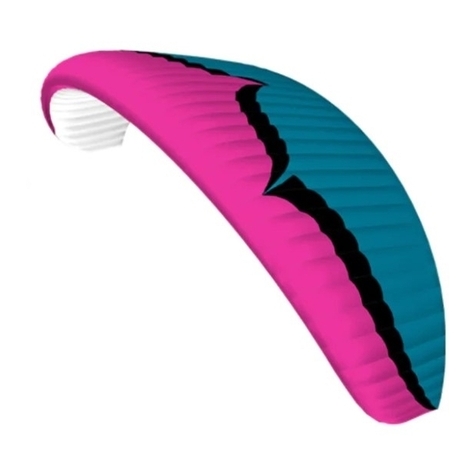
Ozone Speedster 19 User manual

19 &22

YOUR WING IS HERE
19 &22

CONTENTS
Pilots Manual (En) 2 > 17
Manuel de VOL (F) 20 > 39
Line Diagram 40
Riser Diagram/Lengths 42
Technical Specications 42
Version 1.1 Dec 2012
The Speedster 19 and 22 hold a valid load test, they do not have ight certication. Please ignore all references to certication in this manual.
Les speedster 19 et 22 ont eu le load test mais n’ont pas l’homologuation en vol. Ignorez toutes les références aux homologuations dans ce
manuel.


3
ENGLISHENGLISH
Thank you for choosing to y an Ozone Speedster.
As a team of ying enthusiasts and adventurers, Ozone’s mission is to build sweet handling, agile paragliders which pro-
duce ‘cutting edge’ performance, whilst still keeping you safe in rough air.
All our research and development is concentrated on creating the best handling characteristics possible with optimum secu-
rity. Condence and belief in your paraglider is a far greater asset than any small gains in performance - ask any of the Ozone
pilots on your local sites, or those who have taken our gliders on ground-breaking adventures and stood on podiums around the
world.
Our development team is based in the south of France. This area, which includes the sites of Gourdon, Monaco and Lachens,
guarantees us more than 300 yable days per year. This is a great asset in the development of the Ozone range.
As pilots we fully understand just how big an investment a new paraglider is. We know that quality and value for money are
essential considerations when choosing your new paraglider; so to keep costs low and quality high we now build all our wings
in our own production plant. This way we can guarantee that all our paragliders meet the same high standards that we expect
ourselves.
This manual will help you get the most out of your Speedster. It details information about the Speedster’s design, tips and ad-
vice on how best to use it and how to care for it to ensure it has a long life and retains a high resale value.
If you need any further information about Ozone, the Speedster, or any of our products please check www.yozone.com or con-
tact your local dealer, school or any of us here at Ozone.
It is essential that you read this manual before ying your Speedster for the rst time.
Please ensure that this manual is passed on to the new owner if you ever resell this paraglider.
Ozone’s web site, www.yozone.com carries up-to-date information, including any safety issues or issues specic to your
Speedster. Please check it regularly.
Safe Flying
All the team @ Ozone

WARNING TEAM OZONE
4
Paragliding/kParamotoring is a potentially dangerous sport that can cause
serious injury including bodily harm, paralysis and death.
Flying an Ozone paraglider is undertaken with the full knowledge that para-
motoring involves risks.
As the owner of an Ozone paraglider you take exclusive responsibility for all
risks associated with its use. Inappropriate use and or abuse of your equip-
ment will increase these risks.
Ozone paragliders are only suitable for qualied pilots or those under in-
struction. This manual does not replace proper instruction. Make sure you
seek professional tuition and learn with a reputable school.
Use only certied paragliders, harnesses with protector and reserve para-
chutes that are free from modication, and use them only within their certi-
ed weight ranges. Please remember that ying a glider outside its certied
conguration may jeopardise any insurance (e.g. liability, life etc) you have.
All pilots should have the appropriate level of license for their respective
country and third party insurance.
Make sure that you are physically and mentally healthy before ying.
Choose the correct wing, harness and conditions for your level of experience.
Pay special attention to the terrain you will be ying and the weather condi-
tions before you launch. If you are unsure do not y, and always add a large
safety margin to all your decisions.
Avoid ying your glider in rain, snow, strong wind, and turbulent weather
conditions or clouds.
Any liability claims resulting from use of this product towards the manufac-
turer, distributor or dealers is excluded.
Be prepared to practice as much as you can - especially ground handling, as
this is a critical aspect of paramotoring. Poor control whilst on the ground is
one of the most common cause of accidents.
Be ready to continue your learning by attending advanced courses to follow
the evolution of our sport, as techniques and materials keep improving.
Make sure you complete a thorough daily and pre-ight inspection of all of
your equipment. Never attempt ying with unsuitable or damaged equip-
ment. Always make sure your engine is pre ight checked and warmed up
ready for ight. (See manufacturer’s recommendations).
Always wear a helmet, ear defenders, gloves and boots.
If you use good, safe judgment you will enjoy many years of paramotoring.
Remember, PLEASURE is the reason for our sport
Everyone at Ozone continues to be driven by our
passion for ying, our love of adventure and our
quest to see Ozone’s paraglider development cre-
ate better, safer and more versatile paragliders.
Paragliding design is led by the ever thoughtful David Dagault; Dav
has a wealth of experience both in competition, adventure ying
and paraglider design. Also on the design team are test pilots Rus-
sell Ogden and Luc Armant. Russ is a top competition pilot and ex
paragliding instructor, he can usually be found putting Dav’s latest
creation through a series of test maneuvers. Luc, a dedicated XC
addict has a background in naval architecture. He brings a wealth
of knowledge and ideas to the design team and works closely with
Dav in the design process.
World, European and French Paramotoring champion Mathieu
Rouanet has been heavily involved with the test ying, offering
valuable advice and feedback throughout the development process
to produce the perfect blend of safety, speed and performance.
Back in the ofce Mike ‘Da Boss’ Cavanagh generally keeps control
of the mayhem. Promotion and Team pilots are organised by Matt
Gerdes. Karine Marconi and Jill Devine make sure we don’t spend
too much money and look after the ordering system.
Our manufacturing facility in Vietnam is headed up by Dr Dave
Pilkington, who works relentlessly manufacturing gliders and pro-
ducing prototypes as well as researching materials and manufac-
turing processes for our future products. He is backed up by Ngan
and 400 production staff

YOUR SPEEDSTER
5
ENGLISH
Bag
The bag has been redesigned to be comfortable and useful (pad-
ded hip belt, ergonomic and adjustable shoulder straps). It has
a large volume that will allow you to store all your kit, whilst still
being comfortable for hiking.
Brake Lines
The brake line lengths have been set carefully during testing. We
feel it is better to have slightly long brake lines and to y with a
wrap (one turn of line around the hand). However, if you do choose
to adjust them, please bear in mind the following:
Ensure both main brake lines are of equal length.• If a brake handle has been removed, check that its line is still • routed through the pulley when it is replaced.
When the brake handles are released in ight, the brake lines • should be slack. There must be a substantial “bow” in them to
guarantee no deformation of the trailing edge.
There must be a minimum of 10cm of free play before the • brakes begin to deform the trailing edge. This prevents the
trailing edge from being deformed when using the speed sys-
tem.
IMPORTANT: In the unlikely event of a brake line snapping
in ight, or a handle becoming detached, the glider can be
own by gently pulling the rear risers (D-risers) or the Tip
Steering System line for directional control.
Risers
The Speedster has been designed with 4 rows of lines and risers.
Each riser is covered with coloured webbing, this allows them to be
easily identied.
The A’s are GREY. You will notice that the A’s are split in two parts.
The small riser on the back, holding only one line, is the “Baby A”;
it has been designed to make applying “Big Ears” simple.
The B’s, C’s and D’s are BLACK.
The Speedster has been created with a wide range of pilots in
mind, ranging from XC distance iers to ground skimmers and
adventure pilots alike. It is a paramotor specic glider with char-
acteristics similar to the Viper 2 (World Championship winning
competition wing) but with an overall much higher ease of use.
The Speedster is a wing for paramotor pilots who want reassuring
comfort, stability and a high cruising speed with the safety of EN C
certication.
The Speedster features a customised Ozone Reex Prole (OZRP)
that has been tuned specically for powered ight, this gives the
Speedster high levels of stability at lower angles of attack and
makes it very collapse resistance even in turbulent air. The OZRP
provides constant lift through a wide range of angles of attack al-
lowing you to y very fast and very slowly with condence.
In the air the Speedster is pitch stable and comfortable. Handling
has been rened to give the highest possible amount of agility
throughout the speed range. This allows precise thermalling and
low level manoeuvrability allowing the pilot to accurately place the
wing exactly where they want. This makes the Speedster a wing of
choice for competition pilots who need both speed and precision,
for high ights or for ground skimming.
Special attention has been made to the launching characteristics
of the Speedster. The ination is smooth and constant in any wind
speed, and the wing comes up directly overhead without shooting
in high winds or lagging behind in no wind.
Although it is designed for pilots who y mainly (if not exclusively)
under power, the Speedster performs excellently un-powered. The
sink rate is low enough to soar in light lift, thermal in all conditions
and the glide performance is good enough to y cross country.
Both intermediate and advanced pilots will appreciate the charac-
teristics of the Speedster; easy launches, stable ight, high top
speed and Ozone’s trademark handling.

6
Tip Steering System
The Tip steering system is for precise handling at high speeds
without the need to use the brakes. Located on the risers the small
handle is linked to the very tip of the wing giving you high levels
of precision and comfort for high speed cruising or low level stick
kicking.
NOTE: Ozone recommends that whilst at low level, brakes
should always be kept in the hand in case of engine failure
or impromptu landings.
Trimmers
The Speedster is supplied with a trim riser set. The ‘neutral’ or
standard position is when the trimmers are pulled all the way
down. It is in this position that the wing is certied. The trimmers
can be set to the white line for better ination behaviour during
take-off. This is especially useful in light winds and/or at high alti-
tudes. The standard (certied) trim setting is ideal for climbing un-
der power, whilst thermalling and when the air is turbulent. Brake
pressure is lighter and the handling at its best on the standard
(certied) trim setting. To increase cruise speed you can use the
speed system, release the trimmers, or do both. Using the speed
system has exactly the same effect as releasing the trimmers so it
is safe and possible to y with the trimmers in the standard posi-
tion whilst using the full range of the speed system.
In turbulent air the reex prole is very stable. It will resist
reasonable levels of turbulence with a high resistance to collapse
without pilot input. The faster the wing is own the more inherent
stability there is, as the reex has a greater effect. In mild turbu-
lence it may be best to not attempt to y the wing actively and let
the prole absorb the turbulence itself, indeed small applications of
the brakes can reduce the inherent stability of the prole. How-
ever in very strong turbulence Ozone recommends to return the
trimmers to the neutral position (pulled down) and ying the glider
actively. This way, you will be in the best position to react correctly
should an incident occur.
NOTE: The standard position is when the trimmers are
pulled down to the slowest position. In this position the
maillons on the risers are NOT level. The white line on the
riser is the recommended position for Take off.
NOTE: The Speedster is certied in accelerated ight (speed
bar) with the trimmers set in the standard or slowest posi-
tion. Flying the Speedster in the untrimmed (fast) position
whilst using the speed bar is safe, but it is not certied in
this conguration.
Accelerator System
To set up an accelerator on the ground, ask a friend to pull your
risers into their in-ight position while you sit in your harness. Now
adjust the length of the line so that the main bar sits just beneath
your seat. You should now be able to hook your heel in to the sec-
ondary (lower) loop of the accelerator.
The accelerator must be slack enough to ensure that the front ris-
ers are not pulled down in normal ight, but not so long that it is
impossible to use the full range of the speed system.
Once set up, test the full range of the speed system in calm y-
ing conditions: ensure that both risers are pulled evenly during
operation. Fine-tuning can be completed when you are back on the
ground.
IMPORTANT: Using the accelerator decreases the angle of
attack and can make the gliders recovery from a collapse
more aggressive, therefore using the accelerator near the
ground or in turbulence should be avoided.
Harness and Motor
It will be in your harness that you will enjoy ying. Therefore,
we recommend you spend the time on the ground to adjust your
harness’ different settings. Hang from a solid beam and double
check that you are comfortable and that you can reach the brake
handles, tip steering handles and that you can achieve the full
BASIC FLIGHT TECHNIQUES
7
ENGLISH
range of speed bar travel before ying.
The Speedster is suitable for all types of motor. There are many
different motor units available and it is vitally important that you
choose one that is suitable for your needs, weight and skill level.
Always seek assistance and advice from your instructor or experi-
enced pilots before choosing equipment for yourself.
Total weight in ight
Each Speedster has been certied for a dened weight range. We
strongly recommend that you respect these weight ranges and y
the wing most suited to your weight. That way you can get many
hours of ight both powered and un-powered with the same wing.
To familiarise yourself with the glider it is a good idea to perform
practice inations and ground handling with and without the motor.
You should have no difculties ying the Speedster for the rst
time in suitable conditions, but as with all new equipment; only y
in conditions that you would normally y in, on a familiar site and
do so progressively.
Preparation
Lay out the Speedster downwind of your motor on its top surface
in a pronounced arc, with the centre of the wing higher than the
tips. Lay out the lines one side at a time. Hold up the risers and
starting with the brake lines, pull all lines clear. Repeat with the D,
C, B and A lines, laying the checked lines on top of the previous
set, and making sure no lines are tangled, knotted or snagged.
Mirror the process on the other side.
Remember: Always lay out your glider downwind of the
motor, never leave the motor downwind of the wing or con-
nected to the motor if unattended.
Take-off checklist:
1. Check reserve parachute - pin in and handle secure
2. Helmet on and fastened
3. All harness buckles closed - check leg-loops again
4. Karabiners and maillons tight
5. Holding the A’s, your brake handles and throttle
6. Leading edge open
7. Aligned directly into wind
8. Engine warm and able to deliver full power
9. Trim set correctly
10.Prop clear of lines
11.Airspace and visibility clear
Launching
Your Speedster will launch with either the forward or reverse
launch techniques.
When taking off under power, make sure there is enough clear
space upwind of you to launch and climb out safely, avoiding trees,
power lines and any other obstacles that may affect you should
you have a power failure. Always y with a safety margin so that
power failures do not leave you compromised. You should always
be able to glide power off to a suitable landing place.
Whilst inating your wing, you should hold both of the A risers on
each side. Once clipped in, and you have gone through the take-off
check list (above), stand central to the wing to ensure an even and
progressive ination.
Run in an upright position so that the motor is generating forward
thrust, do not lean too far forward otherwise the power of the
motor will attempt to push you into the ground! When you have
enough airspeed a gentle application of brake will help you lift off.
Do not stop running until your feet have left the ground and you
are sure of a safe climb out.
Forward Launch - Nil to Light winds
When the wind is favourable, move forward positively: your lines

8
The Climb Out
Once in the air you should continue ying into wind whilst gaining
height. By setting the trimmers to the standard (certied) position
you will achieve the best climb rate. Do not attempt to climb too
steeply or too quickly by using the brakes. The wing already has
a high angle of attitude, coupled with a higher AoA (if you use the
brakes) plus the engine’s full thrust acting on the pilot, this could
contribute to make the glider more prone to stall. Furthermore,
in the event of an engine failure the resulting backward pendulum
motion of the pilot and the forward dive of the wing may bring
you back to the ground very hard. Do not initiate turns until you
have sufcient height and airspeed. Avoid low turns downwind with
insufcient airspeed.
The Speedster is well damped in roll but under certain circum-
stances it is possible for the pilot to induce oscillations. This is
caused by a combination of the engine/propeller torque and pilot
weightshift and/or brake inputs. To stop oscillations it is best to
reduce the power slightly and ensure that you remain static with
weightshift and brake inputs. Once settled you can once again ap-
ply full power.
Under full power the torque effect will attempt to gently turn the
wing, using weightshift or adjusting the trims asymmetrically is the
best method to correct this.
NOTE: Using the trims asymmetrically will invalidate certi-
cation
The handling characteristic of the Speedster is truly amazing. We
have worked hard on tuning the wing so that it turns tightly but
also efciently, as the ability to climb in a turn is very important for
powered and free ight, making the climb out fun and thermalling
easy.
Normal Flight
Once at a safe height you can release the trimmers for a faster
cruise speed. If your motor has enough power, the Speedster will
achieve very good straight line speeds whilst maintaining level
should become tight within one or two steps. The Speedster will
immediately start to inate. You should maintain a constant pres-
sure on the risers until the wing is overhead.
Do not pull down or push the risers forward excessively, or the
leading edge will deform and possibly collapse making taking-off
more difcult and potentially dangerous.
Move smoothly throughout the entire launch, there is no need to
rush or snatch at it. You should have plenty of time to look up and
check your canopy before committing yourself. Once you are happy
that the Speedster is inated correctly, progressively apply full
power and accelerate smoothly for the launch.
The trimmers can be set to the white line for better ination
behaviour during take-off. This is especially useful in light
winds and/or at high altitudes.
Reverse Launch -Light to Strong Winds
Lay out your Speedster as you would for the forward launch. How-
ever, this time face the wing, and attach the risers in the correct
manor (half a turn in each riser, and crossed in the direction you
want to turn). Now you can pull up the Speedster by its A-risers.
Once the wing is overhead, brake it gently, turn and launch.
In stronger winds, be prepared to take a few steps towards the
glider as it inates. This will take some of the energy out of the
glider and it will be less likely to over-y you. Once stable and
above your head apply progressive power and accelerate smoothly
for a controlled take off.
IMPORTANT: Never attempt to take off with a glider that is
not fully inated, directly overhead or if you are not fully in
control of the pitch/roll of the wing.
Practice ground handling and launching as much as possible! It is
great fun, and will give you a much better feel for your Speedsters
ight characteristics. It will also improve your overall enjoyment of
ying by making your launches easier and safer.
This manual suits for next models
1
Table of contents
Languages:
Other Ozone Paramotor manuals