Mechanical Principles
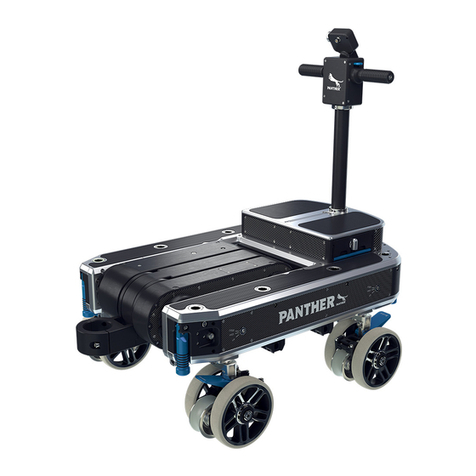
Un d e rst a n d i n g t h e Su p e r Pa n t h e r III d o l l y ' s m e c h a n i c a l p r i n c i p l e s h e l p s t o a v o i d e rro rs i n o p e r a t i o n .
Fo l l o w i n g i s a b ri e f su m m a ry o f t h e m a i n p o i n t s.
Th e m o t o r i s l o c a t e d o n t h e s i d e o f t h e Panther and a special belt-drive transmission rotatesthe central
sp ind le t h a t d rive s the c o lu m n u p a n d d o w n .
Th e Pa n t h e r ' s d e s i g n c o m b i n e s m i n i m u m w e i g h t w i t h m a x i m u m p e r f o r m a n c e , w h i c h i s a c c o m p l i s h e d b y
a special counter-pressure configuration of 4 pneumatic springs in the base of the column. These
sp ri n g s e xe rt a p p ro x. 1 . 4 k N o f u p w a rd p re ssu re o n t h e c o l u m n . Wh e n t h e Pa n t h e r i s sw i t c h e d o n , t h e
motor-drive beginsworking against the weight differential, or balance, of column load minusspring
pressure, and holds the column in position. The energy needed by the motor to keep the column
sta ti o n a ry is i n p ro p o rtio n t o the c o lu m n 's l o a d ra t io t o the sp ri n g p re ssure . En e rg y c o n su m p tio n is le a st
when load equals pressure, i. e. when the load is approx. 140 kg.
Whe n the Pa n the r is switc he d o f f, th e c o lumn wo u ld n o rm a lly d rive u p wa rd s o r d o wn wa rd s, a c c o rd in g
to the load. In order to hold the column position when the Panther is switched off, there is a brake
situ a t e d o n t h e m o to r sh a f t t h a t a u t o m a tic a lly a p pliesspring pressure to the motor shaft assoon asthe
Pa n t h e r i s sw i t c h e d o f f .
Whe n the d o lly is switc he d o n, the initia l sta g e is the a c tiva tio n o f the e le c tro n ic syst e m o nly, o r sta n d b y
condition. The brake remainson until you use the manual control switch on the hand set. Then the
brake iselectromagnetically released, holdsthe "brake open" position and the motor switcheson. At
this point, the "brake open" LED on the front panel lights up.
Th i s p h a s e , w i t h e l e c t r o n i c s y st e m , m o t o r a n d e l e c t r o m a gnetic brake release all activated, iswhen
power consumption isat itsmaximum. Therefore, when column drive isnot required, switch Panther off
to conserve power and extend battery life.
If the Pa nthe r is le ft o n fo r a time , b ut d rive system is no t used, a secondary system that recordsthe
power drag when the brake isreleased will reapply the brake (a "click" will be heard). Once the brake
is on, the Panther is back in stand by mode and the motor shuts down. The "brake open" LED will no
longer be lit.
Once the manual control switch is pressed, the system is reactivated: the brake is released and the
motor operates to hold the column in position.
If the "c lic k" you he a r whe never the b ra ke is rele a se d o r rea p p lie d sho uld d isturb lo c a tio n so und
rec o rd ing, operate the manual control switc h before shooting begins. This resets the sec onda ry system,
and you have the full time (depending on the load) until the next "click" (brake activation).
Note:
Whe n y o u turn t he Su p e r Pa nthe r III d o lly o n , the syste m is in "stand by" mode.
Th e b r a k e i s r e l e a s e d a f t e r e i t h e r p r e s s i n g t h e m a n u a l c o n t r o l sw i t c h o n t h e h a n d se t o r w h e n r e c a l l i n g a
program.
Whe n c o lumn d rive is n o t b e in g use d , a se c o nd a ry syste m will o p e ra t e the b ra ke a fte r
120 seconds.