Electrical 5
Before using pump, check your motor
nameplate for voltage. Your electric supply voltage and
the stamped nameplate voltage must agree. Motors
stamped with two voltages (for example 220/380 volts),
may be used with either supply voltage. For these motors
check connections against wiring diagram on motor
nameplate and make any changes necessary to agree
with your supply voltage. If in doubt, call a licensed
electrician. Incorrect voltage will cause serious damage
to the motor.
Some models are equipped with three phase motors.
Three phase motors require magnetic starters.
To check motors for proper rotation: The shaft can be
seen through the motor - pump adapter bracket. A mark
can be made on the shaft to make it easier to notice
rotation. Jog the motor (start it briefly) and note the
rotation. It should rotate clockwise when viewed from
the motor-end. If rotation is not clockwise, see motor
nameplate for hookup information. BE SURE power is off
to the motor when working on electrical
connections.
Motor normally operates at high
temperature and will be too hot to touch. Before
handling pump or motor, stop motor and allow it to cool
for 20 minutes.
IMPORTANT: BE SURE lead wire opening on end of
motor is fully sealed when conduit or a pressure switch
is not used. Failure to seal it properly will allow dirt,
rain, bugs, etc. to enter motor through conduit opening.
Service
Never run pump dry. Running pump
without water may cause pump to overheat, damaging
seal and possibly causing burns to persons handling
pump. Fill pump with water before starting.
Never run pump against closed discharge.
To do so can boil water inside pump, causing hazardous
pressure in unit, risk of explosion and possibly scalding
persons handling pump.
PRIMING THE PUMP
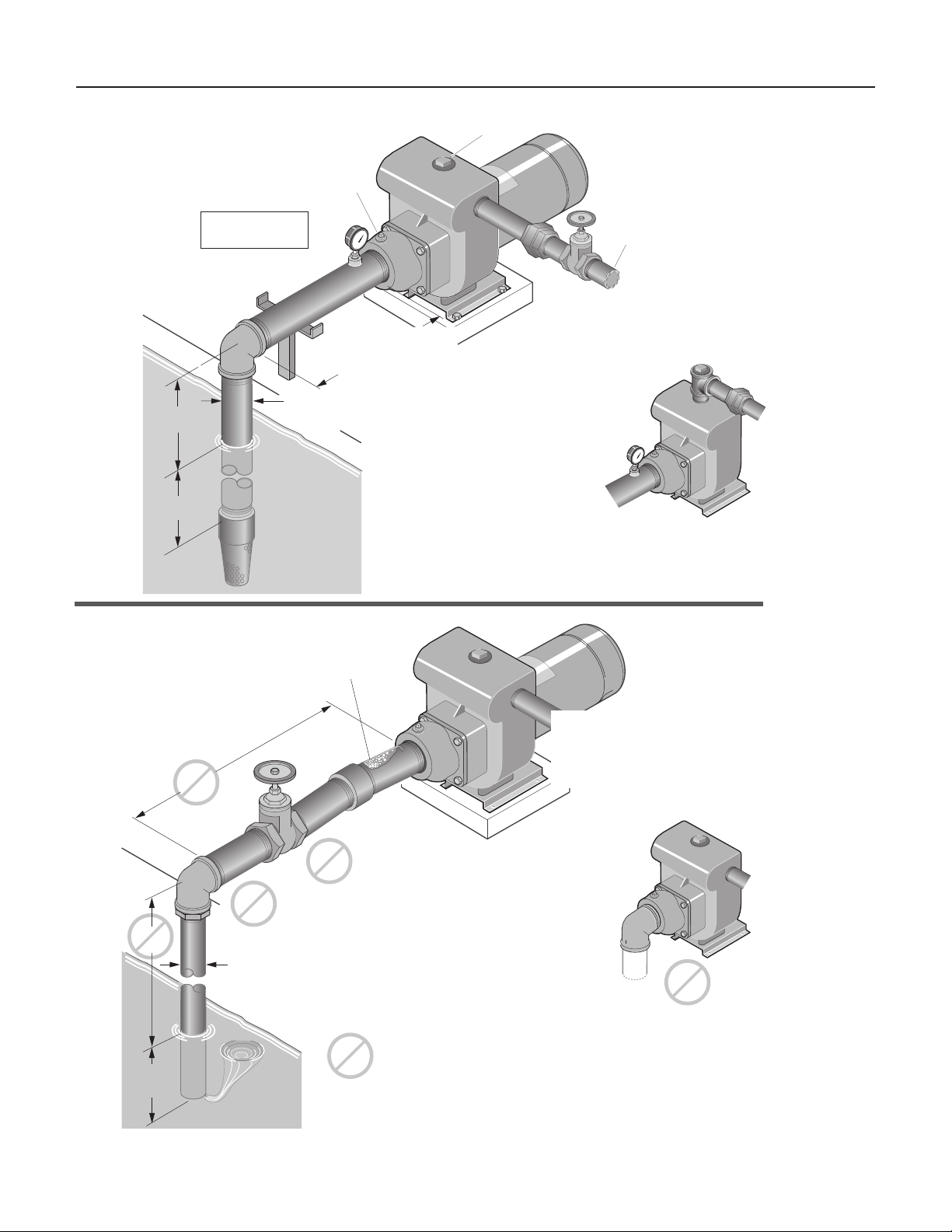
A tee installed in the discharge opening of the pump,
and provided with a priming plug at the top position,
will enable you to fill the pump with liquid. Once filled
and the priming plug replaced, the pump will prime. The
pump should prime itself time after time, as long as the
built-in check valve functions.
MAINTENANCE
Little or no maintenance to pump is required other than
possible replacement of shaft seal after a reasonable
period of operation (see Page 7).
Lubricate motor according to motor manufacturer’s
in-structions. Periodic greasing is required for most
motors.
PUMP STORAGE
Drain pump to prevent freezing.
Keep motor dry and loosely covered. Do not wrap with
plastic sheeting; trapped moisture could cause corrosion
or insulation deterioration.
NOTE: A good rust inhibitor in the liquid end of cast
iron pumps is recommended to prevent excessive
corrosion.
PUMP START-UP AFTER STORAGE
Replace all drain plugs and close all drain valves in
system.
Be sure all connections are tightly sealed.
After initial check is made, fill pump according to
“Priming the Pump,” above.
SHAFT SEAL REPLACEMENT
IMPORTANT: The highly polished and lapped faces of
the seal are easily damaged. Follow instructions and
handle the seal with care.
Hazardous
voltage
Be sure unit is grounded and power
disconnected before attempting any work
on pump or motor.