6 / 14
OPERATION
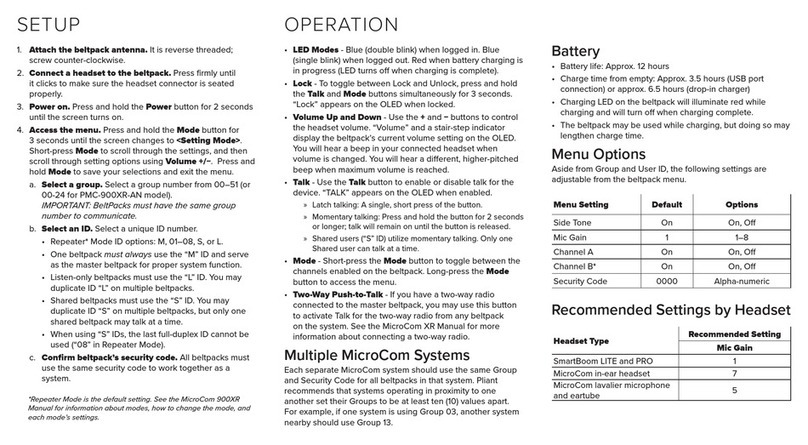
• LED Modes - LED is blue and double blinks when logged in and
single blinks when logged out. LED is red when battery charging is in
progress. LED turns off when charging is complete.
• Lock - To toggle between Lock and Unlock, press and hold the TALK
and MODE buttons simultaneously for three (3) seconds. A lock icon
appears on the screen when locked. This function locks the TALK
and MODE buttons, but it does not lock headset volume control,
the POWER button, or the PTT button.
• Volume Up and Down - Use the +and −buttons to control the
headset volume. “Volume” and a stair-step indicator will display the
beltpack’s current volume setting on the screen. You will hear a beep
in your connected headset when the volume is changed. You will
hear a different, higher-pitched beep when maximum volume is
reached.
• Talk - Use the TALK button to enable or disable talk for the device.
“TALK” appears on the screen when enabled.
»Latch talking is enabled/disabled with a single, short press of the
button.
»Momentary talking is enabled by pressing and holding the button
for two (2) seconds or longer; talk will remain on until the button
is released.
»Shared users (“S” ID) can enable talk for their device with the
momentary talking function (press and hold while talking). Only
one Shared user can talk at a time.
• Mode - Short-press the MODE button to toggle between the
channels enabled on the beltpack. Long-press the MODE button to
access the menu.
• Two-Way Push-to-Talk - If you have a two-way radio connected to
the Master beltpack, you may use the PTT button to activate talk for
the two-way radio from any beltpack on the system.
• Out of Range Tones - The user will hear three quick tones when the
beltpack logs out of the system, and they will hear two quick tones
when it logs in.
OPERATING MULTIPLE MICROCOM SYSTEMS IN ONE LOCATION
Each separate MicroCom system should use the same Group and Security Code for all beltpacks
in that system. Pliant recommends that systems operating in proximity to one another set their
Groups to be at least ten (10) values apart. For example, if one system is using Group 03, another
system nearby should use Group 13.
Figure 1: Lock Indicator
Figure 2: Volume Setting
Figure 3: Talk Indicator
Figure 4: Channel Indicator
Figure 5: 2-Way PTT
Indicator