plumBOSS Australia Head Oce - Ph: 1300 331 141 | Fax: 1300 764 510 | E: info@plumboss.com.au
exactCUT 170/170E/220E Operating Instructions
Safety
l. Check the operation of the lower guard. If the guard
and the spring are not operating properly, they must
be serviced before use. Lower guard may operate
sluggishly due to damaged parts, gummy deposits,
or a build-up of debris.
m. Do not reach into the saw dust ejector with your
hands. They could be injured by rotating parts.
n. Do not work overhead with the saw. In this manner
you do not have suf cient control over the power
tool.
o. Do not operate the power tool stationary. It is not
designed for operation with a saw table.
p. Do not use high speed steel (HSS) saw blades. Such
saw blades can easily break.
q. When working with the machine, always hold it rmly
with both hands and provide for a secure stance. The
power tool is guided more secure with both hands.
r. Secure the workpiece. A workpiece supported by
pipe holders is held more secure than by hand.
s. Always wait until the machine has come to a
complete stop before placing it down. The tool insert
can jam and lead to loss of control over the power
tool.
t. Never use the machine with a damaged cable. Do
not touch the damaged cable and pull the mains plug
when the cable is damaged while working. Damaged
cables increase the risk of an electric shock.
Additional specic safety rules
The pipe saw must never be used in the following
cases, if:
• There is water or another liquid, explosive gases or
poisonous chemicals inside the pipe to be cut.
• The power switch is faulty.
• The power cable is faulty,
• The blade is bent.
• The blade is blunt or in poor condition.
• The plastic components are cracked or have parts
missing.
• The gripper unit is not properly tightened around the
pipe or if it is warped.
• The blade guard cover or moving blade guard has
been damaged or removed from the machine.
• The locking mechanisms do not work properly
(UNLOCK-button).
• The pipe saw has become wet.
When using the pipe saw, the following factors
must always be taken into consideration:
• Support tubes to minimise the risk of blade pinching.
• Ensure that the pipe to be cut is empty.
• Ensure that the blade is correctly installed.
• Ensure that the diameter and thickness of the blade
are suitable for the pipe saw and that the blade is
suitable for the rpm-range of the machine.
• Never use sideways force to stop the blade, always
allow the blade to stop freely.
• Check the attachments of the blade guards.
• Never use excessive force when using the pipe saw.
• Never use the pipe saw to lift the pipe while it is still
attached to the pipe.
• Avoid overloading the electric motor.
• Always follow the safety and operating instructions
and current regulations. Functional Description Read
all safety warnings and all instructions. Failure to
follow the warnings and instructions may result in
electric shock, re and/or serious injury.
Intended Use
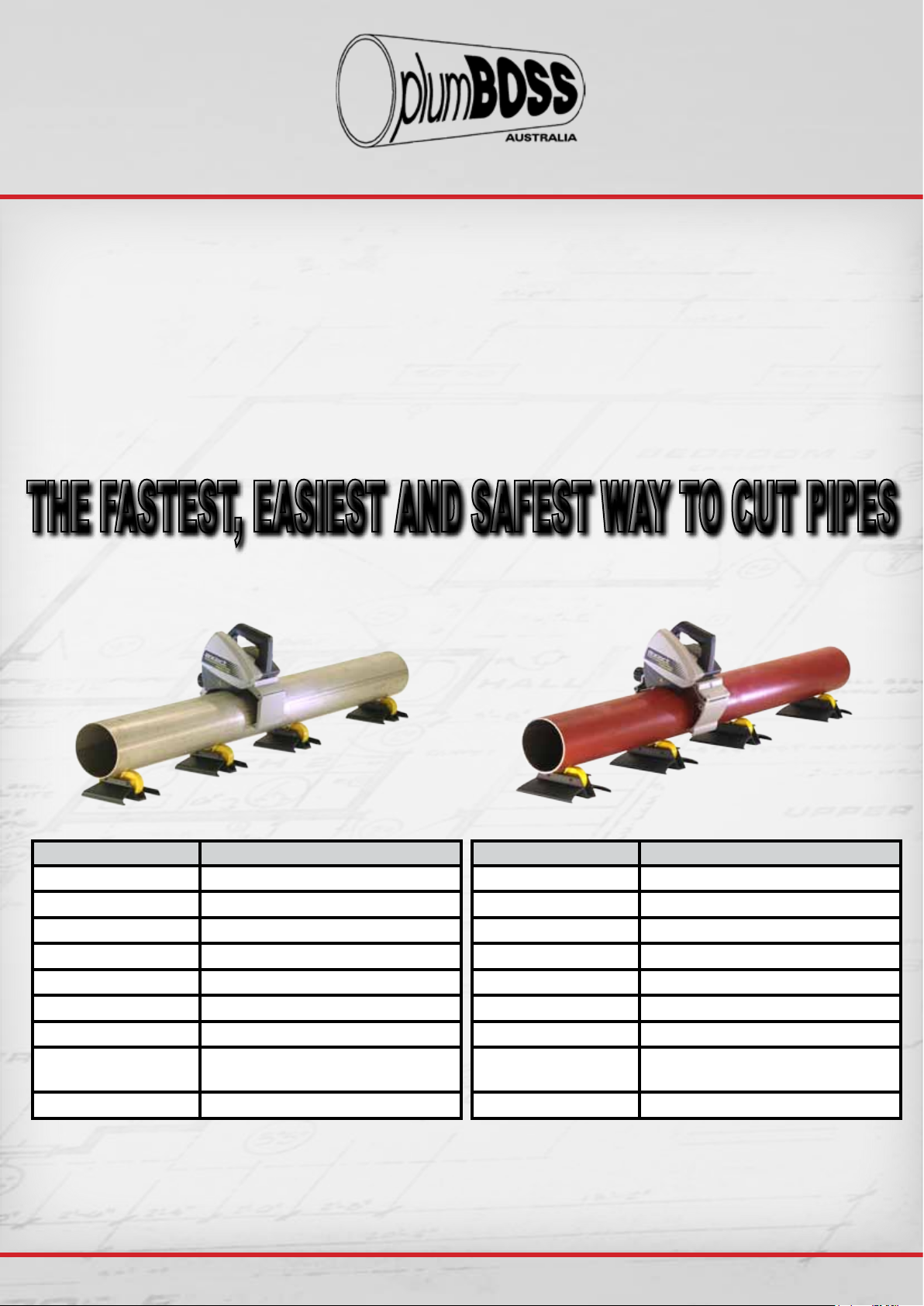
The PipeCut 170/170E/220E pipe saw is intended
for use as a pipe tter’s tool at the installation site.
The PipeCut 170/170E/220E pipe saw can only be
used to cut round pipes, with a diameter of 15-170
mm (0,6”-6”) models 170 and 170E,15-220 mm (0,6”-
8,6”) model 220E and a maximum wall thickness of
6 mm (0,23”) (model170) and 8 mm (0,31”) (models
170E and 220E) with steel and other ferrous and non-
ferrous materials and 0 55” (14 mm) with plastics.
The PipeCut 170/170E/220E pipesaw can be used to
cut allnormalpipe materials, such as steel, stainless
steel, cast iron,copper aluminium and plastic. PipeCut
170/170E/220E pipe saw is intended for short,
intermittent use. The machine may be loaded for 2,5
minutes during a 1Q-minute period (83 25 %). PipeCut
170/170E/220E pipe saw is not intended for use in
industrial production. Use pipe holders to support pipe.
Product Features
While reading the operating instructions, unfold the
graphics page for the machine and leave it open.
This page is folded under the cover of this manual
(page 3). The following numbering of the product
features refers to this illustration.